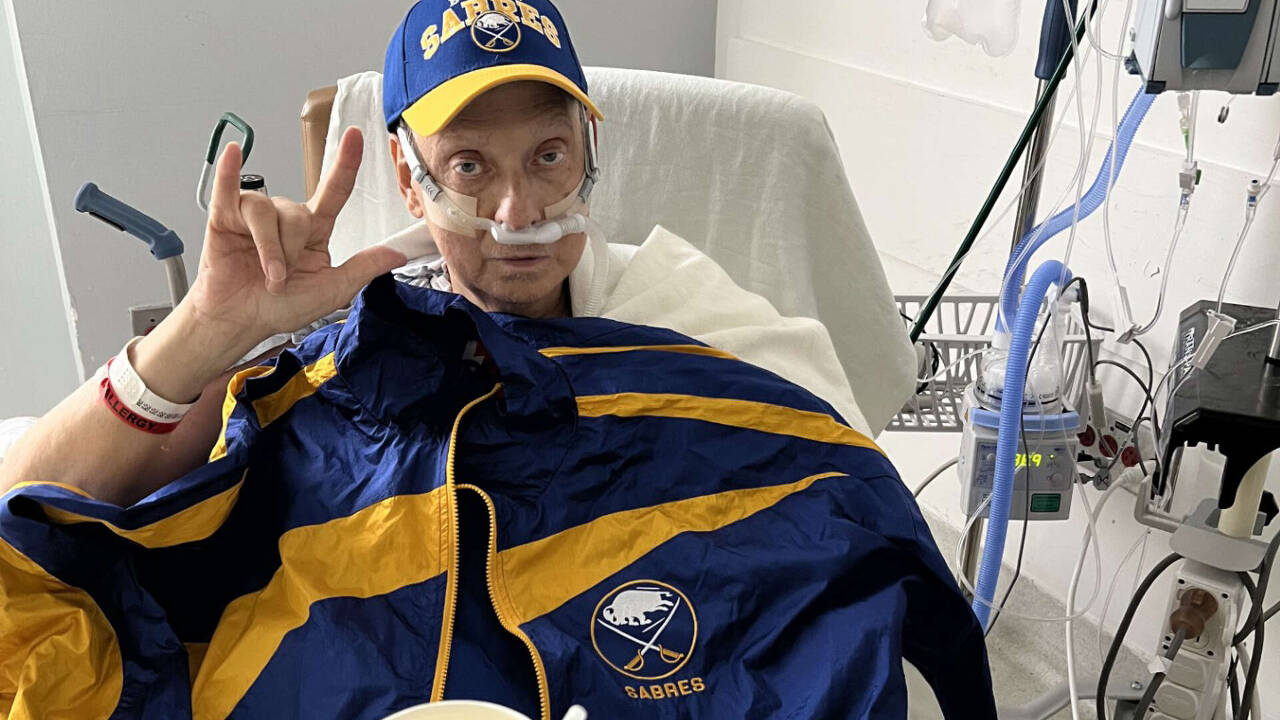
San Francisco 49ers radio voice Greg Papa is stepping back into the public eye just six months after an allogeneic bone marrow transplant nearly cost him his life, overcoming acute lymphoblastic leukemia, 78 days in an intensive care unit, and total respiratory failure. At 63 years old, the veteran broadcaster’s return to NBC Sports Bay Area’s studio coverage defies standard medical projections, which typically mandate a full year or more of profound convalescence after such catastrophic systemic trauma.
The timeline of survival reads like a critical care manual. Diagnosed in July 2025 after cancer cells infiltrated his brain and spinal column, Papa endured grueling rounds of chemotherapy before receiving a bone marrow transplant from his sister, Judy. What followed was a cascade of near-fatal complications. Pneumonia set in. Both of his lungs collapsed. He spent a week fighting for every breath on a mechanical ventilator, flanked by chest tubes and four distinct blood clots, one of which lodged dangerously in his lung. Also making headlines recently: Why Blaming Tariffs For Your Expensive Hockey Gear Is Pure Laziness.
Medical teams later informed him that ninety-five percent of patients do not survive the exact sequence of organ failure he endured. For weeks, walking to a hospital room's bathroom felt like scaling an insurmountable mountain. Permanent lung scarring loomed as a permanent reality, and the physical foundation that supported a legendary four-decade broadcasting career had vanished. He dropped thirty-six pounds during the acute phase of treatment, leaving behind a skeletal frame and an uncertain horizon.
Yet the anatomy of a comeback rarely follows a clean graph. Recovery is messy, nonlinear, and punctuated by moments of intense vulnerability. By early autumn, Papa had begun a rigid physical rehabilitation regimen. Counting out roughly two thousand steps a day, utilizing resistance bands, and lifting light dumbbells, he slowly clawed back seventeen pounds of lost mass. Supplemental oxygen tanks, once a constant fixture of his home life, were gradually phased out as his lung capacity inched upward, though he continues to fatigue faster than he did during his decades calling Raiders, Giants, Warriors, and 49ers games. Further insights regarding the matter are explored by ESPN.
The Cost of Preparation
Broadcasting a National Football League broadcast is not merely talking into a microphone for three hours. For a craftsman of Papa’s caliber, it is an exercise in obsessive, monastic preparation. Game notes compiled over forty-two years rely on sharp cognitive endurance, intense film study, and the physical stamina required to travel across time zones.
During his extended absence, the 49ers relied on a rotating committee of voices to fill the radio booth, a reminder that the machine of professional sports moves forward regardless of who is behind the glass. When news surfaced earlier in the year that his long-term radio home at KNBR had parted ways with him during his medical leave, the local sports community erupted in backlash. Instead of fading into a quiet retirement, Papa pivoted, accepting an expanded studio and digital role with NBC Sports Bay Area, setting the stage for an initial studio return ahead of the team's opening stretch.
Medical caution remains the dominant backdrop. Hematologists remind patients that the first twenty-four months post-transplant carry severe relapse risks, alongside the perpetual threat of graft-versus-host disease. High-altitude press boxes and rigorous travel schedules present genuine hazards for a respiratory system that has barely survived a collapse.
Papa has been characteristically blunt about his motivations. He does not return to prove a point to critics or to satisfy an industry expectation. He returns because the terminal diagnostic odds failed to silence him, and because the timeline of his departure belongs to him alone. As the red light on the studio camera blinks on, the voice that has narrated generations of Bay Area sports history is back on the air, carrying the heavy invisible weight of a battle fought in the dark.