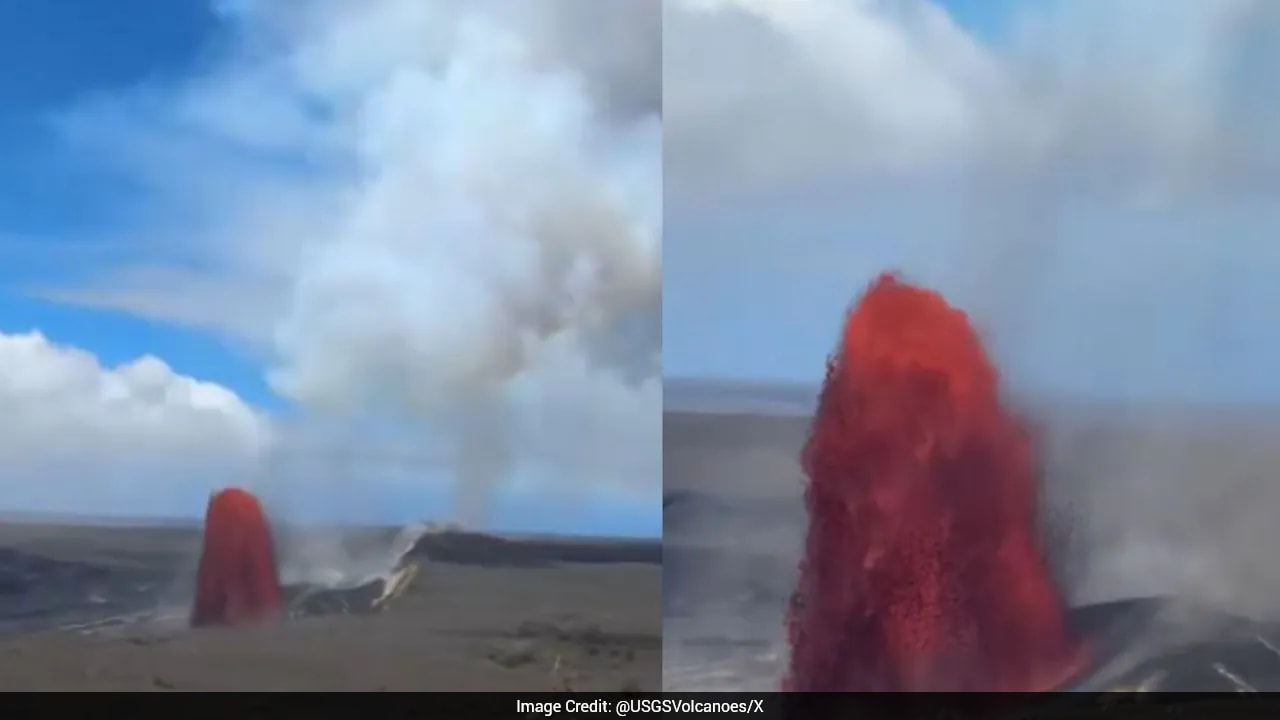
Volcanic eruptions are frequently mischaracterized by the popular press as chaotic, unpredictable explosions. In reality, events like the recent activity at Hawaii's Kilauea volcano—where lava fountains reached heights of 700 feet—are highly governed kinetic systems driven by specific thermodynamic and fluid-dynamic constraints. Understanding these events requires looking past the visual spectacle and analyzing the precise mechanics of magma ascent, volatile exsolution, and hydrostatic pressure variations that dictate the scale and duration of Hawaiian-style eruptions.
The Volatile Drive: What Powers 700-Foot Fountains
The primary mechanism behind high-altitude lava fountaining is the rapid expansion of dissolved gases, chiefly water vapor ($H_2O$), carbon dioxide ($CO_2$), and sulfur dioxide ($SO_2$), within the magma column. This process, known as volatile exsolution, is directly analogous to uncorking a carbonated beverage, but it operates under extreme geological pressures and temperatures.
The height of a lava fountain is not a random variable. It is a direct function of the gas-to-liquid ratio and the decompression rate as magma ascends through the conduit.
- Solubility Thresholds: Deep within the mantle, high pressure keeps gases dissolved within the silicate melt. As magma ascends toward the surface, hydrostatic pressure drops below the solubility threshold of these specific gases.
- Bubble Nucleation: $CO_2$ exsolves first at greater depths due to its lower solubility at high pressures. $H_2O$ and $SO_2$ follow as the magma nears the surface. The formation of these gas bubbles drastically reduces the bulk density of the mixture.
- The Fragmentation Threshold: As bubbles expand, they occupy a greater volume fraction of the conduit. When the gas volume fraction reaches approximately 70% to 75%, the magma transitions from a liquid containing bubbles to a gas carrying suspended liquid droplets (clasts).
This rapid expansion accelerates the mixture toward the vent. The kinetic energy required to propel millions of tons of molten basalt 700 feet into the air is supplied entirely by this thermal-to-kinetic energy conversion.
Fissure Geometry and Fluid Dynamics
The shape and structural integrity of the eruptive vent act as a physical throttle on the eruption's intensity. Kilauea’s eruptions often begin along linear fissures before concentrating into localized vents. This transition follows predictable principles of fluid mechanics and thermal conservation.
The Linear-to-Point Source Transition
Initial eruptive phases utilize long, structural fractures in the volcanic rift zone. This distributed geometry creates a highly inefficient thermal profile. The high surface-area-to-volume ratio of a long fissure causes rapid heat loss to the surrounding country rock, increasing the viscosity of the basalt along the periphery.
Over hours or days, localized zones within the fissure experience higher flow rates. Higher velocity equates to localized thermal conservation; the rock heats up, reducing friction and resistance to flow. The system self-optimizes, freezing out the slower portions of the fissure and channeling the entire volumetric discharge through one or two circular point-source vents.
Nozzle Mechanics
Once a point-source vent is established, it acts as a hydrodynamic nozzle. If the conduit narrows just below the surface, the velocity of the escaping multi-phase fluid must increase to maintain mass conservation. This constriction directly influences the velocity vector of the ejected clasts, transforming a wide, low-velocity bubbling pool into a highly directed, supersonic or near-supersonic fountain.
Quantifying the Hazards: Structural and Atmospheric Impacts
The hazards of a 700-foot fountaining event extend far beyond the immediate footprint of the lava flow. The dynamics of the fountain dictate both local topographic formation and regional atmospheric pollution.
Tephra Dynamics and Cone Construction
When molten material is thrown hundreds of feet into the air, its trajectory determines its cooling rate and subsequent structural behavior upon landing.
- Reticulite and Scoria Formation: Highly vesicular clasts cool rapidly in mid-air, solidifying into lightweight scoria or fragile reticulite glass. Wind currents easily transport these low-density particles miles downwind.
- Spatter Accumulation: Larger, denser clots of lava retain their internal heat during their brief flight time. When they land near the vent, they remain molten enough to weld together, building steep-sided spatter cones. If the rate of accumulation is too high, the pile becomes unstable, leading to localized structural failures and high-velocity rootless lava flows.
Atmospheric Gas Partitioning
The massive surface area exposed to the atmosphere within a high fountain accelerates the release of toxic gases. Sulfur dioxide reacts with moisture, oxygen, and sunlight to form volcanic smog, or vog. The efficiency of this conversion is amplified by the thermal updraft generated by the fountain, which injects these aerosols higher into the troposphere than standard passive degassing would allow, altering air quality across vast geographic areas.
Monitoring the Subsurface Plumbing
Volcanologists do not rely on visual confirmation of fountains to understand an eruption's trajectory. Instead, they monitor the deflation-inflation (DI) cycles of the volcano using precise instrumentation arrays.
- Tiltmeters: These instruments measure micro-radian changes in the slope of the volcano's surface. Rapid deflation indicates that magma is draining from the shallow reservoir to feed the eruption at the surface.
- InSAR (Interferometric Synthetic Aperture Radar): Satellite-based radar allows scientists to map broad-scale ground deformation, revealing the exact path magma takes through subsurface rift zones before breaking the surface.
- Seismic Tremors: Continuous, low-frequency volcanic tremor is the direct acoustic signature of magma and gas vibrating the walls of the conduit as it rushes toward the vent. The amplitude of this tremor correlates strongly with the volumetric flow rate of the eruption.
Analyzing these data inputs allows for the calculation of the total mass discharge rate (MDR), which is the definitive metric used to assess whether an eruptive phase is stabilizing, accelerating, or entering a period of exhaustion. When the rate of magma withdrawal exceeds the rate of replenishment from the deeper mantle source, the hydrostatic pressure within the shallow reservoir drops, causing the fountain height to decay in a predictable logarithmic curve.