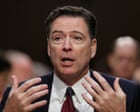
Two men stood at the center of a quiet storm that never truly left Washington. One spoke with the measured cadence of a former prosecutor who still believed in the weight of institutional norms. The other spoke with the blunt, rhythmic certainty of a populist leader who viewed those same institutions as a rigged game.
"I'm still innocent," James Comey insisted, his voice carrying the familiar, deliberate calm that once defined his press briefings at the J. Edgar Hoover Building. Almost simultaneously, Donald Trump fired back across the digital divide, branding his former FBI director a "dirty cop."
On the surface, it looked like another round in a decade-long political grudge match. Just another live-blog headline scrolling past commuters on their morning train.
Look closer, though. Beneath the familiar insults lies a far deeper fracture in American civic life. This clash is no longer merely about emails, dossiers, or firing decisions made years ago. It is a battle over who gets to define truth, accountability, and legitimacy in the modern republic.
The Architecture of a Feud
To understand why these four words—"innocent" and "dirty cop"—still detonate like grenades in public discourse, you have to step back into the fluorescent-lit hallways of the federal justice system.
For generations, the unwritten rule of Washington governance relied on a delicate separation of powers. Presidents set policy; the Department of Justice and the FBI operated at arm's length, insulated from partisan whim. That boundary was never as pristine in practice as it was in civics textbooks, yet the shared pretense mattered. It kept the machinery running.
Consider a hypothetical veteran analyst—let us call her Elena—who spent twenty years inside the Justice Department reviewing routine compliance files. To Elena, the system was built on paper trails, chain-of-custody logs, and sworn testimony. Reputation was currency. If an official claimed innocence, the claim rested on whether the documentation backed it up.
When Donald Trump entered the Oval Office in 2017, that bureaucratic worldview collided head-on with an entirely different operating code. Trump approached governance through the lens of personal loyalty and public combat. In his framing, an investigation into his campaign was not a neutral administrative process; it was an existential attack orchestrated by entrenched insiders.
James Comey, tall, formal, and acutely conscious of his own place in history, became the physical embodiment of that tension. When Trump dismissed him in May 2017, the firing did not end the story. It turned both men into permanent avatars for competing visions of the American state.
Two Languages, Zero Translation
Listen to how each man speaks about the exact same events, and you realize they are not even using the same dictionary.
When Comey says, "I'm still innocent," he is speaking the language of procedural legality. He is pointing to the absence of criminal charges against him, the findings of internal inspector general reviews that criticized his judgment on certain protocols while clearing him of partisan treason, and the formal standards of the legal profession. In his telling, he was a public servant navigating impossible terrain who made imperfect calls under extraordinary pressure.
When Trump calls Comey a "dirty cop," he is speaking the language of political morality and institutional betrayal. To Trump and millions of his supporters, the phrase does not require a courtroom conviction to ring true. In their view, using the investigative apparatus of the federal government against a political movement—relying on flawed surveillance applications and unverified opposition research—is the very definition of corruption.
Think of it like two people standing on opposite sides of a glass wall, shouting warnings at each other while neither can hear a word. One points to the rulebook; the other points to the outcome.
This linguistic divide explains why the feud refuses to fade. Standard political scandals burn hot and then exhaust themselves once a verdict is reached or an election passes. This conflict endures because the two sides cannot agree on what constitutes valid evidence in the first place.
The Invisible Stakes for Everyday Citizens
It is easy to treat the Trump-Comey dynamic as political theater—a high-stakes reality show starring two outsized personalities. Doing so misses the real casualty.
Every time a former president labels the former head of federal law enforcement a criminal, and every time that former director maintains his complete vindication, a quiet erosion takes place in the mind of the ordinary citizen.
Imagine sitting in a jury box in a mid-sized American city. A prosecutor stands before you, resting a case on the testimony of a federal agent. Ten years ago, the badge alone carried a baseline presumption of credibility. Today, depending on which news channel plays in your living room, that same badge might symbolize either heroic defense of the rule of law or weaponized partisan overreach.
That shift is not abstract. It alters how people view subpoenas, grand juries, special counsels, and election results. When trust in the referee collapses, every call on the field looks like a fix.
The historical parallel here is sobering. Following the Watergate era of the 1970s, Congress and the executive branch spent years erecting guardrails—ethics offices, inspector general roles, strict guidelines on White House contact with the Justice Department—specifically designed to prevent law enforcement from becoming a political weapon. Those reforms worked only because leaders from both parties largely agreed to respect the fence.
Today, that fence is down, and both camps accuse the other of tearing it apart.
Anatomy of an Unresolved Verdict
Why hasn't the historical record settled the score? Because the official findings themselves contain enough nuance for both sides to claim victory.
Department of Justice Inspector General reports examined the origins of the Russia investigation and Comey's handling of sensitive memos. Critics of Comey seized on the documented failures: significant errors and omissions in surveillance applications, violations of bureau policy regarding the retention and sharing of personal notes, and a lack of candor with oversight officials. To Trump's allies, those facts formed the backbone of the "dirty cop" indictment.
Defenders of Comey, meanwhile, highlighted different conclusions from those very same reports: that the investigation was opened with a legitimate factual predicate, that investigators were not driven by improper political bias, and that no criminal prosecution of Comey was warranted. To Comey and his supporters, those findings proved his core assertion of innocence.
In a healthier media ecosystem, that complexity would invite careful debate about institutional reform. Instead, modern political incentives reward compression. Nuance is stripped away until only the sharpest slogans remain.
Living Inside the Echo
For anyone who has worked around Washington over the past decade, the psychological toll of this permanent standoff is unmistakable. Conversations in hallways lower to whispers. Career officials second-guess routine decisions, wondering how an internal email might look blown up on a congressional hearing poster five years from now.
The fear is rational. When the boundary between policy dispute and criminal accusation blurs, public service begins to feel less like a calling and more like walking across a minefield without a map.
Yet voters, too, feel trapped in the crossfire. Many Americans harbor genuine doubts about both narratives. They can look at the surveillance failures documented by the Inspector General and feel legitimate alarm about government overreach. At the exact same time, they can look at relentless attacks on the justice system and worry about what happens to a democracy when no institution is trusted to check executive power.
Holding both thoughts at once requires effort. It resists the comfort of team loyalty. And it receives almost zero encouragement from the loudest voices in public life.
The Echo That Won't Fade
Years from now, historians will sift through the transcripts, the memos, the social media posts, and the court filings of this era. They will trace the exact sequence of events from the summer of 2016 to the firing in May 2017 and the endless reverberations that followed.
What they will find is not merely a clash between Donald Trump and James Comey. They will find the moment two incompatible stories about American power collided in full view of the public—and stayed locked in place.
One man still stands at the microphone, insisting the record clears his name. The other still stands before the crowd, insisting the system itself was broken from within. Between them sits an empty space where public trust used to live, waiting for someone to prove it can ever be rebuilt.