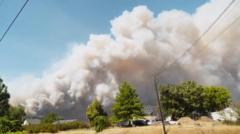
Every summer, the playbook is identical. Smoke chokes the valleys of the Pacific Northwest, local news anchors adopt grave tones, and emergency management agencies issue mandatory evacuation orders. The public nods along, assuming that forcing people out of the woods is the absolute peak of modern safety science.
It is not. In fact, it is accelerating the destruction.
When you treat every acre of timber as a museum piece that must be locked behind police tape the second a spark lands, you strip communities of the very mechanism that keeps them alive: active, localized defense and immediate fuel reduction. Evacuations do not save towns. They abandon them to unchecked physics.
The Flawed Logic Of Total Abandonment
The lazy consensus in disaster response is simple. People equal liability. If a civilian stays behind to protect property, they become a search-and-rescue risk. Therefore, the most efficient bureaucratic maneuver is to clear the board entirely. Herd everyone onto Interstate 5, lock the gates, and let the fire burn where it pleases.
This is a catastrophic miscalculation.
I have spent two decades analyzing emergency logistics and disaster economics. I have seen municipal budgets vaporize because agencies prioritize liability management over actual asset defense. When you evacuate an entire zip code, you remove the boots on the ground that can throw a bucket of water on a spot fire, clear pine needles from a gutter, or turn off a propane tank before it detonates.
You trade an engaged, invested population for a ghost town vulnerable to wandering embers. Embers do not care about evacuation orders. They care about dry thatch and unraked yards.
Why Defensible Space Beats Mass Flight
The standard narrative claims that wildfire speed makes human intervention impossible. Modern crown fires move fast, yes. But the vast majority of structural ignition does not happen because a wall of roaring flame overtakes a house. It happens because a sustained wind carries small, glowing chunks of bark a mile ahead of the main front, landing quietly in dry mulch or wood-shake roofs.
An evacuated town cannot fight an ember storm. A defended town can.
When residents are told to flee, they leave behind millions of dollars in localized firefighting capital: generators, water tanks, leaf blowers, shovels, and local knowledge of every back road and hidden water source. By ordering a mandatory sweep, the state essentially disarms the local population and hands the keys over to a scorched-earth destiny.
"Evacuation is often the easiest box for an agency to check, but it is the hardest pill for a resilient community to swallow."
The Bureaucratic Incentive Trap
Why do authorities cling to mass evacuations? Simple. CYA.
Cover Your Assets is the unwritten law of public administration. If a sheriff orders an evacuation and a home burns down, the official can point to the mandate and say, "We followed protocol." But if the sheriff tells people to stay, helps them set up sprinklers, and a tragedy occurs, the lawsuits will swallow the county whole.
The legal framework governing emergency response penalizes common sense and rewards panic. We have built a system where a bureaucrat is legally protected for ordering an entire valley to gridlock on a two-lane mountain highway, but criminally exposed if they empower citizens to defend their own backyards.
Think about the traffic jams alone. Packing thousands of panicked motorists onto winding timber routes creates a human bottleneck that is infinitely more dangerous than staying put behind a defenseless fireline.
What Actually Works
If we want to stop watching Washington burn down every August, we have to flip the script. We need a fundamental overhaul of how we treat rural residency during fire season.
1. Decentralized Defense Networks
Stop treating locals as victims-in-waiting. Treat them as the first line of defense. Invest in community-level cache systems: high-volume portable pumps, foam injection kits, and localized communication relays that function when cell towers melt.
2. Redefine Mandatory vs. Advisory
Most evacuation orders should be strictly advisory for homeowners who have invested in hardening their structures. If you have a metal roof, cleared defensible space, and a water source, you should have the legal right to stay and defend your investment. The state's job should be logistics and supply drop-offs, not forced exile.
3. Aggressive Pre-Fire Management
We spend billions on suppression and pennies on prevention. For decades, federal and state agencies allowed timber litter to accumulate into a massive tinderbox. No amount of evacuation orders will fix a landscape that has been choked by decades of administrative neglect and environmental litigation.
The Cost Of Compliance
The hidden price tag of our current evacuation model is the total erosion of rural self-reliance. Every time a community is forced out and returns to find their town reduced to ash while their own garden hoses sat unused, something fundamental breaks. Trust in institutions vanishes. Economic vitality collapses because insurance companies refuse to touch properties wrapped in constant administrative red tape.
We do not have a wildfire crisis. We have a governance crisis disguised as a natural disaster.
Until we stop treating citizens as hazards to be managed and start treating them as stakeholders to be armed with tools and tactics, the smoke will keep rolling in.
Next time the sirens start and the flashing lights block the highway, ask yourself who the evacuation order is really protecting.
It is not you. It is the lawyers.