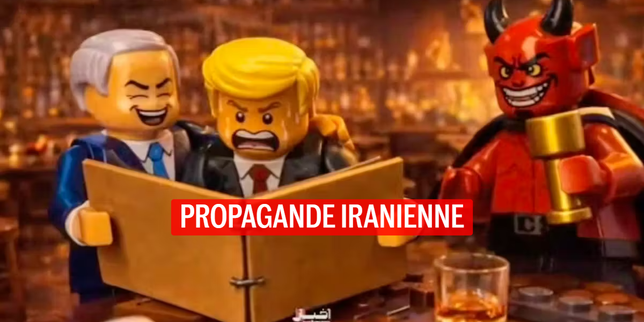
The Iranian state has mastered a psychological trick that western observers consistently fall for. While security forces suppress domestic dissent with lethal force, the regime’s digital apparatus floods the international information space with calculated trivialities. This is not accidental noise. It is a sophisticated strategy designed to exploit the mechanics of social media algorithms and the short attention spans of a global audience. By forcing toy blocks, viral memes, and staged "lifestyle" content into the same feed as human rights violations, Tehran effectively dilutes the gravity of its own violence.
The core of the problem lies in the forced proximity of the mundane and the macabre. When a user scrolls past a report of an execution only to be met immediately with a state-sponsored "Lego" recreation of a national landmark, the cognitive dissonance performs a specific function. It creates a sense of normalcy. It suggests a nation preoccupied with hobbies and heritage rather than one gripped by a systemic crisis of legitimacy. This strategy exploits the "engagement" metrics that govern modern platforms, where a colorful image of a plastic model often garners more automated visibility than a grainy video of a street protest.
The Architecture of Distraction
The Islamic Republic does not just censor the internet; it floods it. This is a shift from the old-school model of total information blackouts toward a more modern, "firehose" approach to propaganda. The goal is to make the truth about the regime's brutality just one small, easily ignored voice in a crowded room.
Tehran’s "Cyber Army" operates through thousands of coordinated accounts. These are not all hardline political bots shouting slogans. Many are "soft power" accounts that share art, architecture, and seemingly innocent cultural commentary. This creates a digital facade. When an international crisis occurs, these accounts are activated to pivot the conversation. They don't necessarily deny the violence; they simply provide something more pleasant to look at.
Consider the timing of these cultural pushes. Historically, whenever the regime faces a surge in international condemnation, its digital footprint shifts toward "humanizing" the state. We see high-production videos of Iranian youth in cafes or elaborate displays of traditional craftsmanship. This creates a curated reality designed for the western "tourist" gaze. It tells the viewer that the protesters are a fringe element and that the "real" Iran is busy building, creating, and playing.
How Algorithms Reward the Regime
The tragedy of the digital age is that the truth is rarely as "shareable" as a clever distraction. Social media algorithms prioritize high engagement rates, which are naturally skewed toward visual, non-controversial content. A video of a person being beaten by the Basij is often flagged, shadow-banned, or hidden behind "sensitive content" warnings. Conversely, a post about Iranian-themed toys or high-tech innovations in Tehran is boosted by the system.
This creates a systemic bias. The regime understands that if it can generate enough benign content, it can effectively bury the evidence of its crimes under a mountain of plastic and pixels. This is not just a failure of the audience; it is a failure of the platforms themselves. They have built engines that prioritize the aesthetic over the ethical, and autocracies are the primary beneficiaries of this design flaw.
The Psychology of Apathy
There is a limit to how much trauma a human being can process from a screen. This "compassion fatigue" is a vital component of Iranian statecraft. By saturating the feed with a mix of high-stakes violence and low-stakes trivia, the regime triggers a psychological retreat in the viewer.
When the news cycle becomes too heavy, the mind naturally gravitates toward the lighter content. The regime provides that exit ramp. By engaging with the "Lego" version of Iran, the international observer feels they are still "connecting" with the country without having to face the soul-crushing reality of its prisons. It allows for a form of armchair activism that is entirely toothless. It is a way to look at Iran without actually seeing it.
The Mirage of Reform Through Consumption
A recurring theme in this propaganda is the emphasis on Iran’s "modernity." The regime wants the world to see its malls, its tech startups, and its consumer culture. The subtext is clear: a country with these things cannot be a "medieval" autocracy. This is a deliberate attempt to decouple the idea of economic and technological development from the idea of human rights.
The presence of western-style hobbies and products is used as evidence of a "reforming" society. However, this is a hollow modernity. A skyscraper or a complex plastic model does not change the fact that the legal system remains an instrument of repression. The regime is betting that the global public will accept the window dressing as a substitute for actual political change.
The strategy also targets the Iranian diaspora and those sympathetic to the culture. It plays on nostalgia and national pride. It asks the viewer to choose between the "ugly" news of the day and the "beautiful" heritage of the nation. By framing the discussion this way, the regime turns the act of criticizing the state into an act of criticizing the culture itself. It is a powerful shield.
Breaking the Cycle of Digital Complicity
The solution is not to stop looking at Iranian culture, but to recognize when that culture is being used as a weapon of state. We must develop a more cynical eye for the "viral" moments that emerge from Tehran during times of unrest.
- Question the Source: Who is sharing this beautiful imagery? Is it an independent artist, or is it an account that exclusively promotes a sanitized version of Iranian life?
- Acknowledge the Context: If you see a post about a new park or a toy collection in Tehran, ask what happened in the streets of the same city that morning.
- Demand Platform Accountability: Why do algorithms prioritize state-backed "lifestyle" content while suppressing citizen journalism?
The regime in Tehran is not just fighting its own people; it is fighting for the narrative of what "Iran" is. If we allow ourselves to be distracted by the toys, we become silent partners in the erasure of those who are dying for the right to be more than just consumers in a gilded cage. The plastic blocks are a diversion. The blood on the pavement is the reality.
Stop engaging with the distraction. Stop rewarding the algorithm for hiding the truth. The next time a "charming" piece of Iranian lifestyle content crosses your feed, look past it. The people risking their lives in the streets of Mashhad and Shiraz deserve more than a distracted glance before you move on to the next bright, shiny object.