Gravity rarely cares about choreography.
You can spend six months negotiating a communiqué across four time zones, align sixteen time-strapped schedules, sweep a stage until the floorboards gleam, and place four rectangular stickers on the carpet so the world's most powerful people know precisely where to plant their heels. Still, glue dries out. A shoe sole catches an edge. And suddenly, in the middle of a tightly scripted diplomatic summit, a small printed piece of the Indian tricolor comes loose on the floor.
Most people in that room did not notice. They were busy watching the choreography.
If you have ever stood behind the velvet rope at an international summit—my boots have scuffed the floorboards of press risers from Brussels to Tokyo—you know the peculiar, breathless quiet that descends right before the shutters start firing. The air smells faintly of floor wax, wool suiting, and hot camera batteries. Protocol officers hover just outside the frame like anxious stagehands, mouths tight, eyes darting between watch faces and shoe tips. Everything in that space is designed to project permanence, order, and effortless command. Nothing is supposed to touch the ground unless it was meant to be there.
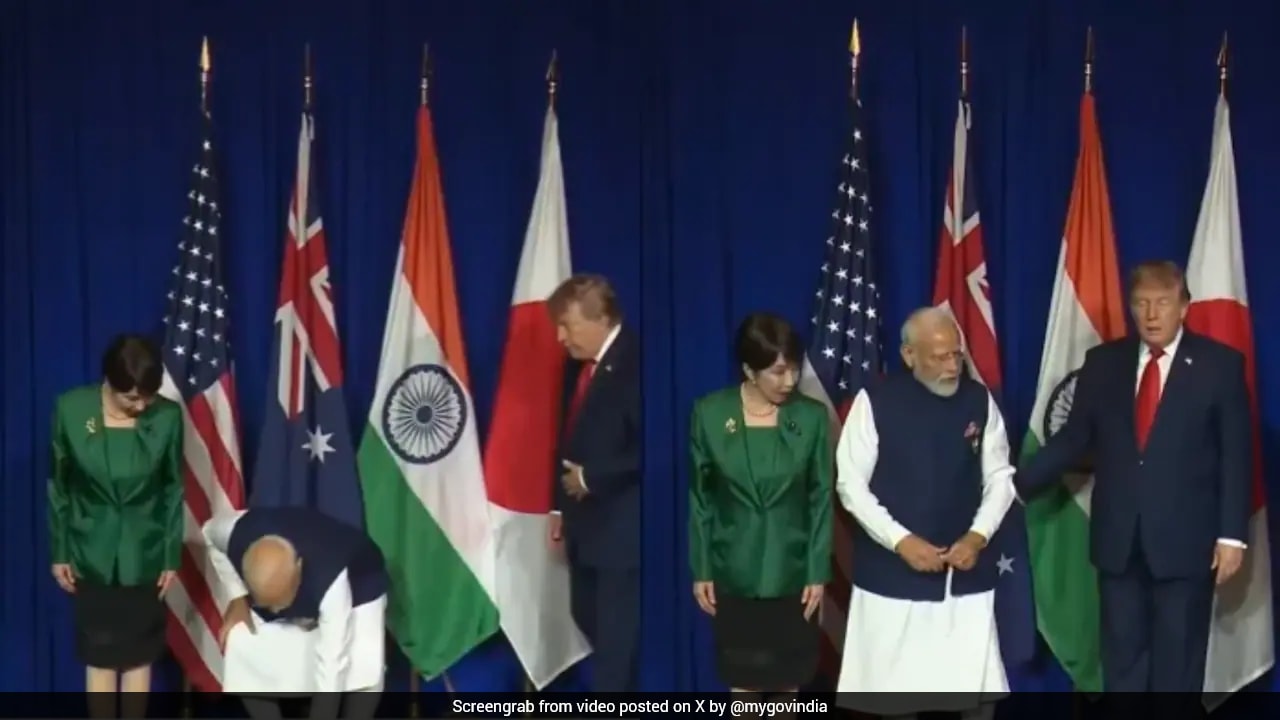
Which is why what happened during the Quad Leaders' Summit photo opportunity broke the spell so completely.
The Architecture of the Photo-Op
To understand why a three-second bend at the waist traveled faster across the internet than the joint security statement issued later that afternoon, you have to understand what a summit photo-op actually is. It is not a casual snapshot. It is theater engineered to look like inevitability.
When the leaders of the Quadrilateral Security Dialogue—Australia, India, Japan, and the United States—step onto a stage together, every inch of real estate carries geopolitical weight. Who stands beside whom. How wide the stance is. Whether hands are clasped in front or hanging relaxed at the sides. Diplomacy relies on these micro-signals because words in international relations are expensive, hedged, and endlessly parsed, whereas a photograph lands in a voter's brain in less than a tenth of a second.
Consider a hypothetical aide—let us call her Maya, a junior protocol officer working her third international summit on four hours of sleep. Maya has spent the entire morning measuring distances with a tailor's tape. She knows that if one leader stands six inches too far forward, the wide-angle lens will distort the frame, making one nation look dominant and another diminished. So she lays down floor markers. Small laminated squares bearing each nation's flag, taped precisely where the center of each leader's shoes should rest.
In the hierarchy of summit staging, those markers are purely utilitarian. They are the diplomatic equivalent of chalk marks on a film set. Once the actors hit their spots, the markers are meant to disappear beneath polished leather soles. Nobody expects a head of government to even look down at them, much less treat them as anything other than floor tape.
Yet when Indian Prime Minister Narendra Modi stepped onto the platform and noticed the small Indian flag marker lying loose on the floor—risking being trampled under the shoes of the leaders walking across the stage—he did not step over it. He did not signal an aide with a subtle nod of the chin. He paused, bent down, picked the marker up with his own hands, and tucked it neatly away before taking his place beside his counterparts.
Three seconds. Maybe four.
Why Small Gestures Cut Through Diplomatic Noise
We live in an era saturated with manufactured authenticity. Every gesture on a public stage is filtered through communications teams, pre-tested for domestic consumption, and dissected within minutes by armies of partisan commentators. Audiences have grown cynical, and frankly, they have earned that cynicism. We know how the sausage is made. We know that a rolled-up shirtsleeve usually means a focus group decided the candidate looked too stiff, and a spontaneous diner stop was booked three weeks in advance.
Because the machinery of image-making has become so visible, anything unscripted carries a sudden, electric charge.
Think of it like watching a live symphony where a sheet of music slips off a stand. If the concertmaster ignores it and keeps playing while a stagehand scrambles across the floor, the illusion holds, though everyone feels a flicker of awkwardness. If the conductor reaches down without breaking tempo, lifts the page, and hands it back seamlessly, the audience exhales. The humanity inside the tuxedo suddenly becomes real.
In Indian public life, the national flag—the Tiranga—occupies an emotional and legal space that foreign observers sometimes underestimate. Under the Flag Code of India, the emblem is not merely a decorative motif; it is treated with strict reverence, and allowing it to touch the ground or be stepped upon is considered a profound indignity. Even a miniature paper representation used as a floor guide carries that cultural resonance. Had Modi walked across it, domestic critics would have seized on the frame before the summit tea had even cooled. Had he gestured for a staffer to retrieve it, the moment would have read as aristocratic detachment.
By bending down himself, he bypassed both traps in a single fluid motion.
Does a three-second gesture alter maritime patrol schedules in the Indo-Pacific? No. It does not change semiconductor supply chains, resolve border standoffs, or rewrite trade tariffs. Anyone claiming that picking up a floor marker reshapes global power dynamics is selling fairy tales. Diplomacy is built on cold calculations of national interest, shared anxieties, and hard-won compromises hammered out behind closed doors long after the cameras are escorted out of the room.
Still, politics is not practiced by algorithms. It is practiced by human beings trying to gauge the instincts of other human beings.
The Invisible Stakes on a Crowded Stage
Watch the faces of the other leaders and staffers in the periphery of that clip, and you see something revealing. In high-level summits, leaders are constantly reading one another's reflexes. They already know each other's talking points—those were traded by ambassadors weeks ago. What they are actually watching for across the table is temperament. How does this person react when something goes slightly off-script? Do they stiffen? Do they look around for someone to blame? Or do they handle the friction quietly and move on?
History is full of these accidental Rorschach tests on diplomatic stages. In 1970, West German Chancellor Willy Brandt dropped to his knees in silence at the Warsaw Ghetto memorial—an unplanned act that no speechwriter had drafted, yet one that shifted the moral atmosphere of European reconciliation overnight. On a much quieter, everyday scale, world leaders are judged constantly by how they treat the invisible infrastructure around them: the translator struggling with a technical phrase, the server pouring water during a tense bilateral meeting, the loose piece of paper lying in the path of oncoming shoes.
I have watched plenty of powerful people fail those tiny tests. I once stood ten feet away from a European minister who dropped his briefing folder on a rainy tarmac and stood completely motionless, staring straight ahead at the cameras while two soaked aides scrambled on their knees around his ankles to gather the pages. The photograph that ran in the next morning's papers wasn't about his trade summit. It was a picture of his shoes surrounded by frantic staffers. He looked less like a statesman and more like a man who had forgotten how his own knees worked.
That contrast explains why the Quad footage resonated far beyond partisan boundaries. Even observers who routinely critique Modi's domestic policies or communication style recognized the instinct at work. You cannot rehearse a loose piece of tape. You either step over the symbol, wait for someone below your pay grade to rescue it, or pick it up yourself.
The Distance Between Protocol and Instinct
Of course, skepticism is healthy here, and we should name it plainly. In the hyper-visual ecosystem of modern politics, every leader knows cameras are rolling from the moment they step out of the armored sedan. A seasoned politician operating at the highest level of global statesmanship possesses a heightened, almost sixth-sense awareness of lenses. It is entirely fair to wonder where pure reflex ends and lifelong political conditioning begins.
Yet after decades in the brutal crucible of electoral politics, conditioning and character often fuse into the same thing. What a leader does in the split second before their advisors can whisper in their ear reveals what they have trained themselves to notice. Most people walking onto a brightly lit stage with three other heads of government are focused entirely upward and outward—scanning the press gallery, locating the broadcast cameras, calculating their posture. Looking down at the floor requires an awareness of the ground beneath your feet, literally and figuratively.
There is a lesson in that for anyone who has ever led a team, managed a crisis, or walked into a room where the stakes felt suffocatingly high. We spend enormous energy preparing our grand statements. We polish our slide decks, memorize our metrics, and rehearse our answers to the toughest questions in the room. And yet, the people watching us—our colleagues, our clients, the strangers weighing whether to trust our judgment—rarely base their verdict on the prepared remarks. They watch how we behave during the transitions. They notice what we do when a minor, unglamorous detail falls out of place while everyone else is staring at the spotlight.
The summit proceeded on schedule. The leaders stood shoulder to shoulder, smiled for the cameras, and turned toward the closed doors where the real, grinding work of Indo-Pacific strategy awaited them. The protocol officers exhaled. The press pool filed out to file their dispatches on supply chains and regional security.
Down on the carpet, the spot where the fourth marker had been was empty, tucked safely inside a pocket out of sight, leaving nothing on the floor for anyone to step on.