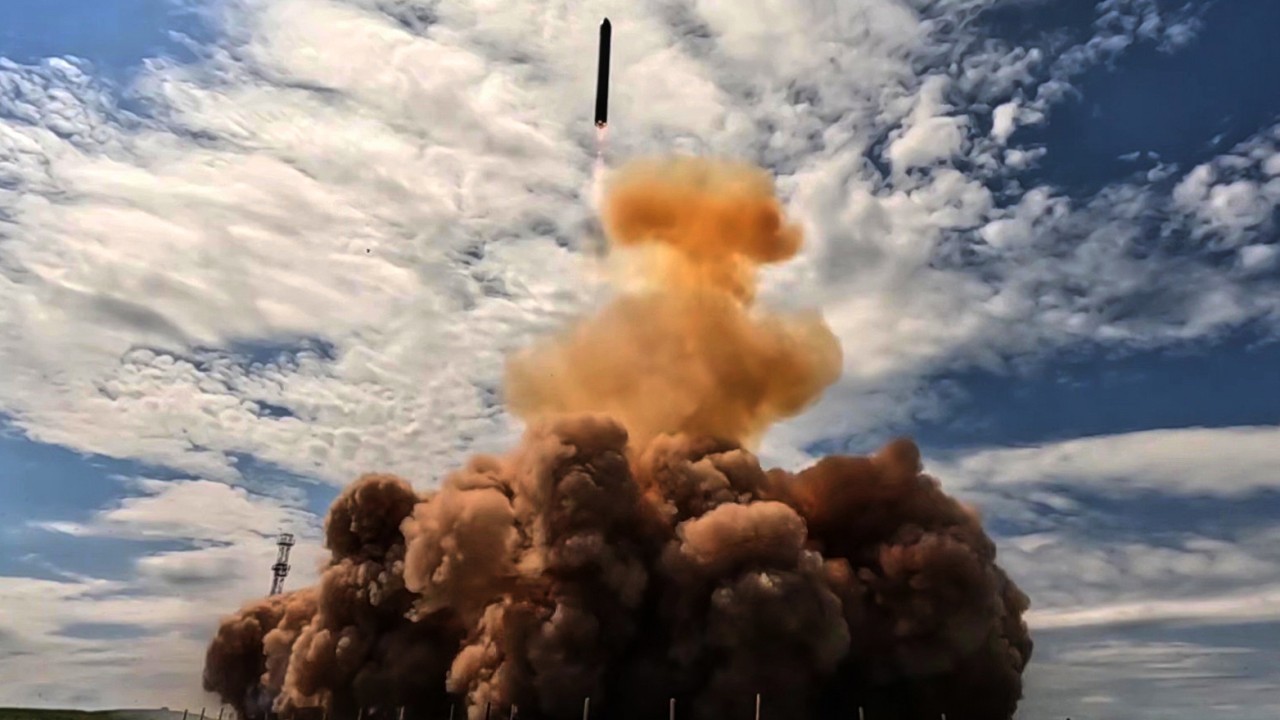
The ground does not merely shake when 200 tons of steel and physics ignite; it screams. Deep in the Archangel region, tucked away in the biting silence of the Plesetsk Cosmodrome, a hatch swung open. What emerged was not a tool of exploration, but a pillar of silver-grey intent. It rose on a column of fire so bright it turned the afternoon shadows into ghosts. This was the Sarmat. To the West, it is known by a more evocative, visceral name: Satan II.
Vladimir Putin watched the feed from a distance, his expression a practiced mask of statecraft. He spoke of it as a crowning achievement, a warning to those who "try to threaten" Russia. He called it the most powerful missile on Earth. He is likely right. But to understand the Sarmat, you cannot look at the technical specifications alone. You have to look at the silence that follows the launch.
The Anatomy of an Ending
To the engineers who built it, the Sarmat is a marvel of fluid dynamics and inertial guidance. It is a liquid-fueled heavy intercontinental ballistic missile designed to replace the aging Voyevoda systems. It carries enough weight to deliver up to 15 independent nuclear warheads, each capable of carving a city out of the map.
Think of it as a bus traveling at twenty times the speed of sound. Now imagine that bus is carrying a dozen different passengers, each of whom has their own specific destination, and each of whom carries the heat of the sun in their pocket. This is the concept of MIRVs—Multiple Independently Targetable Re-entry Vehicles. Once the Sarmat reaches the edge of space, it doesn't just drop a bomb. It sows a field.
The technical brilliance is undeniable. It is designed to fly over the South Pole, bypassing the vast majority of missile defense systems clustered in the Northern Hemisphere. It is fast enough to make the window between detection and impact feel like a heartbeat. But facts like these are cold. They sit on the page like stones. The reality is found in the displacement of air and the sudden, sharp realization that the geography of our safety has shifted.
The Ghost in the Silo
Consider a hypothetical watch officer in a darkened room, thousands of miles from Plesetsk. Let’s call him Elias. Elias doesn't see the fire of the launch. He sees a pixel. A single, glowing dot on a high-resolution monitor that shouldn't be there.
His heart doesn't race because of "geopolitical tension." It races because he knows the math. He knows that if that dot represents a Sarmat, the luxury of contemplation has vanished. In the old days, during the height of the Cold War, there was a certain predictable rhythm to the dance of destruction. You had time to pick up a phone. You had time to verify.
With the Sarmat, the rhythm is broken. It is a weapon designed to be uncatchable. It uses "boost-glide" technology, meaning it can maneuver in the atmosphere, dodging interceptors like a ghost darting through a graveyard. For Elias, and for the millions of people represented by the coordinates on his screen, the Sarmat isn't a "strategic deterrent." It is a fundamental alteration of the human condition.
The Language of Power
When Putin stood before the cameras to hail the test, his words were chosen with the precision of a jeweler. He spoke of "invulnerability." It is a seductive word. It suggests a shield that cannot be pierced and a sword that cannot be parried.
But invulnerability is a myth we tell ourselves to feel small in the face of our own creations. The Sarmat is the result of decades of research, billions of rubles, and the collective intellect of thousands of the world's brightest minds. We have spent the best of our genius figuring out how to make a rock fall from the sky with such force that it erases the ground it hits.
The Sarmat’s range is roughly 18,000 kilometers. That is nearly half the circumference of the planet. It means there is nowhere on Earth that is "away." We are all living in the shadow of the same silo.
The Cost of the Invisible
There is a tendency to view these tests as theater. We see the grainy footage of the missile clearing the tower, the slow-motion roar, the patriotic music dubbed over the top. We treat it like a movie trailer for a film we hope never reaches the theaters.
But the cost is real long before the fuse is lit. The resources required to maintain a nuclear triad—land, sea, and air—are staggering. While the world grapples with shifting climates and crumbling infrastructure, we are perfecting the art of the vacuum. We are building machines that are designed specifically to never be used, yet their mere existence dictates the flow of history.
The Sarmat is not just a missile; it is a weight on the scale of global trust. Every successful test is a withdrawal from the bank of international stability. We trade the certainty of tomorrow for the "security" of a bigger stick.
The Arc of the Fire
During the test flight, the Sarmat traveled across the entirety of the Russian landmass, eventually striking a target on the Kamchatka Peninsula. It worked perfectly. The warheads hit their marks. The telemetry was flawless.
From a purely technological standpoint, it was a triumph. It proved that Russia can still build the most complex machines known to man under the most grueling of circumstances. It proved that the laws of physics are indifferent to the motives of the people who harness them.
But as the dust settled in Kamchatka, the world felt a little smaller. The distance between "us" and "them" was shortened by the speed of a hypersonic glide vehicle. We are entering an era where the weapons are faster than our ability to think through the consequences of using them.
The Sarmat is a testament to what we can achieve when we focus our will on the absolute. It is a masterpiece of engineering that serves a terrifying purpose. It is a reminder that while we have mastered the fire of the stars, we are still struggling with the shadows they cast on the cave wall.
The fire at Plesetsk eventually went out. The smoke cleared. The scientists went home to their families, and the politicians returned to their desks. The missile was gone, but the air it left behind felt different. It felt charged. It felt like the world was holding its breath, waiting to see if the next star to fall would be one of ours, or one of theirs.
There is no "after" once the Sarmat is launched. There is only the long, cold silence of a planet that finally ran out of time to talk. We live in the interval. We live in the space between the ignition and the impact, hoping that the brilliance of the machine is never matched by the darkness of the hand that controls it.