Two thousand five hundred miles separate London from Munich, yet for a quarter of a century, the distance between English football and its highest individual honor felt closer to a light-year.
Ask anyone who stood in the cold rain outside Wembley in the autumn of 2001. Michael Owen had just won the Ballon d'Or, a twenty-two-year-old blur of red and white who seemed to outrun gravity itself. To the people leaning against steel railings with warm paper cups of tea, that trophy felt like an appetizer. England had David Beckham's right foot, Steven Gerrard's lungs, Frank Lampard's timing, and Wayne Rooney's teenage fury waiting in the wings. Surely the golden ball would return to English soil within three years. Five at most. Also making news recently: Why Mbappe Lost Chinese Brands Over One Dictator Joke.
Twenty-five years passed.
Kids born the morning Owen lifted that heavy, dimpled sphere grew up, graduated university, took out mortgages, and watched their own children kick mud-caked footballs across Sunday morning parks. Every October, the ceremony in Paris rolled around like an annual reminder of an unspoken curse. English players made the podium. They collected silver and bronze medals, offered polite applause from the front row of the Theatre du Chatelet, and flew home empty-handed. Additional insights into this topic are explored by FOX Sports.
Until the night Harry Kane finally broke the glass.
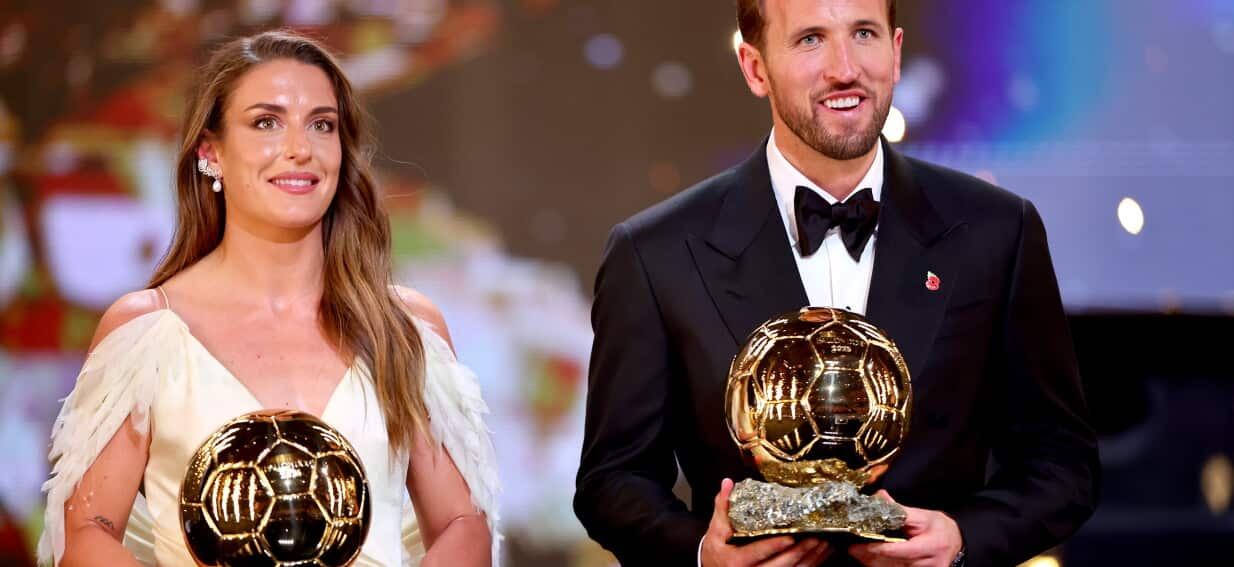
Standing under the blinding stage lights in Paris alongside Alexia Putellas—who claimed her own historic third Ballon d'Or Feminin on the very same evening—Kane did not look like a man conquering a mountain. He looked like a man setting down a boulder he had carried on his shoulders since he was eleven years old.
The Anatomy of a Punchline
To understand why Kane's victory feels less like a coronation and more like an exorcism, you have to remember what he used to be to the rest of the world.
For more than a decade, Harry Kane was football's grandest tragicomedy. He scored goals at a rate that defied modern defensive systems, yet his trophy cabinet remained barren. Critics turned his loyalty to Tottenham Hotspur into a punchline. Rival fans chanted about empty shelves every time he touched the ball near a corner flag. Even when he packed his bags for Bayern Munich in search of silverware, his first season in Bavaria ended with Bayer Leverkusen snapping Bayern's eleven-year stranglehold on the Bundesliga title.
Think about the psychological toll of that kind of noise. Imagine waking up every morning, performing your job better than ninety-nine percent of your peers on planet Earth, and having strangers tell you your life's work is meaningless because of a metal cup you cannot lift alone.
I remember watching him walk off the pitch after missed finals—the Champions League in Madrid, the European Championships at Wembley and Berlin—his shoulders slightly hunched, his eyes fixed on the grass ten yards ahead of his boots. You could almost feel the heavy, humid air of expectation pressing against his ribs. Every missed penalty, every narrow defeat, seemed to calcify into a permanent verdict: great player, wrong era, no cigar.
Then came the reckoning.
Rather than retreating into bitterness or playing it safe, Kane stripped his game down to its barest essentials and rebuilt it in the German crucible. He stopped trying to prove he belonged in the conversation and simply made it mathematically impossible to leave him out. Goals poured in from twenty yards, six yards, from the penalty spot, with his left foot, his right, his forehead. He dropped into midfield like a seasoned quarterback, spraying forty-yard diagonal passes to sprinting wingers before arriving in the penalty box three seconds later to finish the move himself.
By the time the ballots were cast, the old narrative had collapsed under the weight of sheer, undeniable production.
Meanwhile, in Barcelona, a Different Kind of Defiance
If Kane's journey was a twenty-five-year siege against history, Alexia Putellas fought a war against her own body.
Sit down with any athlete who has heard the sharp, sickening pop of a torn anterior cruciate ligament, and they will tell you the physical pain is the easy part. The real torture happens six months later, alone in a sterile rehabilitation gym, staring at a leg that looks like it belongs to someone else while your teammates play under stadium floodlights on television.
Putellas had already conquered the mountain. She won the Ballon d'Or in 2021 and again in 2022, becoming the undisputed queen of world football. Then, on the eve of the European Championship in July 2022, her knee gave way during a routine training session.
Most players never truly return to the summit after an injury like that. They come back a half-step slower, a fraction more hesitant in fifty-fifty challenges, haunted by the memory of what happens when cleats catch in the turf. For two years, Putellas endured the grueling, unglamorous crawl back to fitness—rebuilding muscle fiber by fiber, watching younger stars claim the spotlight, hearing quiet whispers in the press box that her peak belonged to the past.
She did not listen.
Instead, she adapted. Like a master chess player who loses a rook early and adjusts her entire geometry of the board, Putellas traded raw explosive speed for something far more lethal: absolute spatial omniscience. Watching her orchestrate Barcelona's midfield over the past twelve months felt like watching a conductor who had memorized every note before the orchestra even tuned their instruments. A flick of her left ankle opened up defensive lines that had spent ninety minutes locked shut. A single delayed run into the box broke hearts across Europe.
When she walked onto the stage to collect her third Ballon d'Or, separating herself from every other woman in the history of the award, the applause in the room carried a different texture. It was not the polite clapping reserved for expected winners. It was the sound of peers recognizing survival.
What the Trophy Actually Measures
There is a persistent myth in modern sports that individual awards are vanity projects—shiny distractions designed for television broadcasts and social media debates.
Consider what actually happens in the living rooms where those broadcasts are watched.
Picture a fourteen-year-old academy midfielder in Manchester or Madrid, staring at a rejection letter from a youth club after being told he is too slow, or a sixteen-year-old girl in Seville icing a swollen knee after surgery, wondering if she will ever sprint again. To understand what these trophies do, use a simple analogy: they are lighthouses built on impossible cliffs. You do not build a lighthouse to celebrate the rocks; you build it so sailors in the dark know the shore actually exists.
Harry Kane was released by Arsenal's academy at age eight because he was deemed too chubby and unathletic. He spent years on loan at Leyton Orient, Millwall, Norwich City, and Leicester City—sitting on cold wooden benches in England's lower divisions while scouts wrote him off as a slow striker who lacked the burst required for the top flight.
If a player with that resume can outlast twenty-five years of English heartbreak to win the Ballon d'Or, what excuse does anyone else have to quit early?
And if Alexia Putellas can shatter her knee at the height of her fame, endure the darkest corridors of athletic rehabilitation, and climb back to claim a historic third crown, what does that say about the shelf life of human resilience?
The Silence Before the Roar
Football history is usually written in loud moments—last-minute volleys, roaring stadiums, confetti cannons blasting into the night sky.
Yet the moments that define careers almost always happen in quiet rooms when nobody is watching. They happen at 6:30 in the morning in a freezing parking lot outside a training ground in Hertfordshire. They happen on a physical therapist's table in Catalonia while rain streaks the windowpane. They happen in the stubborn refusal to accept what everyone else has already decided is your ceiling.
England's twenty-five-year wait is over. The records will show Michael Owen in 2001, a long blank space across a quarter-century of near-misses, and then Harry Kane in 2026, standing beside Alexia Putellas under the Parisian chandeliers.
Somewhere in a dimly lit bedroom tonight, a kid who was just cut from their local team is staring at a photo of those two trophies glowing on a phone screen, setting an alarm for dawn.