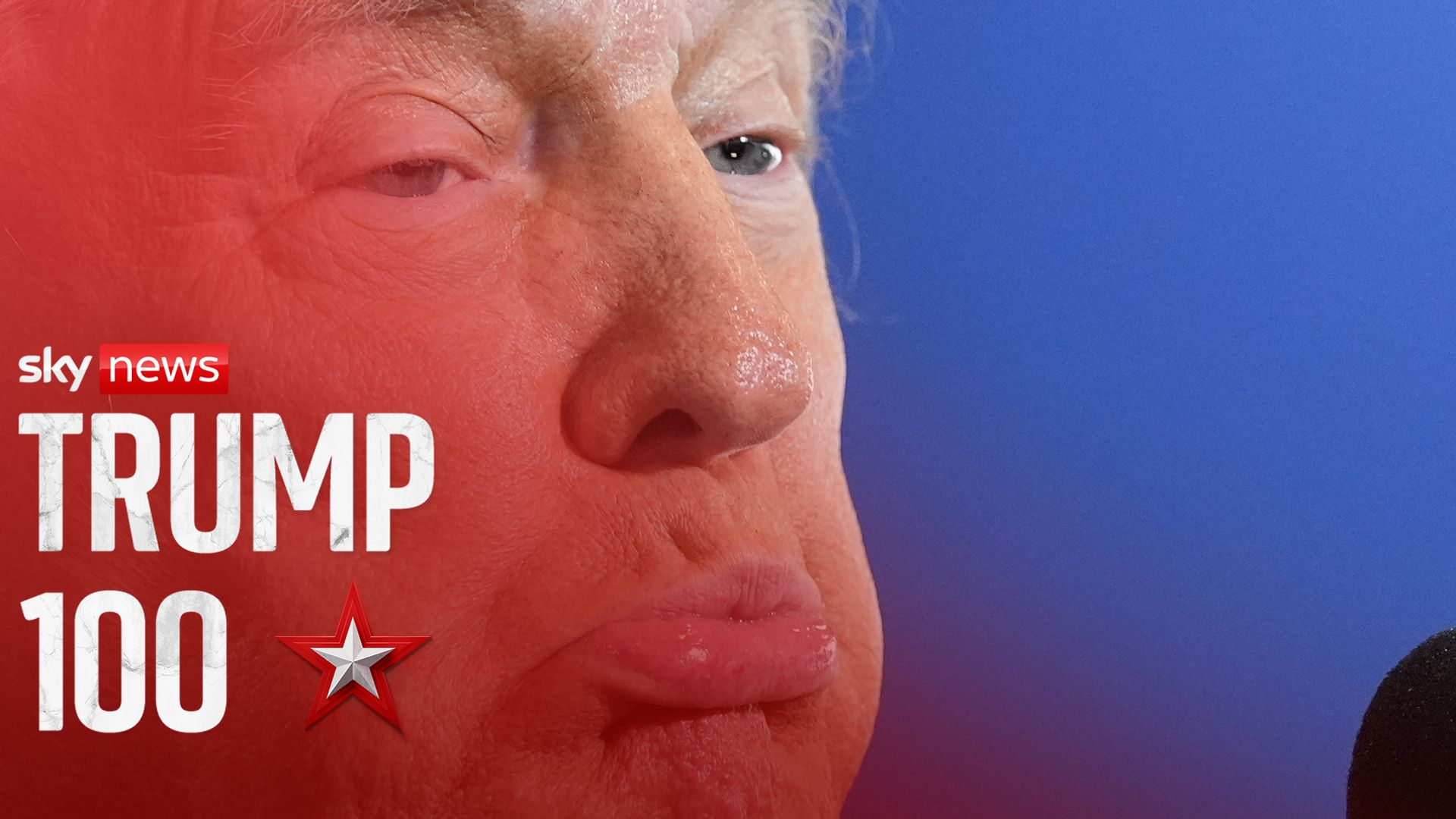
The glare of a television studio light does something strange to the human skin. It strips away the soft textures of reality, leaving only sharp contrasts—the deep lines around a mouth, the slight tremor of a hand, the silver hue of hair under a thousand watts of illumination. For decades, we have watched one man navigate that glare. We know the cadence of his voice. We know the specific, sweeping arc of his hand gestures.
When a public figure occupies our collective consciousness for nearly half a century, we stop looking at them as flesh and blood. They become icons. Or targets. Or caricatures. But beneath the political theater and the endless cycle of headlines lies a biological reality that spares no one.
Time moves in only one direction.
To look closely at Donald Trump today is to witness a profound, public case study in human aging under the most brutal microscope on earth. The conversation surrounding his physical and mental fitness is rarely conducted in good faith. It is weaponized by adversaries and fiercely deflected by allies. Yet, if we strip away the partisan noise, we are left with a quiet, undeniable truth: the presidency, and the pursuit of it, demands a toll that the human body was never engineered to pay.
The Microscopic Ledger of Stress
Medical charts are cold things. They list numbers, variables, and clinical terms that feel entirely disconnected from the warmth of life. For a man standing at six feet, three inches tall and weighing over 240 pounds, the physical baseline is already a complex matrix. We know from historically released medical summaries that he takes a statin to lower his cholesterol. We know his blood pressure has hovered within ranges that doctors watch with a practiced, cautious eye.
But a life is not lived on a spreadsheet.
Consider the sheer velocity of a modern campaign. It is a grueling, sleepless marathon of tarmac greetings, midnight rallies, and high-stakes adversarial encounters. For a septuagenarian, this lifestyle defies the natural rhythm of the body. Sleep deprivation alone acts like a slow-draining battery. When the brain is denied restorative rest, the prefrontal cortex—the region responsible for executive function, impulse control, and emotional regulation—begins to flicker.
Medical experts who study longevity often point to the concept of allostatic load. It is the wear and tear on the body that accumulates when an individual is exposed to chronic, repeated stress. Think of it as a bridge. A bridge can carry immense weight for days, weeks, or even years. But micro-fractures form in the steel when the pressure never relents. The constant adrenaline required to command a crowd of thousands, coupled with the cortisol of constant legal and political warfare, increases that load exponentially.
The public reacts to the symptoms without understanding the system. When a speech features a tangled sentence or a momentary confusion of names, critics pounce with diagnoses of cognitive decline. Supporters counter with assertions of unorthodox genius. The reality is likely far more mundane and far more human: extreme fatigue compounding the natural, statistical slowing of an aging neurological network.
The Architecture of the Aging Mind
Memory is not a single filing cabinet. It is a vast, interconnected web of neurons that relies on speed and chemical balance. As humans cross into their late seventies and early eighties, the brain naturally loses volume. The processing speed slows. This is not a pathology; it is the standard blueprint of human existence.
An analogy helps clarify how this manifests in a public figure. Imagine a highway system at rush hour. A youthful brain is an open eight-lane superhighway where information travels from the memory banks to the vocal cords without a single brake light. An aging brain, even a highly functional one, experiences lane closures. The information is still there, stored safely in the suburbs of the mind, but the detour required to retrieve it takes just a fraction of a second longer.
In a private citizen, this looks like a misplaced set of keys or a temporary struggle to remember the name of a distant acquaintance.
In a man holding a microphone in front of global media, it looks like a glitch.
The phenomenon of "word finding" difficulty, or anomia, is a well-documented aspect of normal aging. When pushed to the limit of exhaustion, the brain often substitutes words or relies on familiar, well-worn rhetorical tracks to buy itself time. This explains the repetitive nature of modern political speech. It is a survival mechanism. By returning to familiar catchphrases and predictable narrative loops, the speaker allows the subconscious mind to catch its breath and clear the traffic jam on the neurological highway.
The Visible Physical Shift
The changes are not merely cognitive. They are written into the very geometry of movement.
Watch archival footage from the 1980s or 1990s. The movement was fluid, characterized by a certain forward-leaning bravado and a rapid, almost impatient stride. Today, the posture is different. The gait is more measured, the steps deliberate. There is a distinct stiffness in the torso, a common hallmark of degenerative joint changes or spinal stenosis that affects millions of Americans of a similar age.
To hold oneself upright for hours under the heavy fabric of a tailored suit requires core strength that naturally diminishes with every passing decade. The human body loses muscle mass—a process known as sarcopenia—at an accelerated rate after the age of sixty-five. When you subtract muscle and add the weight of immense psychological pressure, the physical frame must overcompensate. Every step becomes an act of conscious will rather than subconscious habit.
There is also the matter of diet and lifestyle. The fondness for fast food and well-done steaks is a permanent fixture of the Trump lore. While a robust constitution has clearly carried him through decades of unconventional wellness choices, the cardiovascular system keeps its own ledger. Arteries lose their elasticity. The heart must pump harder against greater resistance. It is a testament to genetic resilience that a man living on high-stress adrenaline and a fast-food diet remains standing at a podium, but resilience is not immortality. It is simply a longer fuse.
The Mirror of Our Own Fears
The obsession with the health of our leaders is not entirely political. It is deeply psychological. When we look at the visible aging of a public figure, we are forced to look into a mirror that we spend most of our lives trying to avoid.
We see the vulnerability of the human condition.
We are terrified by the prospect that the people steering the great institutions of our world are subject to the same biological decay as our grandparents, our parents, and ultimately, ourselves. We want our leaders to be gods, impervious to the passage of time and the rust of biology. When they falter, when they misstep, or when their voices crack with the weight of years, the illusion shatters.
The medical reality of Donald Trump is not a secret dossier filled with exotic diagnoses. It is the transparent, public ledger of an eighty-year-old man living an extraordinary, high-velocity life in the twilight of his years. It is a story of a heart, a brain, and a skeletal frame fighting a daily battle against the laws of thermodynamics.
The podium offers an illusion of permanence, a solid block of wood and steel that shields the lower half of the body from view. But above the wood, the face tells the true story. The lines are deeper now. The pauses between thoughts are longer. The energy required to project that famous, booming defiance is clearly drawn from a well that is no longer bottomless. He stands there, a solitary figure caught between the unstoppable force of his own ambition and the immovable object of human biology, fighting for every syllable in the dying light of the afternoon.