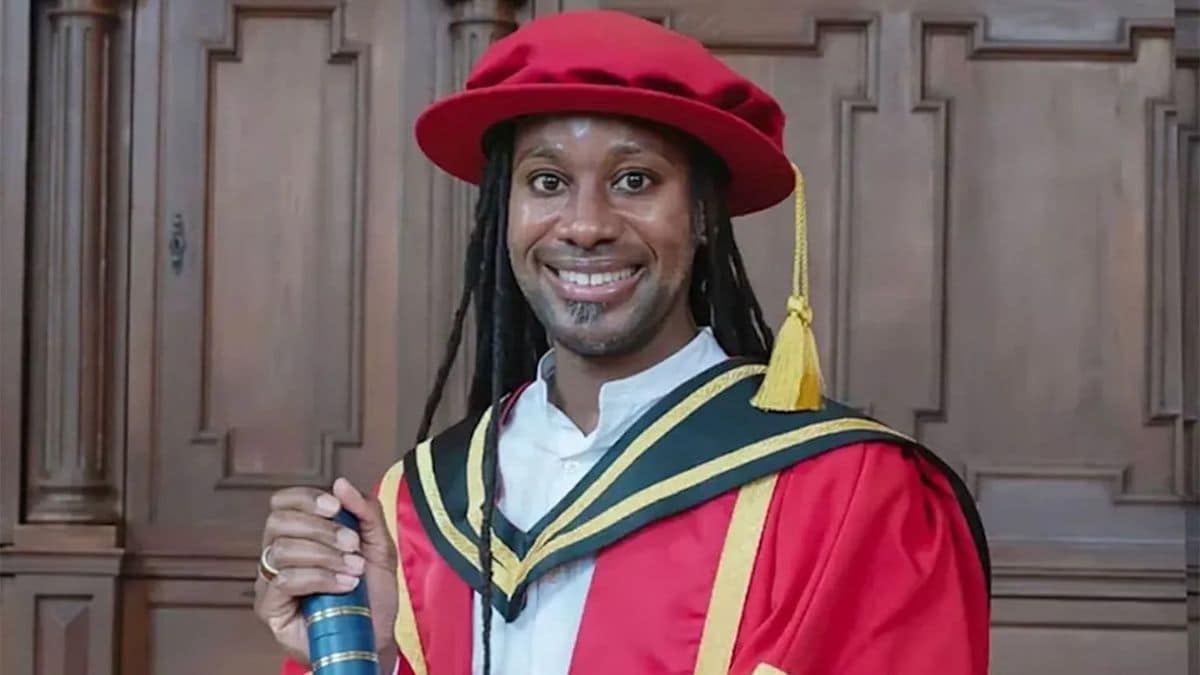
The air inside a university lecture hall at twilight smells of old paper, floor wax, and the distinct, static hum of decades of human ambition. For most people, walking into that room means sitting in the dark and taking notes. For Jason Arday, walking into that room meant carrying the impossible weight of an entire demographic on his shoulders, all while his name bounced across internet search bars in a dark constellation of morbid curiosity.
Did he die? The query haunts the autocomplete algorithms. Millions typed it into search engines, drawn by the grim theater of digital rumor, confusing survival with the terrifying speed of his ascension. No, Jason Arday did not die. What died, or at least violently fractured, was the quiet expectation of who gets to belong at the very top of academia.
To understand the noise surrounding him, you have to look backward to a boy who could not speak until he was eleven.
Imagine growing up in a world of muffled sounds and frustrating silences. While other children argued on the playground, young Jason lived behind a glass wall of global developmental delay and autism. Doctors gently suggested to his mother that he would likely require lifelong institutional care. They sketched out a small, circumscribed life for him, bounded by limitations and managed expectations.
His mother refused the script.
Instead, she filled their home with music, rhythm, and an unrelenting refusal to accept the boundaries drawn by strangers in white coats. Slowly, painfully, the language came. Not just words, but sentences. Not just sentences, but an insatiable hunger to understand how the machinery of society worked.
Decades later, that same boy stood in the historic quadrangles of Cambridge University, having been named its youngest Black professor. At thirty-seven, he occupied a chair in sociology that felt less like a seat and more like a lightning rod.
The internet did not know what to do with that.
When a story defies the comfortable prejudice of failure, modern culture often seeks to demolish it. Soon, the digital whispers began. Anonymous forums and sensationalized blogs buzzed with malicious speculation. Did he die? No, but character assassination arrived right on schedule. Detractors dredged up old accusations, questioned his academic credentials, whispered about plagiarism, and reduced his life's work to the cynical shorthand of a diversity hire.
It is a peculiar kind of cruelty. When someone climbs from the absolute basement of medical prognoses to the pinnacle of global intellectualism, the world rarely applauds the climb. Often, it checks the ropes for fraying.
Let us be entirely honest about the mechanics of envy. Academic spaces have long operated as exclusive country clubs with library cards. They were built by wealth, sustained by pedigree, and guarded by unspoken codes of accent, posture, and lineage. When an autistic child who learned to speak late storms those gates without knocking, the gatekeepers panic. They scour his footnotes. They count his citations. They interrogate his appointments. Every single word he has ever written is placed under an electron microscope, not in search of truth, but in search of a flaw that can justify the old order.
Did he face scrutiny? Intense, suffocating scrutiny. The kind that makes a person second-guess every morning coffee and every late-night draft.
Yet, the irony of the plagiarism and DEI hire accusations lies in their profound intellectual laziness. To suggest that a man who spent his youth battling severe communication barriers somehow stumbled into a professorship at Cambridge purely through administrative charity is to misunderstand both human resilience and the brutal rigor of academic promotion. Universities do not hand out chairs in sociology as participation trophies. They test you until your nerves fray. They make you bleed ink on page after page, year after year, through peer review processes designed to reject more than they accept.
Jason Arday’s research is not about abstract theory; it is about the lived exclusion of marginalized people. He studies how education can either liberate or trap. He writes about the very structures that try to keep kids like his former self in the quiet corners of society. His scholarship is deeply personal, forged in the fires of his own exclusion.
When detractors label someone a diversity hire, they are attempting to perform a subtle alchemy. They take a life defined by exceptional grit and transform it into an administrative accident. They want you to believe he was simply swept into the room by a polite breeze of institutional guilt, rather than having kicked the door down through sheer, unyielding intellectual horsepower.
Consider the psychological toll of that reality. Every time he steps up to a podium, he is not just delivering a lecture on sociology. He is performing a referendum on his own right to exist in that space. If he stumbles, a thousand critics are waiting to roar that they told you so. If he succeeds, he is often met with the quiet, suspicious silence of those who view his presence as a temporary glitch in the matrix.
This is the hidden tax of breaking barriers. The first person through the wall always carries the debris.
The search engine queries asking about his death reveal a darker psychological current. They represent a collective wish for equilibrium, a subconscious desire for the old hierarchy to reassert itself. If he died, or if his career imploded in scandal, the world could return to its comforting narrative: that certain rooms belong to certain people, and the rest are merely visitors.
But he is still here. He is still writing. He is still teaching.
In the quiet hours between seminars, far away from the screaming comment sections and the algorithmic churn of outrage, Jason Arday sits at a wooden desk. Outside his window, the ancient stones of Cambridge catch the pale English light. The ghosts of old thinkers—men who never imagined a face like his in these halls—watch from their oil paintings on the wall.
He turns another page. He picks up his pen. The silence in the room is no longer a cage; it is a canvas.