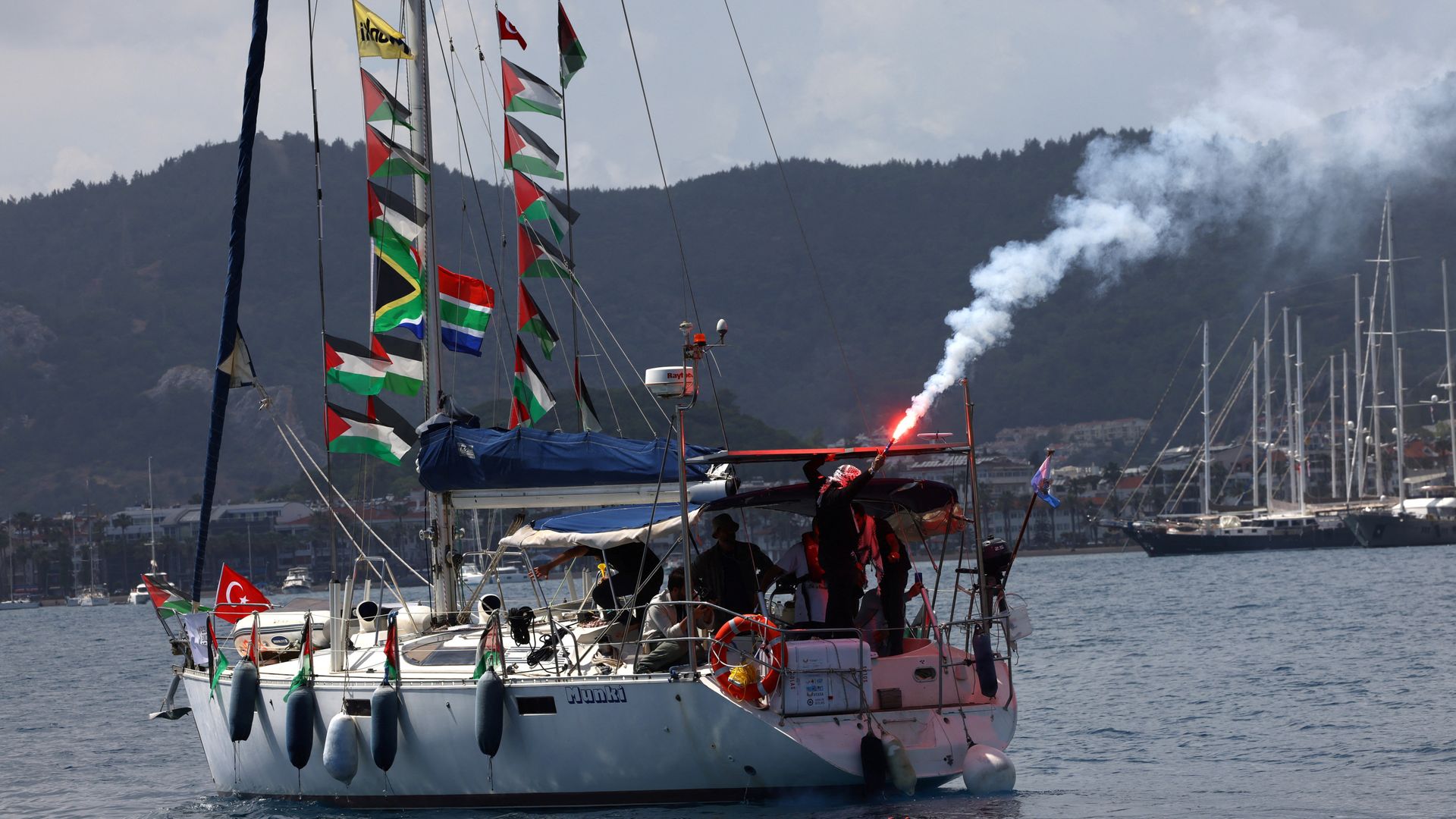
The Mediterranean looks deceptively peaceful from the deck of a cargo ship. It is an expanse of sapphire glass, broken only by the white wake of vessels carrying everything from electronics to grain. But when a ship is bound for Gaza, the water changes character. It ceases to be a mere maritime highway. It becomes one of the most heavily scrutinized, politically charged, and dangerous stretches of water on earth.
For weeks, hundreds of volunteers, activists, and humanitarian workers from across the globe have gathered in dockyards, checking manifests and securing crates. They are part of the Freedom Flotilla Coalition, a collective of international organizations determined to break through the naval blockade that has encircled the Gaza Strip for nearly two decades. To the activists, the mission is a straightforward moral imperative to deliver food, medicine, and clean water to a population trapped in a catastrophic humanitarian crisis. To the Israeli government, the flotilla is a calculated provocation, a threat to national security, and a potential conduit for contraband that could sustain hostile militant groups.
Behind the political grandstanding, the naval strategies, and the legal arguments lies a deeply human reality. Ships are built of steel, but they are propelled by human will. Understanding the movement requires stepping off the dry land of policy briefs and into the cramped, anxious, and fiercely determined world of those who choose to sail.
The Microcosm on the Water
Picture a woman named Elena. She is not a politician or a seasoned revolutionary. She is a retired nurse from Madrid, used to the quiet routine of a suburban clinic. Now, she sits on a narrow bunk in the belly of a converted passenger ship, listening to the relentless thrum of the diesel engine. Around her are people from dozens of countries—doctors from Malaysia, journalists from the United States, lawyers from South Africa, and parliamentarians from Europe.
They are squeezed into shared cabins, navigating the daily friction of language barriers and seasickness. Yet, a singular conviction unites them. Elena’s duffel bag does not contain weapons or propaganda. It contains specialized pediatric bandages, water purification tablets, and letters of solidarity written by schoolchildren in Spain.
The logistical reality of launching an international flotilla is staggering. It requires millions of dollars in donations, rigorous safety inspections, and navigating a labyrinth of international maritime law. Each vessel must be registered under a national flag, a process subject to immense diplomatic pressure. Governments hostile to the flotilla’s mission often pressure flag states to revoke registration at the eleventh hour, leaving ships stranded in port before a single knot is tied.
Then comes the cargo itself. Every box of milk powder and every pallet of medical supplies must be meticulously cataloged. The activists know that the slightest discrepancy will be used to justify the seizure of the vessel. They invite independent international observers to inspect the holds, trying to prove to a skeptical world that their intentions are entirely transparent.
But transparency does not guarantee safe passage. The shadow of history hangs heavily over the decks. Everyone on board is acutely aware of what happened in 2010, when a similar flotilla led by the MV Mavi Marmara was intercepted by Israeli naval commandoes in international waters. The resulting confrontation left ten activists dead and triggered a profound international diplomatic crisis. That memory is a physical presence on the ship. It sits in the silence during safety briefings. It is felt when the crew practices emergency drills, learning how to respond if flashbangs echo across the deck and masked soldiers descend from helicopters.
The Architecture of the Blockade
To understand why people are willing to risk their lives on the open sea, one must look at the strip of land they are trying to reach. Gaza is a coastal enclave roughly twenty-five miles long and six miles wide. Since 2007, following the rise of Hamas to power, Israel and Egypt have maintained a strict land, air, and sea blockade on the territory.
The blockade is not a static wall. It is a dynamic, complex system of control. Israel asserts that the restrictions are vital to prevent Hamas from acquiring weapons, rockets, and dual-use materials—items like concrete or steel that could be used to construct underground military tunnels. Under international law, nations have a recognized right to self-defense and can implement maritime blockades under specific criteria, provided they do not cause disproportionate suffering to the civilian population.
The definition of disproportionate, however, is where the consensus shatters.
For the over two million residents of Gaza, the blockade is the defining feature of daily existence. It dictates how much electricity powers their homes, whether a local bakery has enough flour, and if a hospital has the specialized medication required to treat a child's leukemia. The economy has been systematically strangled, resulting in some of the highest unemployment rates in the world. Clean water is a luxury, as the infrastructure required to treat sewage and desalinate seawater is severely degraded and starved of spare parts.
Consider the perspective of a fisherman in Gaza. The sea is right in front of him, a vast source of protein and economic independence. But under the rules of the blockade, his fishing zone is strictly limited, fluctuating constantly based on the political climate. If he sails too far out, he faces warning shots from naval patrol boats. The irony is bitter. The ocean represents both a beautiful, tantalizing horizon of freedom and the physical perimeter of a prison.
The flotilla movement seeks to challenge the legality of this entire structure. Activists argue that the blockade constitutes collective punishment, which is explicitly prohibited under the Geneva Conventions. By attempting to sail directly into the port of Gaza, they are not merely delivering aid; they are attempting to assert that the waters off Gaza belong to the international commons and that the people living there have a right to trade, travel, and receive visitors without an external gatekeeper.
The Diplomatic Chessboard
A flotilla is never just about the ships at sea. It is a high-stakes chess game played out in foreign ministries, intelligence headquarters, and the halls of the United Nations.
When a collection of ships prepares to depart from ports in the Mediterranean, phones begin ringing across global capitals. The Israeli government launches a parallel diplomatic counter-offensive. Intelligence agencies monitor the procurement of the vessels, looking for any financial links, however tenuous, to banned organizations. Diplomatic envoys pressure Mediterranean nations—Greece, Cyprus, Turkey, Italy—to prevent the ships from leaving their docks, citing safety concerns or potential violations of domestic law.
The tension is palpable in the port cities where the flotilla assembles. Dockworkers find themselves caught between sympathy for the humanitarian cause and pressure from port authorities worried about political blowback. Activists face sudden bureaucratic roadblocks: unexpected maintenance inspections, delayed fuel deliveries, or sudden changes in port regulations that keep their ships tied to the pier.
For the countries whose citizens are on board, the situation is a diplomatic nightmare. If a state allows its citizens to sail, it risks damaging its strategic relationship with Israel and its allies, particularly the United States. If it forcibly stops its citizens from sailing, it faces fierce domestic backlash from a public horrified by the unfolding humanitarian tragedy in Gaza.
This friction reveals the deeper, systemic failure of international diplomacy. The flotilla exists because traditional political channels have stalled. Decades of peace initiatives, UN resolutions, and diplomatic negotiations have failed to lift the blockade or secure a lasting, just peace for both Israelis and Palestinians. The ships are a loud, disruptive symptom of a broken global order. They are a declaration that when governments fail to act, ordinary citizens will step into the void, regardless of the geopolitical cost.
The Confrontation at the Horizon
The climax of every flotilla movement occurs at an invisible line on the water. It is the boundary where the international high seas meet the exclusion zone enforced by the Israeli Navy.
As the ships approach this perimeter, the atmosphere on board undergoes a profound shift. The casual conversations and shared meals give way to a tense, hyper-alert focus. The captain keeps his eyes locked on the radar screen, watching the blips that signify the approach of fast-attack craft and missile boats. Over the marine radio, a voice cuts through the static. It is the Israeli military, issuing a formal warning. The voice states that the ships are entering a closed military zone, that their actions are illegal, and that they must redirect their course to an approved port, such as Ashdod, where their cargo can be inspected and processed through official channels.
The activists have their own script. They respond that they are unarmed civilians carrying humanitarian aid to a population in desperate need, and that they have no intention of complying with an illegal blockade.
What happens next is a test of human psychology under extreme pressure. The activists have pledged themselves to strict principles of non-violent resistance. They have undergone training on how to link arms, how to protect themselves from tear gas, and how to remain calm in the face of overwhelming force. But theory vanishes when the black hulls of naval vessels loom alongside in the darkness.
From the perspective of the naval crews, the operation is fraught with ambiguity. They are trained to fight wars, to counter armed insurgents, and to protect their coastline from catastrophic attacks. Now, they are ordered to board a vessel filled with elderly volunteers, peace activists, and journalists, all while the eyes of the international media are watching through live-streamed satellite feeds. The potential for miscalculation is immense. A misunderstood gesture, a panicked reaction, or a sudden movement can instantly transform a tense standoff into a tragedy.
If the ships are boarded and seized, the drama does not end. The vessels are towed to Israeli ports, and the participants are detained, interrogated, and systematically deported. The cargo is confiscated. The Israeli government often promises to deliver the permissible aid to Gaza via land crossings after security screening, but the activists view this as a co-optation of their mission. They did not set out to feed Gaza through Israel's permission; they set out to break the permission structure itself.
The Ripple Effect
It is easy to look at the history of the flotilla movement and conclude that it is an exercise in futility. Most ships never reach the shores of Gaza. They are stopped in port, turned back by diplomatic pressure, or intercepted by naval forces long before they can see the lights of the Gaza coastline. The aid they carry is a drop in the ocean compared to the massive, systemic needs of a population surviving amid ruins.
But measuring the success of the movement solely by whether a ship docks in Gaza is a fundamental misunderstanding of its purpose.
The true impact of the flotilla is not logistical. It is symbolic and political. Every time a ship sets sail, it forces the world to look at a crisis that many would prefer to ignore. It disrupts the comfortable narrative of geopolitical inertia. It forces governments to take a stand, to issue statements, and to justify their policies in the harsh light of public scrutiny.
For the people living inside Gaza, the knowledge that ships are sailing for them is a powerful psychological lifeline. In a place defined by isolation, where the sky is filled with surveillance drones and the land is ringed by concrete walls, the sight of a distant ship on the horizon is proof that they have not been entirely forgotten by the human family. It is a sign that there are people thousands of miles away who are willing to risk their freedom, their safety, and their lives to reach them.
The ships of the flotilla are small, fragile things when measured against the massive apparatus of military and state power. They are slow, vulnerable, and outgunned. But they carry a cargo that cannot be easily intercepted by naval commandos or confiscated by port authorities. They carry the persistent, inconvenient insistence that human suffering demands a human response, and that the sea, no matter how heavily guarded, can never completely wash away our shared responsibility to one another.