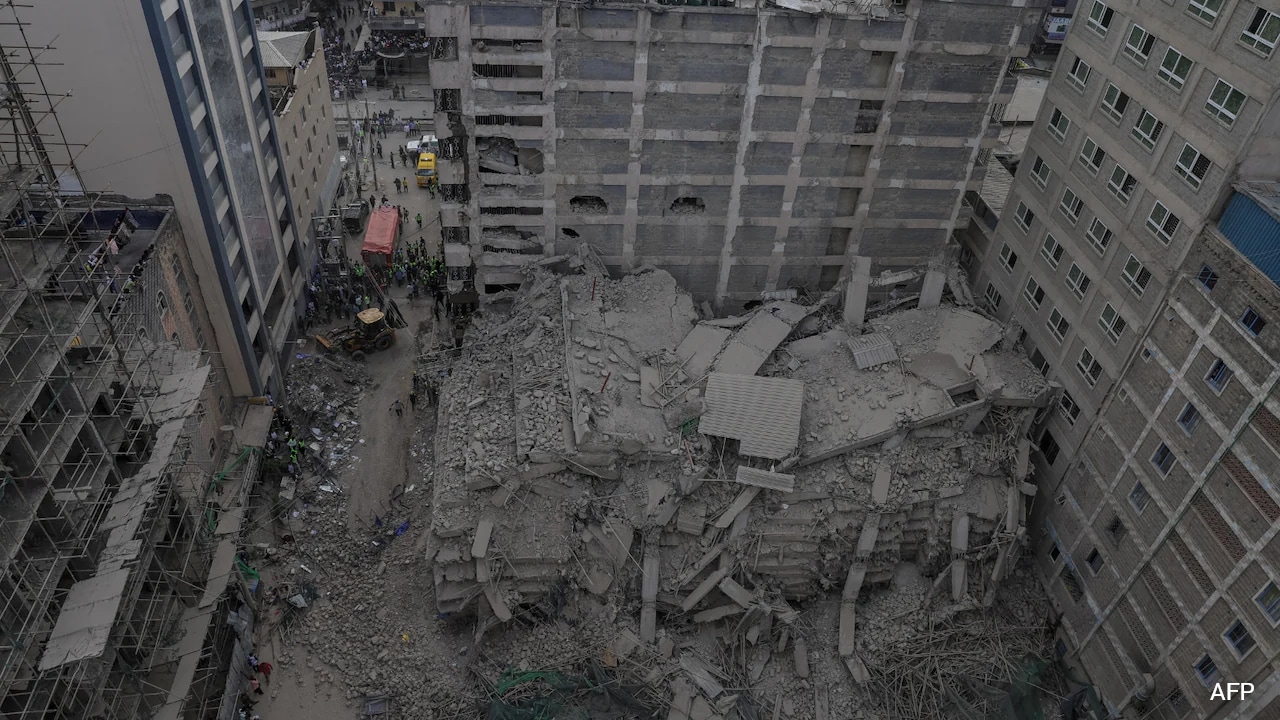
Dust does not settle cleanly in Nairobi. It hangs in the thick air, tasting of crushed limestone, diesel exhaust, and the metallic tang of panic.
When a multi-storey residential building gives way in Kenya, the sound is rarely the cinematic explosion people expect from disaster movies. Survivors who have lived to describe the sensation often speak of a deep, subterranean groan, followed by a sudden, sickening lurch—the floor simply vanishing beneath their feet as gravity reclaims tons of poorly mixed concrete and unreinforced steel. One second, a mother is stirring tea over a kerosene stove or helping a child button a school uniform; the next, the ceiling is inches from her face, the air replaced by choking gray powder, and the world shrinks to the dark, cramped geometry of a pancake collapse.
In the immediate aftermath of any structural failure in rapidly urbanizing hubs like Nairobi, Kiambu, or Kisumu, the headlines follow a predictable, clinical script. Many feared trapped. Rescue teams dispatched. Investigations launched. These sterile dispatches reduce an acute human tragedy into a fleeting news cycle, stripping away the invisible stakes that brought those families into a death trap in the first place. To understand why buildings keep falling in East Africa’s largest economy, you have to look past the twisted rebar and examine the quiet desperation of the people who sign the leases, the corners cut in the dark of night, and a regulatory system straining under the weight of unchecked urban migration.
The Anatomy of a Vertical Gamble
Consider a hypothetical tenant—let us call her Wanjiku—to trace the exact mechanics of how a family ends up living inside an architectural time bomb. Wanjiku works a twelve-hour shift in Nairobi’s industrial area, earning a wage that leaves zero margin for error. Every month, she faces a brutal arithmetic: pay for reliable, code-compliant housing miles away and lose three hours a day—and a third of her income—to matatu fares, or rent a newly painted, suspiciously affordable two-bedroom flat in a booming, densely packed neighborhood like Pipeline, Ruaka, or Kahawa West.
She chooses the flat near her job. Who wouldn't?
On the surface, the building looks like progress. The exterior boasts fresh coats of pastel paint, tiled balconies, and newly installed aluminum-framed windows. For a working family, those cosmetic finishes signal safety, modernity, and upward mobility. Yet behind that smooth plaster lies a structural reality that most tenants have no way of inspecting.
To grasp what actually happens inside a compromised building, think of reinforced concrete like a human body. The concrete itself is the bone—exceptionally strong when compressed, capable of bearing immense vertical weight, yet brittle when pulled or twisted. The steel rebar embedded inside is the muscle and tendon, providing the tensile strength that allows a structure to flex, absorb vibrations, and hold together under stress. When a rogue developer decides to maximize profit by stretching a single bag of cement with too much river sand, or by substituting thick, ribbed high-tensile steel for thin, smooth bars meant only for light fencing, they are essentially building a skeleton out of chalk and ligaments out of thread.
Add two or three unauthorized extra floors onto a foundation engineered for only four, and the physics become unforgiving. The lower columns begin to bear loads they were never meant to carry. Hairline cracks appear in the stairwells, dismissed by caretakers as "normal settling." Doors suddenly stick in their frames. Then, a heavy seasonal downpour saturates the surrounding soil, softening the ground beneath a shallow foundation, and the entire structure folds inward upon itself in seconds.
The Invisible Economy of Corners Cut
Why does this keep happening when Kenya possesses some of the strictest building codes and most qualified structural engineers in the region? The answer sits at the intersection of breakneck demand and systemic corruption.
Nairobi’s population has surged past five million, driving an insatiable hunger for low- and middle-income housing. Land within commuting distance of commercial centers has grown astronomically expensive. For an unscrupulous developer looking to turn a rapid profit, the temptation to bypass due process is enormous. Securing legitimate architectural approvals, conducting proper geotechnical soil tests, hiring a registered structural engineer, and waiting for mandatory municipal inspections takes time and eats into profit margins.
So, a shadow construction economy thrives in plain sight. Developers erect buildings at breakneck speed, often pouring concrete at night or over weekends when county enforcement officers are off duty. When an inspector does arrive and marks a hazardous site with a bold red "X" signaling a stop-work order, a discreet bribe frequently buys silence, or a fresh coat of paint covers the warning before the next batch of concrete is poured.
The National Construction Authority (NCA) and the Architectural Association of Kenya have repeatedly sounded the alarm over this exact pattern. Audits conducted across Nairobi and its satellite towns over the past decade have consistently revealed that a staggering percentage of inspected buildings fail to meet basic safety standards—some lacking approved structural drawings altogether, others built directly over riparian reserves or fragile wetland soils without proper piling.
Yet enforcement remains perpetually reactive. A building is condemned on paper, eviction notices are taped to the lobby walls, and life goes on as usual because neither the landlord nor the tenants have anywhere else to turn. The landlord refuses to forfeit rental income; the tenants cannot afford to forfeit their security deposits or find comparable rent nearby. Everyone gambles that the walls will hold for just one more month.
Inside the Rubble
When that gamble fails, the rescue effort exposes another layer of vulnerability. In the crucial first hours after a collapse—the window emergency responders call the "golden hours," when survival rates are highest—the people pulling survivors from the wreckage are almost never specialized urban search-and-rescue teams. They are neighbors, boda boda riders, construction workers from nearby sites, and terrified relatives clawing at slabs of concrete with bare hands, crowbars, and borrowed hammers.
I have stood at the edge of these cordons and watched the emotional whiplash of a crowd caught between hope and dread. Every time someone shouts for absolute silence, hundreds of onlookers freeze mid-breath, pressing their ears toward the jagged mounds of debris in hopes of hearing a faint knock, a muffled cry, or the ringtone of a trapped resident’s mobile phone. When a dust-covered child is pulled alive through a narrow gap in the rubble, an electric roar of relief ripples down the street. Minutes later, that euphoria evaporates as rescuers extract a body wrapped in a torn bedsheet, and the wailing of mothers cuts through the drone of idling excavators.
Heavy machinery—the cranes and hydraulic breakers needed to lift multi-ton roof slabs—often struggles to even reach the disaster site. The very same unplanned urban density that drove the illegal construction means access roads are narrow, choked with parked vehicles, and lined with low-hanging power cables. By the time specialized military disaster units and Red Cross paramedics establish a perimeter and deploy acoustic listening devices or sniffer dogs, precious hours have bled away.
Even for those who survive the extraction, the trauma does not end when the ambulance doors close. Crush syndrome—a deadly medical condition where damaged muscle tissue releases toxic proteins and potassium into the bloodstream the moment heavy debris is lifted off a trapped limb—can trigger sudden kidney failure or cardiac arrest hours after a seemingly miraculous rescue. And beyond the physical wounds lies the quiet ruin of displacement: families who went to sleep with furniture, birth certificates, schoolbooks, and small business savings, waking up in a community hall with nothing but the dust-caked clothes on their backs.
The Ritual of Outrage and Amnesia
Perhaps the most exhausting aspect of watching these tragedies unfold is the predictability of the political aftermath. Within hours of a collapse, senior officials arrive at the scene in crisp suits, stepping carefully around puddles and debris for the television cameras. They offer somber condolences, declare the incident "unacceptable," and promise that the developers, contractors, and complicit county officials will face the full force of the law.
A task force is formed. Arrest warrants are issued—though the primary property owners frequently vanish before handcuffs can be snapped onto their wrists, leaving behind site foremen or low-level clerks to take the initial fall. For two weeks, talk radio stations buzz with heated debates about urban planning, professional ethics, and accountability. Inspectors sweep through neighboring estates, slapping fresh red paint onto visibly tilting apartment blocks.
And then, slowly, the news cycle moves on. Court cases drag out for years, bogged down by adjournments, missing files, and legal technicalities, rarely resulting in high-profile convictions that deter future offenders. The red paint on adjacent buildings fades under the equatorial sun. New tenants, desperate for affordable shelter and unaware of the building’s history, move into the vacant units.
It is easy, from a distance, to judge tenants for moving into visibly flawed structures, or to dismiss these collapses as an inevitable growing pain of rapid African urbanization. Both conclusions miss the mark entirely. Tenants are not reckless; they are cornered by an acute housing deficit where safe, dignified accommodation remains priced far beyond the reach of the average wage earner. And structural collapses are not natural disasters—they are engineered outcomes, the direct mathematical result of specific human decisions to value profit margins above human breath.
Rebuilding Trust from the Ground Up
Breaking this cycle requires far more than reactionary demolition drives after a tragedy has already claimed lives. It demands shifting accountability from the aftermath of a collapse to the very first day a trench is dug.
Real reform starts with radical transparency. Imagine a system where every multi-storey building in Kenya is required by law to display a permanent, tamper-proof occupancy plaque near its main entrance—complete with a scannable QR code linked directly to a public National Construction Authority database. Before handing over a single shilling of rent, any prospective tenant could scan that code on a basic smartphone and immediately verify the names of the registered architect and structural engineer, the approved number of floors, the date of the final structural integrity sign-off, and whether the building has any active safety violations. When tenants are armed with undeniable proof that a sixth floor was built illegally on a four-floor foundation, rogue landlords lose their greatest weapon: public ignorance.
At the same time, professional indemnity must have sharp teeth. Engineers and architects who lend their stamps to uninspected drawings—a practice known locally as "briefcase consulting"—must face permanent license revocation and criminal liability, not gentle reprimands from professional boards. County inspectors who sign off on substandard work must be held personally accountable alongside the developers who bribed them.
Finally, the government and private financial institutions must confront the root economic driver: the severe shortage of genuinely affordable, code-compliant housing. Until developers receive meaningful tax incentives, streamlined approvals, and lower-cost financing to build safe, mid-rise housing for working-class families, the black market in cheap, dangerous concrete will always find desperate buyers.
Somewhere in a rapidly growing Kenyan neighborhood tonight, a family is unlocking the door to a brand-new apartment. They are admiring the glossy ceramic tiles, testing the kitchen taps, and placing their children’s mattresses on the cool floor, grateful to finally have a solid roof over their heads. Whether that roof remains a sanctuary or becomes a tomb should never depend on luck, prayers, or the mercy of gravity—it must rest on the unyielding integrity of the hands that built it.