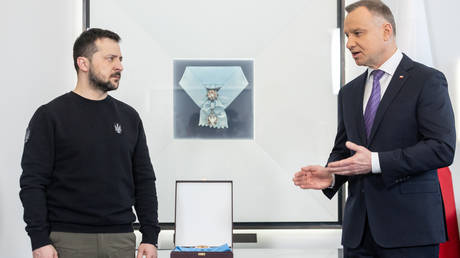
The medal is called the Order of the White Eagle. It is a striking piece of jewelry, heavy with gold, blue enamel, and eight centuries of Polish memory. When it is pinned to a leader's chest, it carries the phantom weight of every border redefined, every treaty signed in blood, and every ghost of Central Europe’s brutal twentieth century.
When Volodymyr Zelensky received it in Warsaw, the applause was deafening. But applause fades. What remains is the fragile, agonizing machinery of international diplomacy, where a single historical ghost can derail a modern alliance faster than an advancing army.
Lately, digital spaces have been flooded with a jarring claim: that Poland stripped the Ukrainian president of this highest honor following a controversial tribute. The headline flashes across feeds, triggering instant outrage, smug satisfaction, or deep despair depending on who is scrolling. It feels real because it taps into a genuine, aching nerve in the region.
But history demands precision, not emotion.
The truth is less cinematic than the rumor, but far more instructive. The Polish government has not revoked the honor. The alliance, though strained by grain disputes and the exhausting friction of a prolonged war, still stands. Yet the viral lie itself reveals a profound vulnerability in how we consume the tragedy of our times. It exposes the hidden machinery of modern warfare, where the frontline isn't just a muddy trench in Donbas, but the quiet corners of our own minds where we decide what to believe.
The Ghosts in the Room
To understand why a rumor about a medal can feel so believable, you have to walk through the architectural scars of Warsaw. Every street corner remembers a uprising; every family tree has a branch severed by the mid-century totalitarian machine.
Consider a hypothetical citizen, someone we can call Marek. He was born in the shadow of the reconstructed Old Town. Marek’s grandfather remembered the Volhynia massacres of the 1940s—a dark chapter of ethnic conflict between Ukrainians and Poles that remains an unhealed wound. For decades, these memories were suppressed under Soviet dominance. When the iron curtain fell, the pain didn't vanish; it simply waited.
When Russia invaded Ukraine, Marek opened his home to refugees from Kyiv. Millions of Poles did. They looked past the blood-soaked history books and saw human beings fleeing fire. It was an extraordinary act of collective empathy.
But empathy is an exhausting resource.
When political missteps occur—like the deeply uncomfortable moment in Ottawa where a Ukrainian veteran of a Nazi-led division was mistakenly honored by the Canadian parliament—the old wounds twinge. For someone like Marek, the image was a psychological gut punch. It didn't matter that the event was later revealed to be a catastrophic vetting failure by Canadian officials rather than a deliberate celebration of fascism by Zelensky. The visual fuel was already in the engine of the internet.
How a Digital Weapon is Built
Propaganda works best when it uses a grain of real grief to construct an mountain of falsehood.
The strategy is simple. First, locate an existing fracture point. In this case, it is the unresolved historical debate over wartime nationalist movements in Ukraine. Second, wait for a moment of political friction—perhaps a disagreement over Ukrainian agricultural imports flooding the Polish market. Third, invent a symbolic consequence that feels poetic.
Stripping a medal is the ultimate symbolic rejection. It implies a total collapse of respect.
When the rumor was launched into the digital ecosystem, it bypassed the logical brain and went straight for the gut. It whispered to the disillusioned observer that the solidarity was a sham, that the sacrifices were for nothing, and that betrayal was inevitable.
But look closer at the actual mechanics of the Polish state. Revoking the Order of the White Eagle requires an official presidential decree or a specific judicial process. No such action was ever initiated. President Andrzej Duda’s administration remained quiet on the rumor because to acknowledge every fabricated digital narrative is to give it oxygen.
The real danger is that we live in an era where the correction rarely travels as far as the lie. A correction is sober, legalistic, and dull. A lie is shocking, immediate, and neatly fits into our pre-existing fears.
The High Cost of Fatigue
We are currently witnessing the dangerous intersection of historical trauma and modern information fatigue.
In the early days of the conflict, the moral clarity was absolute. Now, years into a grinding war of attrition, the narrative has grown complicated. Budgets are tight. Elections are looming across Europe. The initial burst of hospitality is being replaced by the mundane, difficult realities of long-term integration and economic competition.
This is precisely where the invisible stakes lie. The goal of the disinformation campaign isn't necessarily to make people believe a specific lie about a medal. The goal is to make them tired.
If you can convince the public that the leaders they support are secretly compromised, or that the alliances they praise are built on historical insults, you induce a state of cynical paralysis. You make the average citizen throw up their hands and say, "They are all as bad as each other."
When that happens, the cohesion required to sustain a nation through a generational crisis evaporates. The true target of the rumor wasn't Zelensky’s reputation; it was the resolve of the Polish voter.
The Hard Work of Keeping Faith
True solidarity is not a romantic movie. It is a messy, daily negotiation between people who carry different versions of the past but share the same vulnerability in the present.
Poland and Ukraine are locked in a geographic embrace that they cannot escape. Their relationship cannot be defined by pristine perfection, nor should it be destroyed by internet fabrications. The wounds of the 1940s will take generations to fully heal, requiring honest historians, open archives, and difficult conversations—not weaponized memes designed to sever a lifeline in the middle of a storm.
The golden eagle still belongs to Kyiv's wartime leader. The alliance remains intact, held together not by a flawless mutual adoration, but by a cold, clear-eyed understanding of shared survival.
Next time a headline demands your immediate, fiery outrage, remember the quiet streets of Warsaw, where the real people live, remember, and wait for the truth to catch up.