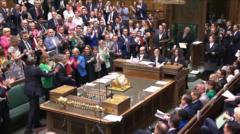
The television cameras love a departure. They love the swell of noise, the theatrical rustle of order papers, and the eventual, inevitable rise of hundreds of politicians clad in charcoal suits clapping for a colleague who is finally leaving the stage.
When Keir Starmer signed off his final PMQs as Leader of the Opposition, the media treated it as a secular sacrament. We were told it was a display of "profound parliamentary respect." Journalists gushed about the dignity of the house. Commentators treated the standing ovation as proof that underneath the tribal warfare, our democratic institutions are fundamentally healthy.
They are lying to you.
That standing ovation was not a triumph of democracy. It was an admission of collusion.
For decades, Westminster has operated on a unspoken contract: mock each other for the cameras, but protect the club at all costs. When you strip away the pomp, the standing ovation is nothing more than the board of directors celebrating a successful run of theater. It is a visual representation of a political class that is entirely insulated from the real-world consequences of its own rhetoric.
If you want to understand why British politics feels broken, you have to stop looking at these moments as signs of healing. You have to start seeing them as the problem.
The Performative Circus of Prime Minister's Questions
Let us dismantle the myth of Prime Minister’s Questions.
We are told PMQs is the crucible of British democracy. It is sold to the public as a weekly masterclass in accountability, where the executive is forced to answer to the legislature.
In reality, PMQs is a low-rent theatrical production. It is a thirty-minute shouting match designed to generate five-second clips for social media and the evening news. It is the only workplace in the country where jeering, shouting down colleagues, and reading pre-scripted insults is not only tolerated but actively encouraged by the management.
Look at the mechanics of the session. The Leader of the Opposition asks a question. The Prime Minister ignores the question, recites a pre-prepared list of his opponent's past failures, and sits down to roaring approval from his backbenches. No information is exchanged. No policy is refined. No accountability is achieved.
I have spent years watching this cycle from the inside. I have sat in rooms where political advisors spend hours drafting "killer lines" that are entirely divorced from any policy reality, solely to get a cheer from the backbenches. It is a game of schoolyard dominance masquerading as governance.
When the session ends with a warm, bipartisan standing ovation, it is the equivalent of actors taking a bow at the end of a play. The anger was fake. The outrage was a pose. The politicians who were supposedly tearing each other apart over public services, the economy, and the NHS five minutes ago are suddenly smiling, shaking hands, and heading to the terrace bar for a drink.
This is not mature politics. It is a farce.
The Illusion of Scrutiny
Why do we accept this? Because the media has a vested interest in maintaining the illusion that PMQs matters.
For political journalists, PMQs is the easiest story of the week. It has a clear narrative arc, a winner, a loser, and plenty of noise. Writing about a complex policy failure in the Department for Work and Pensions requires hours of reading through dry committee reports and interviewing civil servants. Writing about a "clash" at PMQs requires thirty minutes of watching TV and a few tweets.
The public is left with the impression that this is where the real work of government happens. It is not.
If you want actual accountability, you do not look at PMQs. You look at select committees.
In select committees, MPs from all parties sit around a table and question ministers, civil servants, and experts for hours. There are no cameras shouting for attention. There are no jeering backbenchers. The questions are detailed, the answers are scrutinized, and actual policy failures are uncovered.
Yet, select committee hearings rarely make the front page. They do not feature standing ovations. They do not have the theatrical drama that the Westminster press pack craves.
By focusing on the performative nonsense of PMQs, we elevate the least productive aspect of our democracy while ignoring the structures that actually keep the government honest.
The Cozy Cartel and the Loss of Trust
The standing ovation is the ultimate expression of the Westminster bubble. It is a moment where the political class looks inward, entirely forgetting the country they are supposed to serve.
Consider the optics for a voter struggling to pay their mortgage, waiting eighteen months for an NHS appointment, or watching their local high street decay. They tune in to see the people responsible for these issues laughing, joking, and giving each other a round of applause because one of them is moving to a different office.
It signals a profound lack of empathy. It says, "We know we told you the other side was destroying the country, but we did not actually mean it. We are all friends here."
This hypocrisy is what drives the deep-seated public cynicism toward politics. When politicians pretend that the ideological divides are a matter of life and death during election campaigns, but treat parliament as a gentleman's club where everyone gets a pat on the back at the end, they expose their own lack of conviction.
If the policies of your opponents are truly as damaging as you claim during PMQs, you do not stand and applaud them when they leave. You do not treat their departure as a moment of polite consensus. You treat their record with the gravity it deserves.
The standing ovation is an act of mutual absolution. By applauding their opponents, politicians ensure that they, too, will be applauded when their time comes to leave. It is a self-serving ritual designed to sanitize their legacies.
Dismantling the Argument for Bipartisan Civility
Defenders of the parliamentary status quo will argue that civility is essential for a functioning democracy. They will tell you that without these moments of shared respect, politics degenerates into toxic polarization.
This is a false choice.
True civility does not require performative affection. It requires honesty, intellectual integrity, and a respect for the intelligence of the public.
A civil parliament would be one where ministers answer questions directly instead of reciting attack lines. It would be one where the opposition offers constructive critiques instead of hunting for soundbites. It would be one where the rules of debate prevent the childish shouting and jeering that makes PMQs look like a chaotic school assembly.
Applauding a politician at the end of their tenure does nothing to reduce polarization. It merely confirms the suspicion that the hostility of the previous five years was a performance. It suggests that the anger on display during debates was not driven by a passion for the public good, but by a desire to win a rhetorical point.
If we want to fix our political culture, we must demand substance over style. We must stop celebrating the empty rituals of Westminster and start holding our representatives to a standard of behavior that we would expect in any other professional environment.
Stop cheering for the actors when the play is over. The country deserves a better script.


