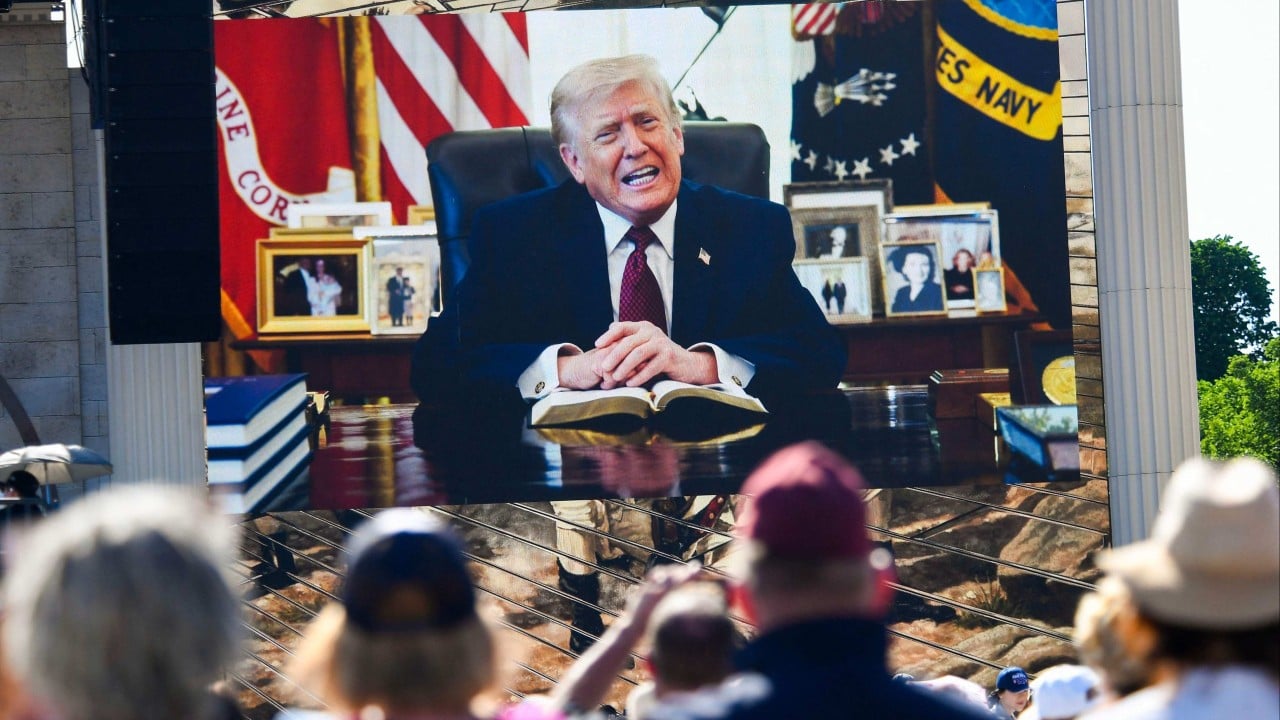
The grass on the South Lawn doesn’t care about politics. It grows precisely the same shade of deep, synthetic green whether the boots walking over it belong to a secular administration or a deeply religious one. But on a humid Tuesday morning, the thousands of people pressing their knees into that damp turf weren’t thinking about the botany of power. They were listening to a low, vibrating hum that started in the throat of a single woman from Ohio and eventually swallowed the entire sound system.
Humming turned into singing. Singing turned into weeping.
History looks different when you are standing in the middle of it, smelling the damp earth and the expensive perfume of Washington insiders mingling with the scent of cheap hairspray from the Midwest. The headlines later described the event as a tactical political maneuver, a calculated bid to shore up a fractured voting base before the midterms. They analyzed the guest list. They counted the prominent evangelical leaders. They parsed the phrasing of the opening remarks for violations of the establishment clause.
They missed the point entirely.
To understand what actually happened on that lawn, you have to look past the podium and the network cameras. Look instead at a man named Thomas. He traveled fourteen hours on a Greyhound bus from a dying coal town in Pennsylvania, carrying nothing but a worn leather Bible and a plastic bottle of tap water. Thomas is sixty-three. His hands are thick, scarred from a lifetime of manual labor, and his eyes have the faded look of someone who has watched his community evaporate piece by piece over thirty years.
Thomas didn't come to Washington to lobby for a bill. He didn't come to protest. He came because he believes, with a fierce and quiet desperation, that the soul of his country is rotting from the inside out, and that the only cure is a collective bending of the knee.
For three hours, the center of American political power looked less like a government seat and more like a frontier tent revival. There were no policy proposals read from the teleprompter. Instead, ancient Hebrew psalms echoed off the neoclassical columns of the Executive Mansion. People fell to their knees on the grass. Some stretched their arms toward the sky, their fingers trembling against the backdrop of the Washington Monument.
It was an undeniable spectacle. A jarring collision of the sacred and the fiercely secular.
The Architecture of Nostalgia
Every mass movement is fueled by a specific kind of longing. In this case, it is the yearning for a foundational myth that may never have existed in the pristine form its defenders imagine.
The speakers who took the stage spoke of a "return." They painted a picture of an early America where faith was the bedrock of every institution, where the founders moved in perfect spiritual synchronicity, and where the nation's early prosperity was a direct result of its covenant with the divine. It is a powerful, comforting narrative. It offers a simple diagnosis for complex modern anxieties: we are suffering because we wandered away from the light.
But history is rarely a straight line, and it is never clean.
The relationship between American power and Christian theology has always been a messy, agonizing tug-of-war. The same founders who invoked the Creator in the Declaration of Independence were deeply suspicious of ecclesiastical authority. Thomas Jefferson famously cut up his New Testament with a razor, removing the miracles to leave only the moral teachings. John Adams explicitly stated in the Treaty of Tripoli that the United States was not, in any sense, founded on the Christian religion.
Yet, the religious impulse is woven into the very fabric of the national identity. You cannot understand the civil rights movement without the rhetoric of the Black church. You cannot understand the abolitionist movement without the burning moral fury of Northern evangelicals. Faith has been the fuel for America's greatest moral leaps, just as it has been used to justify some of its darkest sins.
When thousands of people gather on the White House lawn to "reclaim" those roots, they are choosing a specific version of that history. They are editing out the contradictions. They are looking for a baseline, a solid piece of rock to stand on in a cultural landscape that feels like shifting sand.
Consider the atmosphere in that crowd. As the sun climbed higher, the heat became oppressive. The professional political operatives in their linen suits began to sweat through their shirts, looking uncomfortably out of place among the believers who were entirely lost in prayer. A woman next to Thomas, a schoolteacher from Texas, kept her eyes tightly shut, tears carving clean tracks through the dust on her cheeks.
"We just want God back," she whispered to no one in particular.
That phrase carries an immense weight. It reveals a profound sense of exile. These are people who feel like strangers in the culture they helped build. They look at television, at universities, at corporate boardrooms, and they see a world that speaks a language they do not understand, operating on values they find alien. The mass prayer event wasn't just a religious service; it was a counter-cultural demonstration staged in the very heart of the establishment.
The Hidden Fracture
The real tension of the morning lay in the unstated question hanging over the entire assembly: Who does the land belong to?
To the secular critic, the sight of a mass Christian prayer gathering on the executive lawn is a terrifying transgression. It feels like an encroachment. It looks like the beginning of a system where access to power is mediated by religious conformity. The concern isn't abstract; it is grounded in the lived reality of pluralism. A democracy thrives on the neutrality of its public spaces. When one faith tradition occupies the symbolic center of the state, everyone else is implicitly relegated to the margins.
But the crowd on the lawn sees the exact opposite dynamic at play.
They don't see themselves as conquerors; they see themselves as a remnant. They believe that a aggressive, militant secularism has spent the last half-century systematically purging faith from public life, pushing believers into a corner, and treating their deepest convictions as bigotry or ignorance. To them, standing on that lawn isn't an act of aggression. It is an act of reclamation. It is a way of saying, We are still here. We are part of this story too.
This is the tragedy of the modern American cultural divide. Two groups of people can look at the exact same event and see two completely different realities. One sees a dangerous rise in religious nationalism; the other sees a desperate defense of religious freedom.
The music rose to a crescendo. A famous worship leader, his voice cracking with orchestrated emotion, led the crowd in a song about mercy and healing. The sound rolled across the Ellipse, bouncing off the concrete barriers and the security checkpoints, carried by the wind toward the museums and monuments of the National Mall.
Thomas didn't sing. He stayed on his knees, his forehead pressed against his knuckles. He was praying for his grandson, who is currently serving a sentence in a state penitentiary for possession. He was praying for his town, where the main street is a row of boarded-up windows and fentanyl clinics. He didn't care about the constitutional debate happening in the press tent fifty yards away. His pain was immediate, local, and devastatingly real.
The Mirage of Consensus
Politics is an appetite that is never satisfied. It takes the raw, honest longings of people like Thomas and processes them into data points, voting blocs, and fundraising targets.
By afternoon, the event was over. The crowds filtered out through the security gates, leaving behind crumpled programs, empty plastic water bottles, and patches of flattened grass. The cleanup crews moved in with their rolling bins, working quickly to restore the lawn to its pristine, neutral state before the evening press briefings.
On the bus ride back to Pennsylvania, the air conditioning was broken. The passengers were quiet, exhausted by the emotional output of the day and the sticky summer heat. Thomas stared out the window as the Washington skyline receded into the twilight, the dome of the Capitol building glowing like a white ember against the gathering dark.
He felt a sense of peace, he would later say. He felt that something important had been accomplished, that voices had been heard in the highest places of the earth.
But back in his hometown, the lights were still out on Main Street. The problems that had driven him to his knees remained exactly where he left them, untouched by the prayers on the lawn, indifferent to the rhetoric of restoration. The grass in Washington would grow back by morning, covering the footprints of the faithful, leaving no sign that they had ever been there at all.