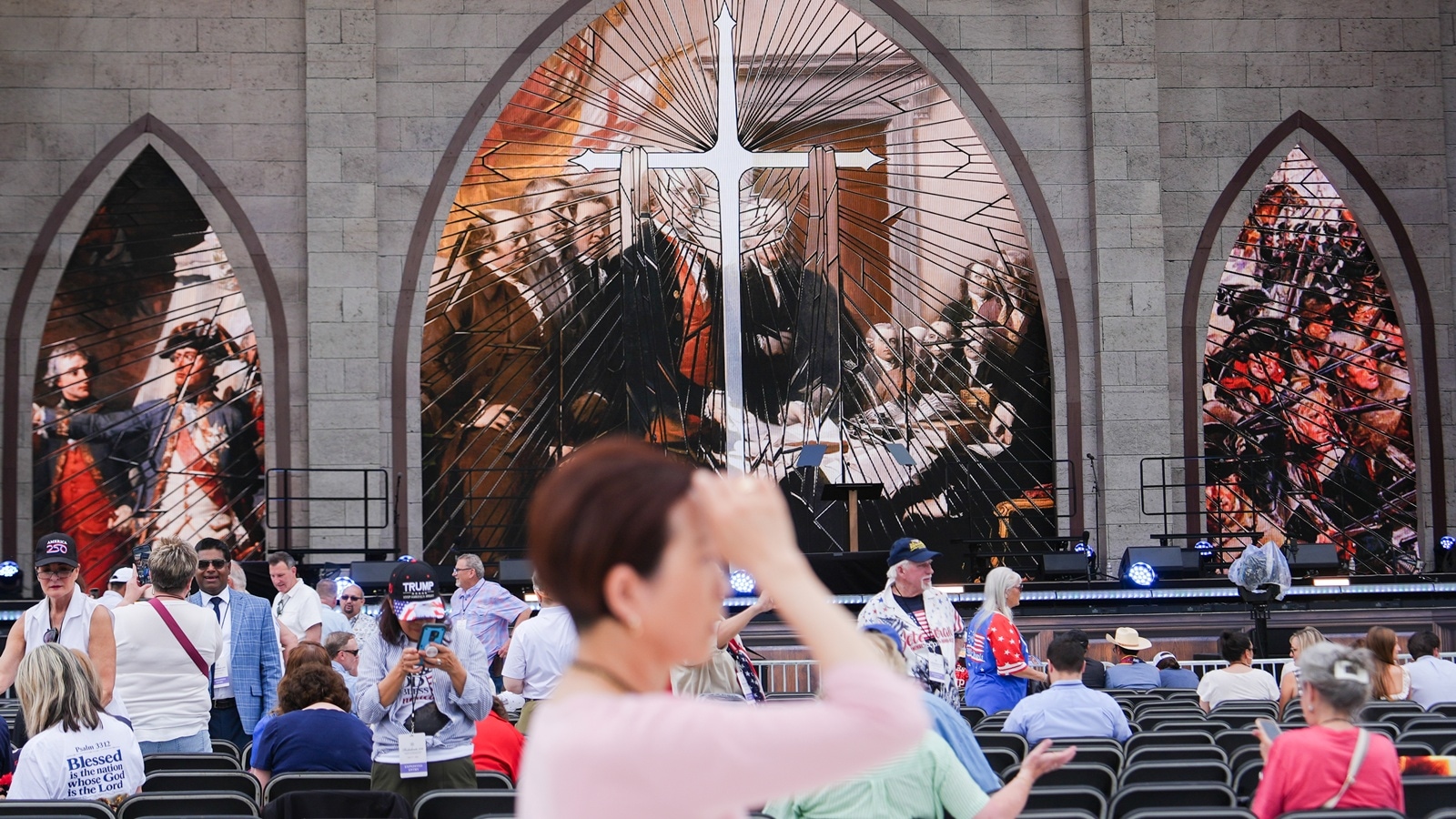
The gravel beneath ten thousand boots sounds like a low, rhythmic grind before the singing starts. If you stand near the base of the Washington Monument just as the autumn sun cuts through the morning haze, the sound is the first thing that hits you. It is not the sound of politics, though the city breathes it. It is the sound of denim rubbing against denim, the heavy sigh of lawn chairs unfolding, and the crinkle of plastic water bottles held in hands that have been calloused by farming, typing, or holding grandchildren.
They came by the busload. They came before the metro stations fully opened their gates.
To the casual observer driving down Constitution Avenue, it looks like another crowd in a city defined by them. Washington, D.C., sees hundreds of these gatherings a year. It is a stage built for grievances. Yet, this particular gathering on the National Mall—framed as an America-themed prayer rally—is different from the angry, fist-shaking demonstrations that usually dominate the evening broadcast.
There are no policy demands here. There are no legislative bills being handed out. Instead, there is an underlying, palpable desperation wrapped in patriotism. It is the collective exhale of thousands of people who believe, rightly or wrongly, that the moral fabric of their home is fraying at the edges, and that the only remaining court of appeal is not the supreme one down the street, but a celestial one.
To understand why a retired teacher from Ohio would spend fourteen hours on a cramped charter bus just to stand on dead grass and pray for a country that often feels deaf to her values, you have to look past the stage. You have to look at the faces in the third row.
The Geography of Faith on the Grass
Consider a hypothetical attendee. We will call her Sarah. She is sixty-two, her knees ache from the damp ground, and she wears a fleece jacket with a small embroidered flag on the lapel. In her hometown, the main street has three empty storefronts and a Methodist church that struggles to fill its pews on Sunday mornings. For Sarah, the news cycle is an endless barrage of alienation. Every headline feels like a memo telling her that the world she helped build is being dismantled.
When she steps onto the National Mall, that alienation evaporates.
Suddenly, she is surrounded by thousands of people who share her specific vocabulary. They speak in the cadence of the King James Bible and the American dream, treating the two texts as if they were written by the same hand. This is the core engine of the mass prayer rally: it is an antidote to the modern epidemic of isolation.
Statistically, the American religious landscape has undergone a massive shift over the last few decades. Data from major demographic studies consistently shows a rise in the "nones"—those who claim no religious affiliation whatsoever. Church attendance nationwide has seen a steady, downward slope. Yet, events like this function as a counter-weight to that data. They are visible, loud proof that while the institutions might be creaking, the impulse to gather under a spiritual banner remains fiercely alive.
The air smells of damp earth and cheap coffee. On the main stage, a preacher yells into a microphone, his voice bouncing off the marble facade of the Lincoln Memorial in the distance. The sound system is massive, turning his whispers into thunders. But the real power of the event is not the man at the podium. It is the murmur that follows his words.
When the crowd is asked to pray, the sound shifts from a collective roar to a soft, oceanic hiss. Thousands of people speaking quietly at once sounds exactly like a incoming tide. Some people close their eyes and tilt their faces toward the grey sky. Others fall to their knees directly onto the dirt, ignoring the stains on their jeans.
The Invisible Stakes of the American Soil
Every monument surrounding this crowd tells a story about sacrifice, war, or statecraft. The Mall is a graveyard of ideas turned into stone. The people gathered here are trying to turn stone back into living ideas.
There is an inherent tension in an America-themed prayer rally. It sits squarely on the fault line between faith and nationalism, a boundary that has always been blurry in the American psyche. To the secular critic, the imagery can look exclusionary or deeply partisan. The flags waving alongside banners bearing the name of Jesus create a visual shorthand that triggers immediate defense mechanisms in an already polarized culture.
But inside the crowd, the perspective is entirely different.
To the people standing on the grass, this is not an act of aggression. It is an act of intercession. They genuinely believe that nations, like people, have souls. They believe that a country can lose its way, become blinded by its own wealth, and break its promises to the divine. The prayers being offered are not just for blessings; they are prayers of repentance.
The historical context here is deep. America was practically founded on the concept of the "Jeremiad"—a type of sermon that laments the moral decline of a society and calls for a return to original virtues. From the Puritans in New England to the Great Awakenings of the eighteenth and nineteenth centuries, Americans have always loved a good public reckoning. This rally is simply the latest iteration of a centuries-old tradition. It is the modern camp meeting, scaled up for the age of mass transit and digital livestreams.
The Sound of the Shift
The day wears on. The sun finally burns through the cloud cover, casting sharp, long shadows across the grass. Security personnel in neon vests stand at the perimeter, leaning against metal barricades. They look bored. There are no counter-protestors here today, no shouting matches across police lines. The event exists in its own self-contained bubble of fervor.
A young man sits on the steps of a nearby museum, watching the rally from a distance. He is not part of it. He has a skateboard resting against his shins and headphones around his neck. He represents the other side of the American ledger—the generation that views these displays with a mixture of confusion and intense skepticism.
To him, the spectacle looks like an artifact from a bygone era. He sees the older demographic of the crowd, the specific style of music playing from the speakers, and the overt mixing of cross and country, and he sees a world that does not speak to his realities. The gap between the skateboarder on the steps and the woman kneeling in the dirt is the real story of modern America. It is a distance that cannot be measured in feet, but in entirely different worldviews.
Yet, for a few hours, that distance does not matter to the people inside the perimeter.
They are caught up in something larger than themselves. A band takes the stage, the acoustic guitars giving way to a swelling, cinematic anthem. The crowd sings. The volume is staggering. It is a song about healing the land, about forgiveness, about a light shining in the darkness.
If you close your eyes, the music carries an undeniable beauty. It is the sound of human hope, raw and unvarnished, stripped of the cynicism that usually infects everything in the nation’s capital. It is the sound of people who want to believe that tomorrow can be better than today, and that they have a role to play in making it so, even if that role involves nothing more than standing still and crying out to the wind.
The Scattered Amen
As the afternoon begins to cool, the energy shifts again. The speakers wrap up their remarks. The final blessings are spoken over the crowd.
Then comes the long, slow dispersal.
The unity of the crowd begins to fracture as people head toward their respective exits. The ten thousand become individual families, couples, and solitary seekers again. They pick up their trash. They fold their chairs. The grass where they stood is flattened, stamped down by thousands of shoes, leaving a temporary map of where the crowd had been deepest.
Sarah walks back toward her bus, her joints stiffer now than they were at dawn. She carries a small plastic flag she bought from a vendor, its edges slightly frayed from the wind. Her phone is buzzing with messages from home—mundane news about groceries, weather, and family drama. The reality of her small town is waiting for her at the end of a long highway.
She looks back one last time at the Mall. The stage is already being dismantled, crew members rolling up thick black cables and packing away the microphones. The giant speakers are silent.
Nothing in Washington has physically changed. The Capitol dome still sits silently at the end of the avenue. The politicians are still trading barbs behind closed doors. The news cycle will continue its relentless, exhausting grind tomorrow morning.
But as Sarah steps onto the bus and the door histrionicly wheezes shut, she is not thinking about the politicians or the headlines. She is thinking about the sound of the tide on the grass. She is carrying the memory of that collective whisper back to a town that feels entirely too quiet. For her, and for thousands like her, the capital was not a place of power today. It was a place of prayer, and that, she believes, is the only power that ultimately lasts.