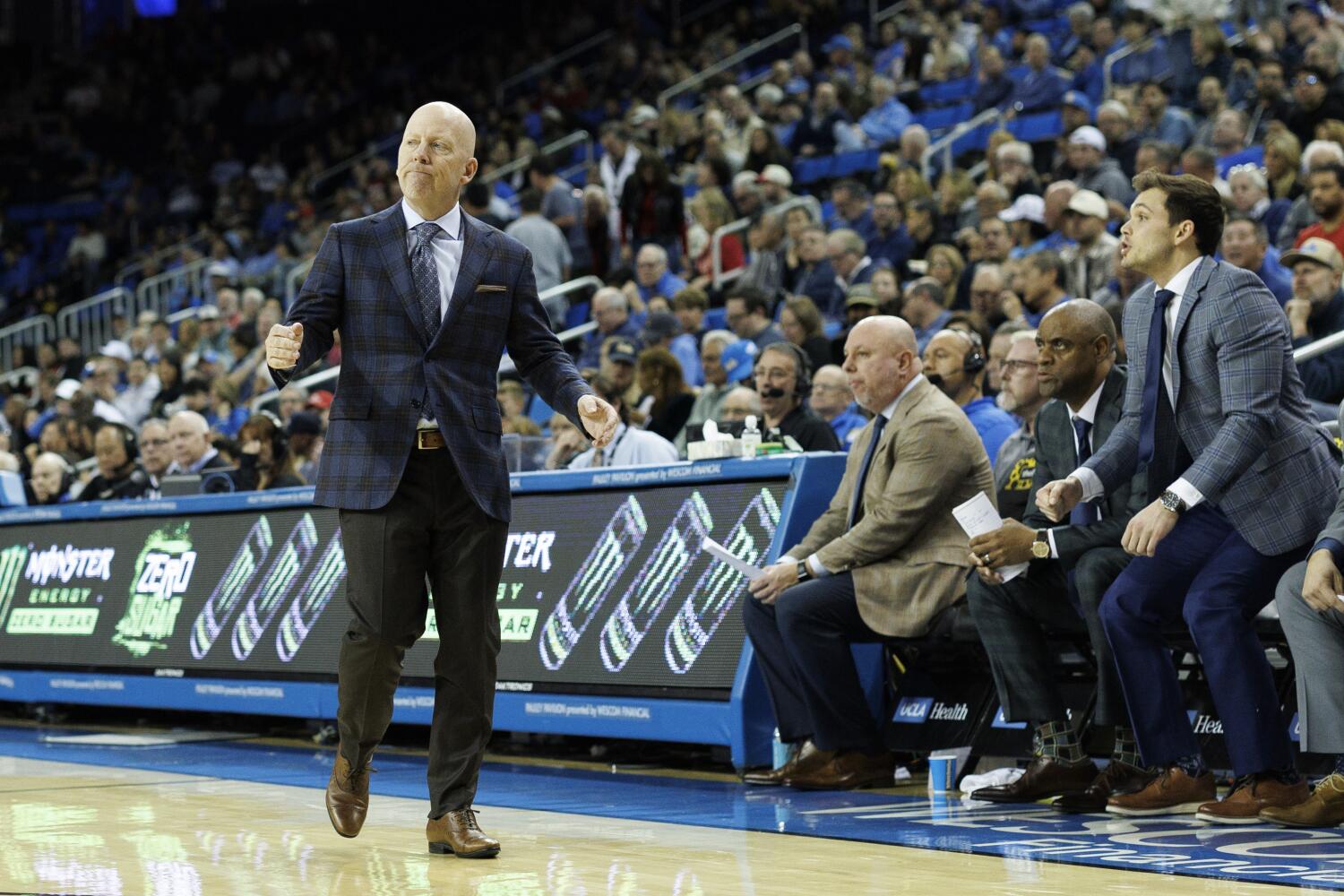
The air inside Pauley Pavilion used to feel different. It wasn’t just the smell of floor wax or the muffled squeak of high-end sneakers. It was a weight. A golden, atmospheric pressure that reminded every teenager in a blue-and-gold jersey that they were playing in a cathedral built on the back of ten championships in twelve years. When you walk under those banners, you aren’t just playing basketball. You are curated. You are part of a legacy of "The Pyramid of Success," a philosophy that demanded as much from a man’s character as it did from his jump shot.
Then there is Mick Cronin.
To watch a UCLA game today is to witness a slow-motion car crash of branding. On one side, you have the four letters—UCLA—which represent the pinnacle of West Coast elegance and athletic royalty. On the other, you have a head coach who spent much of the current season treated like a pressure cooker with a stripped valve.
The boiling point didn't happen during a blowout loss or a missed defensive assignment. It happened in the quiet, sterile confines of a post-game press conference. Following a particularly grueling stretch, Cronin didn't just critique the play; he turned his frustration toward the very institution that signs his checks, grumbling about the lack of "NIL" (Name, Image, and Likeness) funding and the "brutal" reality of modern recruiting.
He apologized later. Sort of. He claimed his words were "misinterpreted" or born of "frustration." But in the high-stakes theater of Los Angeles sports, an apology is often just a script read by a man who knows the cameras are still rolling.
The Myth of the Hard-Nosed Savior
When Cronin arrived from Cincinnati, the pitch was simple: UCLA had grown soft. The Bruins needed a grit-and-grind architect to strip the stucco off the program and find the concrete underneath. For a while, it worked. A Final Four run buys a lot of silence. It makes the screaming on the sidelines look like "passion" and the berating of players look like "accountability."
But winning is a deodorant. It masks the scent of a culture that is slowly rotting.
Consider a hypothetical freshman. We’ll call him Leo. Leo grew up in Crenshaw, dreaming of the flashy, fast-break "Showtime" DNA that once defined Southern California hoops. He chooses UCLA because he wants to be part of that storied lineage. Six months in, Leo finds himself being publicly dismantled by his coach after a turnover. He isn’t being taught; he’s being used as a lightning rod for a coach’s ego.
In the modern era of the transfer portal, Leo doesn't stay. He leaves. And he tells his friends not to come.
This is the invisible tax of the Cronin era. It isn't just the wins and losses, though those have become increasingly lopsided. It is the erosion of the UCLA "vibe." This isn't Cincinnati. This isn't a program that survives on being the underdog with a chip on its shoulder. This is the house that John Wooden built. Wooden, a man who famously never swore and told his players that "the main ingredient of stardom is the rest of the team."
Cronin’s brand of leadership feels less like a pyramid of success and more like a fortress under siege.
The NIL Smoke Screen
The most damning part of the recent friction isn't the shouting. It’s the excuses.
The "we don't have enough money" defense is a curious one for a program that resides in one of the wealthiest donor pockets on the planet. To hear Cronin tell it, the Bruins are essentially a mid-major program trying to compete with the giants of the Big Ten and the SEC with nothing but pocket change and good intentions.
It's a deflection.
NIL money follows excitement. It follows a vision. Donors don't open their wallets for a coach who spends his Tuesday nights complaining that his players aren't good enough or that the system is rigged against him. They invest in excellence. They invest in the "Blue Standard."
When a leader begins to blame the tools instead of the craftsmanship, the foundation is already gone. The reality is that other programs with fewer resources and less historical gravity are out-recruiting UCLA because they offer something Cronin currently cannot: a culture that players actually want to inhabit.
The Loneliness of the Westwood Sideline
There is a specific kind of silence that happens in a legendary arena when the fans stop being angry and start being indifferent.
Anger is good. Anger means they still care. Anger means they believe the program is capable of more. Indifference is the death knell. It’s the empty seats in the lower bowl. It’s the alumni switching the channel to watch a mid-season NBA game instead of their alma mater.
The argument for keeping Cronin usually boils down to stability. "Who else are you going to get?" the defenders ask. It’s a fear-based logic. It’s the same logic that keeps people in bad marriages and failing businesses. It ignores the fact that the cost of staying the same is often higher than the risk of changing.
The stakes aren't just a seed in the NCAA tournament. The stakes are the identity of the most important basketball program west of the Mississippi.
If you lose the "UCLA-ness" of UCLA, what do you have left? You have a mediocre team with an expensive coach who looks like he’d rather be anywhere else.
The Ghost in the Rafters
Basketball in Los Angeles has always been about more than the score. It’s about a certain aesthetic. It’s about the sun through the windows and the feeling that you are watching the future of the game unfold in real-time.
Under Cronin, the game feels heavy. It feels like work. Not the good kind of work that leads to a championship, but the soul-crushing kind of work that happens in a cubicle under fluorescent lights.
The apology for his comments about the program's struggles was a band-aid on a bullet wound. It didn't change the underlying truth: Mick Cronin appears to be a man who has lost his affection for the job, and in turn, the job has lost its affection for him.
You can’t bully your way to greatness in 2026. You can’t scream at 19-year-olds until they become stars, and you certainly can’t complain your way into a national title.
The banners hanging in Pauley Pavilion don't just commemorate wins. They are reminders of a standard. They represent a time when the man at the front of the room was a teacher, a mentor, and a steward of something larger than his own win-loss record.
When you walk out of the arena these days, the cool night air of Westwood feels a little thinner. The lights aren't as bright. The ghost of John Wooden hasn't left the building, but he’s definitely stopped watching the game.
He’s looking at the exit. Maybe it’s time everyone else did, too.
The four letters on the jersey deserve better than a coach who treats the program like a burden he's forced to carry. They deserve someone who understands that being a Bruin isn't about the grind. It’s about the grace.
The lights are dimming on the Cronin era, and no amount of backpedaling or public relations maneuvering can change the fact that the magic is gone. You can apologize for what you said, but you can't apologize for who you've become.
Westwood is waiting for a reason to cheer again.
It’s waiting for someone who realizes that the most important part of the UCLA legacy isn't the trophies in the lobby, but the spirit of the people who put them there.
Until that person arrives, the silence in Pauley Pavilion will only get louder.
The banners are still there, but they’ve never felt further away.