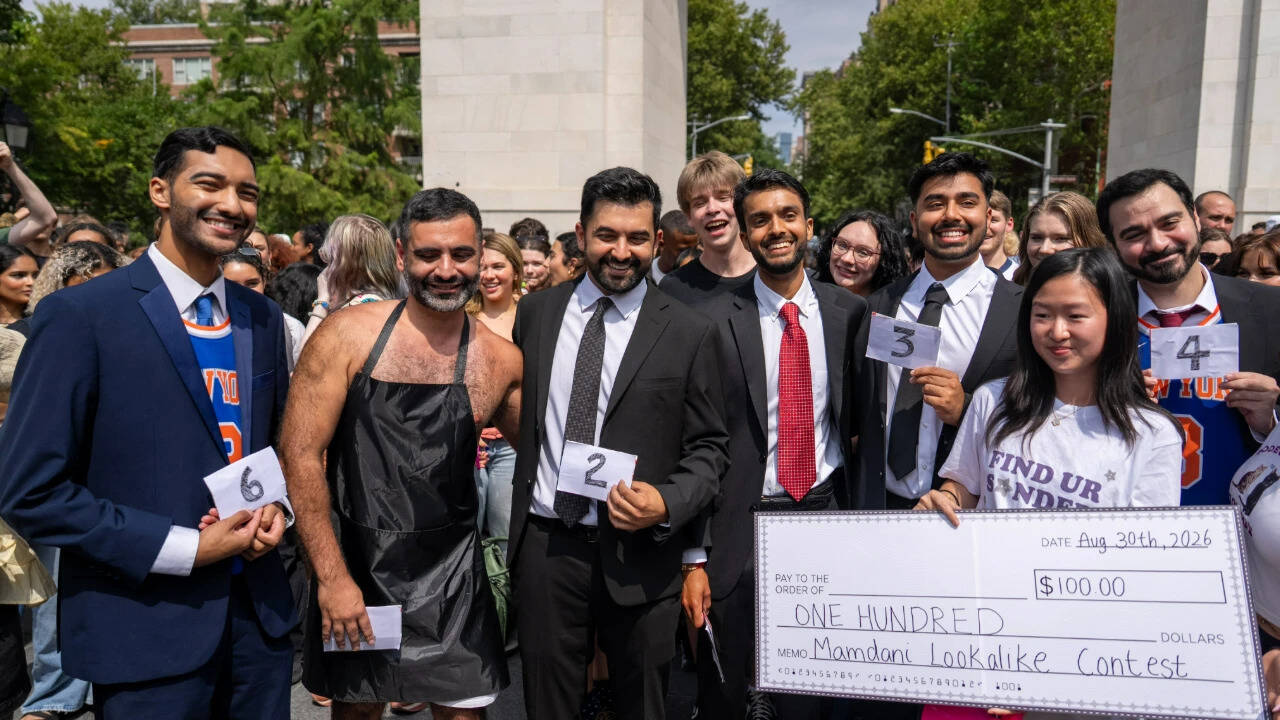
Hundreds of spectators crowded the asphalt just outside Washington Square Park on a Sunday afternoon to witness nine men compete for a hundred-dollar cash prize by impersonating New York City Mayor Zohran Mamdani. The event, sponsored by a social media application called Sonder, quickly outgrew its initial footprint when local police officers requested the crowd disperse from inside the park due to a missing event permit. Undeterred, the assembly shifted boundaries, the contestants lined up, and a rowdy public spectacle unfolded.
Actor and comedian Amadeo Fusca secured the crown by pairing a formal blazer with a New York Knicks jersey, mimicking a celebratory outfit worn by the mayor following an NBA Finals victory. Contestants cycled through various iterations of the municipal executive's publicly documented aesthetic. One wore the brown suit from the 2025 mayoral campaign trail. Another donned an apron over a bare chest, channeling an artifact from a 2019 rap video recorded during Mamdani's musical era. The judging criteria relied entirely on crowd applause after each participant named a preferred local slice of pizza.
This phenomenon represents more than a viral afternoon in Manhattan. It marks a sharp pivot in how urban electorates interact with political power. Doppelgänger competitions used to be reserved for Hollywood actors or rock stars. Translating that energy onto municipal leadership exposes a distinct cultural shift. Mayors are no distant figures operating behind mahogany desks. They are memeified, scrutinized daily on short-form video feeds, and dressed up for weekend amusement.
Political identity in the contemporary urban center functions as a shared pop-culture text. When an elected official becomes the subject of look-alike contests, the boundary between governance and entertainment dissolves completely. Citizens do not merely vote for policy platforms anymore. They consume the entire lifestyle package of the politician. The tailored suits, the silver rings, the bicycle safety gear, and the casual sports fandom transform into marketable props.
The Mechanics of Viral Public Theater
Public parks in New York have a long history of hosting spontaneous gatherings that mock or celebrate institutional authority. Yet the recent wave of look-alike events carries a different structural DNA. These happenings are engineered for digital distribution from their inception. A platform sponsors the gathering. Micro-influencers and local performers arrive with cameras rolling. The physical crowd serves as a live-action studio audience for content destined to populate algorithmic feeds across the city before evening falls.
For Fusca, the victory at Washington Square Park was the logical extension of a burgeoning performance career. Months prior, friends and strangers began pointing out his striking resemblance to the newly elected mayor. Instead of ignoring the coincidence, he headed to a local barber on the morning of the election victory, adjusted his haircut, shaped his facial hair, and leaned into the likeness. What began as casual street-level double-takes rapidly scaled into professional parody work for variety shows and digital sketches.
This commercialization of political resemblance reveals a strange economic reality. Public figures generate an orbit of auxiliary gravity. People who share a jawline or a hairline with a prominent leader can monetize that genetic accident through social media algorithms that reward hyper-specific local novelty. The mayor's office becomes an accidental casting agency.
Critics often dismiss these spectacles as frivolous distractions from serious municipal governance. Housing crises, transit deficits, and budget shortfalls demand sober legislative focus. Yet ignoring these cultural ripples misses how modern political legitimacy is actually maintained. A mayor who enters the cultural bloodstream deeply enough to inspire satirical street pageantry has achieved a tier of public saturation that traditional press releases can never buy.
The Politics of Access and Public Space
The logistical friction that forced the contest out of Washington Square Park highlights an ongoing tension within urban centers. Public squares are legally designated as open forums, yet the bureaucratic reality of permits, police oversight, and crowd control frequently clashes with spontaneous civic expression. An assembly of hundreds watching men argue about pizza slices requires municipal management, even when the entire exercise is absurd.
The intervention of the New York Police Department was swift but non-confrontational. Officers noted the absence of a proper park permit, and the organizers simply moved the crowd a few yards across the boundary line into the surrounding streetscape. The show continued without interruption. This minor bureaucratic shuffle serves as a neat metaphor for urban living. The rules exist, the enforcement happens, and the populace simply adapts its coordinates to keep the momentum going.
The contestants themselves represented a cross-section of urban voyeurism. They were not political operatives or deep-pocketed donors. They were everyday residents who understood the visual shorthand of the current municipal administration. Dressing up as the mayor requires studying the minutiae of modern political signaling. The exact cut of the tie, the particular angle of the frames, the casual inclusion of a bicycle helmet after a round of public criticism—all of these elements are cataloged and reproduced for public appraisal.
When the winner was finally declared by measuring the decibels of neighborhood applause, the prize money totaled a modest hundred dollars. The real return on investment was intangible. It was the collective dopamine hit of a neighborhood momentarily seizing the image of its chief executive and turning it into a punchline.
The Evolution of Executive Satire
Satire aimed at municipal leaders has evolved from printed broadsheets and editorial cartoons into live participatory theater. Mayors have always been targets of public ridicule, but the loop is now instantaneous. An official policy decision or a minor wardrobe choice is weaponized by the public within hours.
This dynamic alters the psychology of those who hold high office. Governing a major American city has never been comfortable, but doing so under the perpetual gaze of an electorate that treats your personal aesthetic as raw material for public comedy requires a thick skin. Every public appearance is scrutinized not just for policy implications, but for its potential as a future Halloween costume or TikTok sketch.
The proliferation of these events suggests that urban residents are searching for new ways to reclaim agency in a dense, heavily regulated environment. City life can feel impossibly complex, dominated by vast transit systems, impenetrable zoning laws, and distant bureaucracies. Gathering in a public square to watch ordinary citizens pretend to be the mayor is a way of cutting through that complexity. It shrinks the scale of government down to a street corner, a pair of silver rings, and a debate over the best slice of New York pizza.
The crowd eventually dispersed into the late afternoon humidity, leaving the pavement empty of look-alikes and cameras. Yet the framework remains firmly established. As long as municipal leaders occupy the center of the cultural stage, the public will find new ways to step into their shoes, quite literally, and test what it feels like to carry the weight of the city.