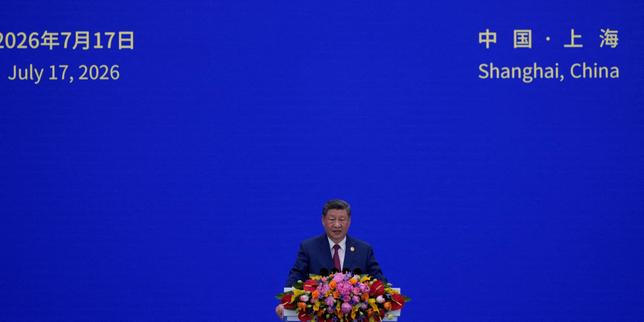
Beijing just threw down the gauntlet in the global tech war, and it didn't involve banning another American microchip company. Instead, Chinese President Xi Jinping used the World Artificial Intelligence Conference in Shanghai to pitch a completely alternative world order for software development.
The headline move? The official launch of the World Artificial Intelligence Cooperation Organisation, or WAICO. Twenty-nine countries have already signed up, including heavy hitters like Brazil, Indonesia, Pakistan, and Russia.
If you think this is just another empty bureaucratic talking shop, you're missing the bigger picture. This is a direct, calculated assault on American tech dominance. While Washington builds walls around its proprietary models, Beijing is positioning itself as the champion of cheap, open-source technology for the rest of the world.
Here is what is actually happening behind the scenes, why the Global South is buying into it, and what it means for the future of commercial tech.
The Strategy Behind WAICO
Washington has spent the last few years leaning hard into export curbs and trade blockades, effectively trying to build an "AI Iron Curtain" to keep advanced chips and software out of Chinese hands. The American strategy relies heavily on Pax Silica, a security-first framework uniting allies like Japan, the UK, Australia, and India to control critical tech supply chains.
China's response isn't to build a higher wall. It's to build a broader field.
Xi called the development of artificial intelligence a "symphony of international cooperation" rather than a solo act. Translated from diplomatic speak, that means China wants to lead a coalition of nations that are tired of being locked out of Silicon Valley's closed ecosystems.
WAICO, headquartered in Shanghai, aims to establish global governance standards that don't originate in Washington. By recruiting 29 founding member states across ASEAN, the African Union, and Latin America, Beijing is creating a ready-made market for its tech stack.
Why the Global South is Turning Left
Western tech leaders frequently push for centralized international safety agencies to govern model deployment. To a developing nation, that sounds like a cartel designed to keep the best tools in the hands of a few wealthy corporations.
China is exploiting that fear. Xi compared artificial intelligence to the steam engine and electricity, promising to share datasets and tech breakthroughs with developing nations to avoid what he labeled "new historical injustices".
It is a highly effective pitch. Consider the concrete promises Beijing just put on the table:
- Five thousand AI training and seminar opportunities for developing nations over the next five years.
- The rollout of localized training centers across major geopolitical blocs.
- Immediate access for 30 countries to a highly advanced, Chinese-developed meteorological tool for early weather warning systems.
When a country like Indonesia or Senegal looks at the landscape, they see two options. They can wait for heavily restricted, expensive proprietary models from American firms—models that Washington can pull from their market at any moment due to national security claims, just as they did with Anthropic models recently. Or they can adopt open-source Chinese alternatives that are cheaper to run and come with state-backed infrastructure investments.
The Open Weight Trap
The commercial tech sector is witnessing a massive vibe shift. For a long time, the narrative was that China was simply copying American technology, hopelessly starved of the high-end Nvidia chips needed to compete.
That narrative is dead. Chinese open-source and open-weight models are rapidly closing the capabilities gap with American labs.
Right as WAICO launched, Beijing startup Moonshot AI dropped Kimi K3, currently the largest open AI model by parameter count globally. This follows recent open-source drops like Zhipu’s GLM-5.2 and the wildly popular DeepSeek models.
Western enterprises are already noticing. Businesses in Europe and Asia are quietly switching to Chinese models for basic infrastructure. Why? Because they are dirt cheap, incredibly capable, and easier to deploy on private servers.
When the Trump administration briefly banned the export of certain American frontier models last month, it spooked foreign executives. Even though Washington backtracked after Silicon Valley complained, the damage was done. It proved to global businesses that relying entirely on US-hosted clouds is a massive operational risk. China is standing right there, ready to catch them with open-source alternatives.
Red Lines and Reality Checks
Don't buy into the utopian rhetoric completely. Beijing’s love affair with open-source is a geopolitical weapon, not a sudden commitment to radical transparency.
There's a massive internal tension in China's strategy. The government wants to export open models to win global influence, but it also has an incredibly strict domestic censorship regime. Rumors are already swirling that Beijing is weighing restrictions on overseas access to certain homegrown models to keep a tighter grip on data security.
Furthermore, Xi spent a significant portion of his Shanghai speech talking about safety, stating bluntly that "AI systems must remain under human control". He called for early-warning and emergency-response protocols to stop autonomous software from evading human oversight.
This isn't just fluff. It shows China is terrified of the same loss-of-control scenarios that keep Western researchers awake at night. But by framing safety through WAICO, China gets to set the rules of the road for 29 other nations, bypassing Western consensus entirely.
What To Do Next
If you are managing a tech stack or planning a long-term software roadmap, you can no longer ignore the parallel ecosystem emerging out of Asia.
Audit your dependencies. If your entire operational infrastructure relies on proprietary US APIs, you are exposed to sudden regulatory shifts, export bans, or geopolitical retaliations.
Start testing leading open-weight models from Chinese labs alongside your current deployments. Evaluate them for cost, local deployment ease, and raw performance. Understanding how to run these alternative systems isn't just a way to cut your compute bill anymore. It's a vital diversification strategy for an increasingly fractured world.