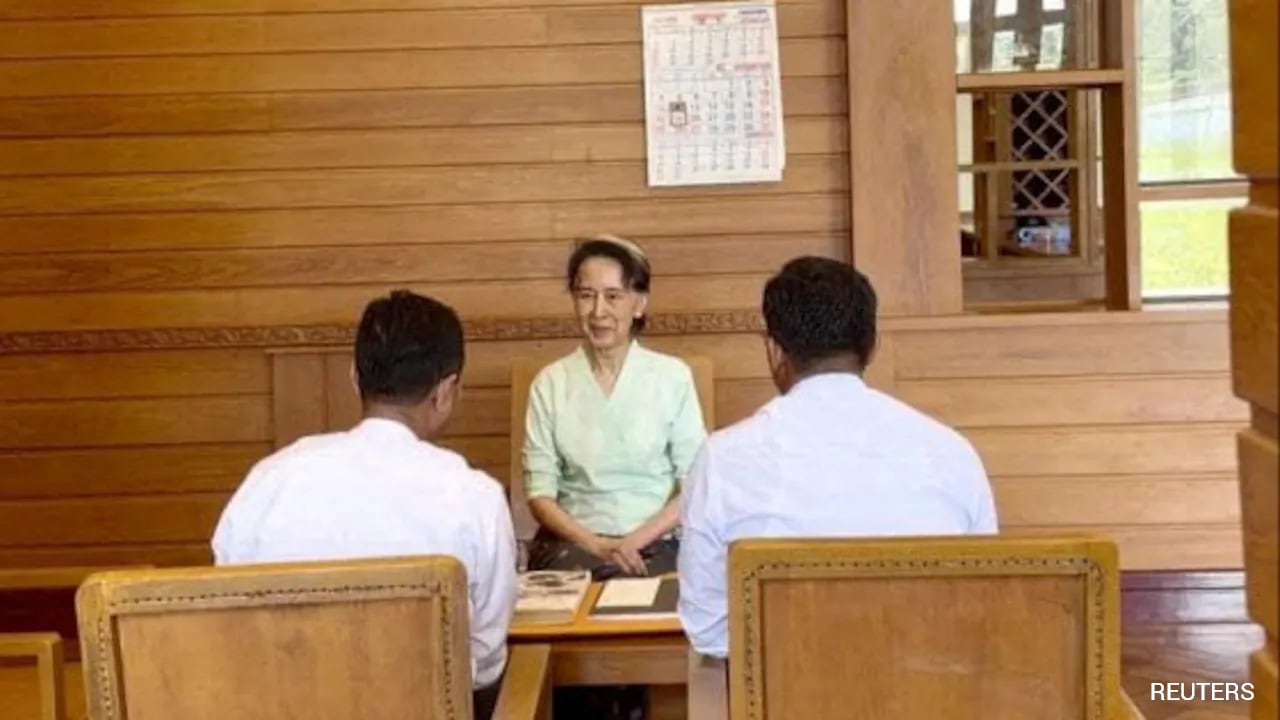
Five years of silence break over a telephone line. Instantly, half the internet treats it like a plot twist.
It isn't. It's a stage direction.
When a headline announces that Aung San Suu Kyi's son has spoken with her for the first time in more than five years, the lazy consensus rushes straight to the same sentimental script. Reunited after half a decade. Proof of life. A sign of softening. A crack in the junta's wall.
Feelings don't govern Myanmar. Power does.
I have watched analysts, diplomats, and commentators burn through credibility for decades by treating charismatic icons as if they were omnipotent chess grandmasters trapped behind a velvet rope. They confuse moral authority with operational leverage. They confuse visibility with control. Worse, they treat every scrap of access granted by a military regime as a spontaneous outbreak of mercy rather than a calculated move on a board the regime thinks it owns.
Let's strip away the melodrama and look at what a five-year gap followed by a single phone call actually tells us about power, captivity, and why the usual questions people ask about this moment are the wrong ones.
The Lazy Consensus Around "Proof of Life" and Softening
Whenever a high-profile detainee resurfaces through a family call, the standard media reaction follows a predictable arc. First comes relief. Then comes speculation about backroom deals. Then comes the quiet hope that isolation is ending.
That reading mistakes a tactical gesture for a strategic shift.
In authoritarian politics, access is a spigot, not a floodgate. A regime that has held a political leader in prolonged isolation—following a coup and years of harsh detention—does not suddenly hand over a telephone because its conscience woke up. Information control is core infrastructure for any military junta. Every word exchanged, every minute allowed, every channel permitted passes through a filter designed to serve the captor's interests first.
Consider what five years of separation actually means in political terms. Five years is not a pause button. In a fast-moving civil conflict, five years is an entire era of realignment. Resistance factions reorganize. Younger generations take up arms who barely remember pre-coup politics on their own terms. Neighbors recalibrate trade and border security. Diasporas splinter and regroup.
Treating a phone call between a mother and her son as a direct line back to the center of Myanmar's political gravity assumes the center never moved. That assumption is lazy. And dangerous.
A family call can carry real human weight while carrying almost zero structural power. Confusing the two is how observers get blindsided.
Defining Terms Before Anyone Gets Carried Away
Half the confusion around Aung San Suu Kyi starts with sloppy vocabulary. People toss around words like influence, legitimacy, and leverage as if they are synonyms. They aren't.
Legitimacy is recognition or moral standing in the eyes of citizens or external actors. Even under detention, a historic figure can retain immense symbolic weight among supporters.
Leverage is the ability to compel another actor to change behavior or pay a cost. A prisoner in custody has almost zero coercive leverage over her jailers.
Influence sits in the middle—the capacity to shape decisions, morale, or alignment without holding a gun or a ministerial seal. Influence erodes when communication is severed for years and re-emerges only under controlled conditions.
When commentators ask, "Does this mean Suu Kyi is back in play?" they usually mash all three terms into one mushy concept. Being talked about is not the same as calling plays. Being loved—or fiercely debated—is not the same as commanding armed brigades on the ground or dictating terms to generals in Naypyidaw.
Imagine A Scenario Where...
Imagine a scenario where a military leadership faces mounting pressure on multiple fronts: economic strain, contested territory, restless ranks, and diplomatic frost. A senior advisor suggests allowing a tightly monitored call with an estranged or distant family member abroad.
Why would a hardline regime do that?
- To test reactions: Watch who panics, who celebrates, and who starts chasing rumors of a grand bargain.
- To project control: Show the world—and domestic audiences—that the state decides when the door cracks open and when it slams shut.
- To fracture unity: Even subtle hints of negotiation or moderation can trigger fierce arguments among opposition factions trying to hold a hard line.
- To buy breathing room: Keep analysts staring at a phone line instead of looking at frontlines, supply chains, or troop movements.
Notice that none of those motives require the regime to surrender a single ounce of real power. A phone call is cheap. Surrender isn't.
Why People Ask The Wrong Questions
When news breaks about Suu Kyi's son speaking with her after more than five years, search behavior clusters around a few predictable questions. Most of them miss the point.
"Does this mean she will be released soon?"
That question treats detention like a timer running down toward a predictable buzzer. Political imprisonment doesn't work on a kitchen clock. Detainees are released when keeping them locked up costs more than letting them out—or when releasing them under specific constraints serves a broader objective. A phone call tells you nothing about that cost-benefit calculation except that the regime felt comfortable permitting contact now.
"What does this mean for Myanmar's democracy movement?"
It means the movement still has to do the hard work itself. Movements built solely around one figure—no matter how iconic—are fragile when that figure is cut off for half a decade. Over the past several years, resistance on the ground has evolved far beyond ballot-box politics and single-leader deference. A phone call doesn't erase armed struggle, ethnic alliances, local governance experiments, or generational divides. If a movement's strategy rises or falls on a single voice from behind bars, it isn't ready for what comes next.
"Is the military junta trying to negotiate?"
Permitting family contact is not the same as opening formal political negotiations. Regimes use "humanitarian" or "family" gestures all the time as low-cost signals without conceding any political ground. Calling every signal a negotiation is like calling a wave a handshake.
What Veteran Observers Get Wrong—And Get Right
I have spent enough time watching high-stakes political standoffs to know that veterans of the field don't all agree, and the best ones don't pretend to have crystal balls.
Scholars of authoritarianism and Southeast Asian politics—figures like David Steinberg, who spent decades analyzing Burma's political cycles and military institutions, alongside newer generations of researchers tracking post-coup armed resistance—have repeatedly shown how deeply entrenched military power structures are and how perilous it is to read wishful thinking into surface gestures. When seasoned analysts look at an event like this, they ask cold, unromantic questions: Who authorized it? Who monitored it? What changed on the ground five minutes after the call ended?
Nothing changed on the ground five minutes after the call ended.
Still, I should admit the blind spot in my own cold-eyed stance. Focusing strictly on power mechanics and regime calculus can make an analyst sound cynical—or worse, blind to genuine human endurance. Five years without speaking to your mother is an eternity for any family. Pretending human emotion doesn't exist in politics is just another form of bad analysis; people fight, grieve, hope, and organize because they are human, not spreadsheets.
The trick is refusing to let empathy masquerade as intelligence. You can care deeply about a family reconnecting after five years without inventing geopolitical fairy tales around it.
How To Read News Like This Without Getting Played
If you track international crises, political prisoners, or authoritarian regimes, stop reacting to single headlines in isolation. Treat every dramatic update as a data point that must earn its weight.
- Separate human milestones from power shifts: A family reunion or first call in years is a human milestone. Unless accompanied by verifiable changes in custody, law, or territory, treat it as a human story first and a political breakthrough only if evidence forces you to.
- Audit who benefits from the narrative: Ask which actor gains advantage if the public believes a secret deal is brewing, if opposition groups argue with each other, or if outside powers pause pressure to "see how things play out."
- Track structural indicators over symbolic ones: Watch troop deployments, border crossings, sanctions enforcement, local administration, and economic lifelines. Symbols shift easily; structures move slowly and tell the truth.
- Build strategies that don't depend on a single figure: Whether you're analyzing a country, leading an organization, or managing a crisis, single-point-of-failure leadership is a vulnerability. Resilience comes from distributed capability, clear principles, and realistic expectations.
A son finally hears his mother's voice after more than five years. That is real. Everything else people project onto that call is up for debate—and most of it won't survive contact with reality.
Hang up the wishful thinking and watch the levers of power.