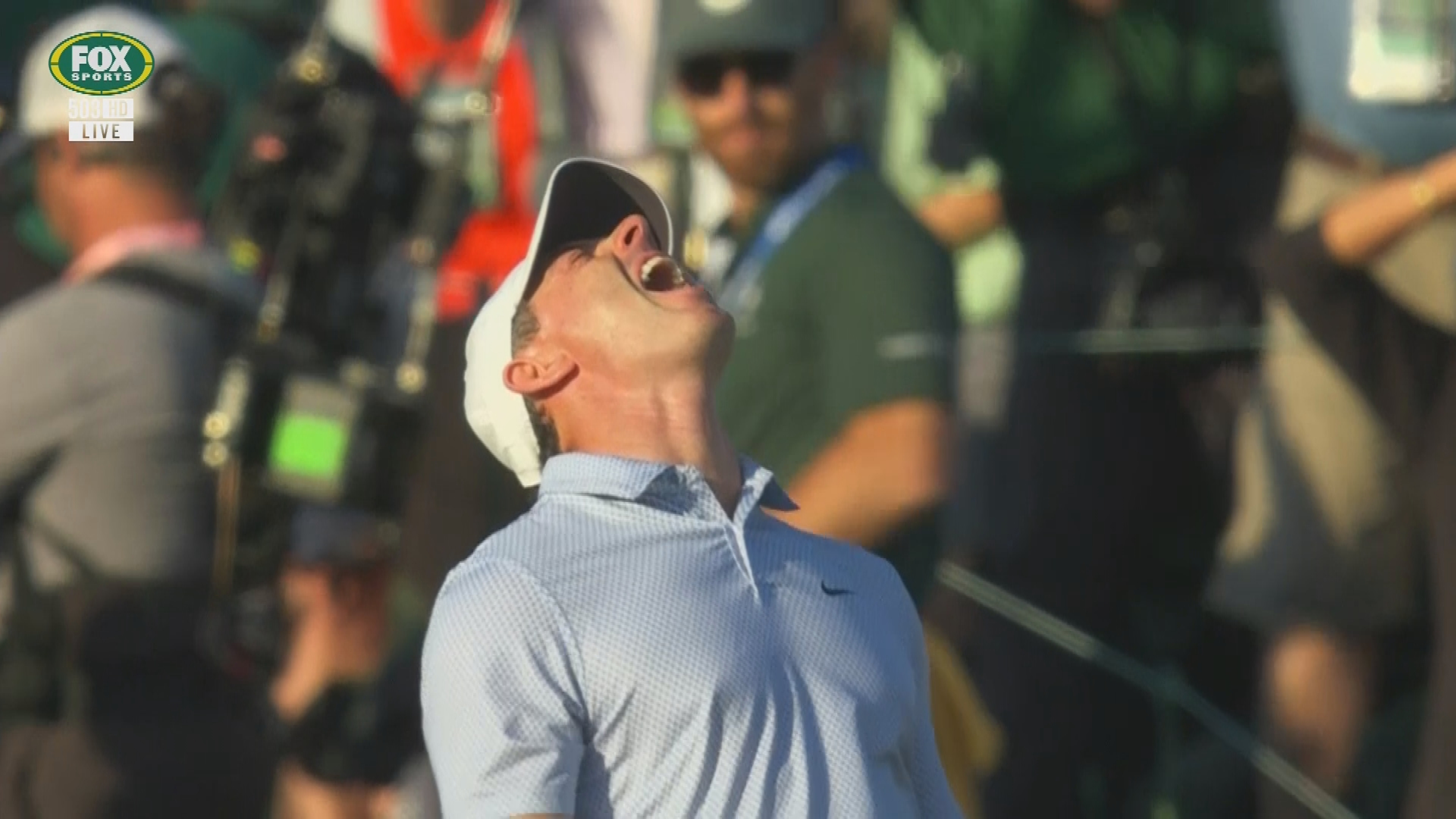
Rory McIlroy stood on the eighteenth green at Augusta National, the Georgia sun dipping low enough to turn the pine needles into shards of copper. He didn't look like a man who had just conquered the most exclusive cathedral in sports for the second year in a row. He looked like a man who had finally stopped running.
For a decade, the Masters wasn't just a golf tournament for McIlroy. It was a recurring nightmare. Every April, he arrived with the weight of the Career Grand Slam pressing against his ribs, a burden so heavy it seemed to physically shorten his backswing. We watched him collapse in 2011. We watched him chase shadows in the years that followed. We saw the polite, pained smiles in the Butler Cabin as he watched someone else slip into the silk-lined sleeves of a Green Jacket. Discover more on a related issue: this related article.
Then, something broke. Or perhaps, something finally healed.
The McIlroy who walked off the course this Sunday—clutching a second consecutive title—is a different creature than the boy who once wept on a long-distance call to his mother after a Sunday 80. He has reached a state of competitive grace that golfers usually only find in dreams or retirement. He is free. But to understand how he got here, you have to understand the specific, suffocating brand of torture that is leading a tournament at Augusta. Additional reporting by CBS Sports delves into comparable views on this issue.
The Silence of the Pines
Imagine standing in a cathedral where the congregation is forbidden from checking their phones. There are no scoreboards within sight of certain tee boxes. You are left with nothing but your pulse and the terrifyingly precise feedback of the wind through the trees.
At Augusta, the pressure doesn't come in a sudden wave; it leaks in. It’s the way the ground feels too firm under your spikes. It’s the way the gallery goes silent before you even reach for a club. For ten years, McIlroy fought that silence. He tried to outrun it with 340-yard drives and aggressive lines over water hazards that would make a sane man tremble. He was trying to force the universe to give him what he felt he was owed.
The shift didn't happen in a gym or on a practice range. It happened in the quiet spaces between tournaments. McIlroy began to talk openly about the fact that golf—this game that had defined his identity since he was a toddler in Holywood, Northern Ireland—was not the sum total of his soul. He stopped treating the Masters like a life-or-death trial and started treating it like a walk in the woods.
That sounds like a cliché. It isn't. In a sport where a fraction of a millimeter at impact determines whether a ball finds the hole or a watery grave, the difference between "trying" and "doing" is everything.
The Anatomy of the Repeat
Winning once is a feat of skill. Winning twice in a row is an act of psychological warfare.
Coming into this week, the history books were stacked against him. Only three men had ever defended a Masters title: Jack Nicklaus, Nick Faldo, and Tiger Woods. That’s the list. That’s the entire pantheon. To join them, McIlroy had to navigate a Saturday afternoon where the wind whipped through Amen Corner like a spiteful spirit.
On the eleventh hole—a long, brutal par four where dreams go to die—his ball hovered over the edge of the pond. A younger, more desperate Rory might have tried to nip a wedge off the muddy bank, risking a triple-bogey that would have derailed his momentum. Instead, he took his medicine. He chipped out. He took the bogey. He smiled.
That smile was the most dangerous thing on the golf course. It signaled to the rest of the field that their best shots wouldn't rattle him. He wasn't playing against Scottie Scheffler or Jon Rahm anymore. He was playing against the ghost of his own past, and he was winning.
Consider the math of the back nine. While his competitors were grinding their teeth, calculating every leaf that blew across the line of their putt, McIlroy was whistling. He hit seventeen of eighteen greens in regulation. It was a display of technical brilliance, yes, but it was fueled by an internal lightness. When the tension is highest, the muscles usually tighten. The "yip" is a physical manifestation of a mental fear. But Rory’s stroke remained fluid, a long, languid pendulum that defied the gravity of the moment.
The Invisible Stakes
Why do we care so much about a wealthy man hitting a white ball into a hole?
We care because McIlroy represents the struggle we all face: the battle to forgive ourselves for our failures. Every person watching has a "2011" in their life—a moment where they had the prize in their grasp and watched it slip away because of a momentary lapse in nerve. We watched Rory fail publicly, repeatedly, and painfully.
His back-to-back victories aren't just about golf. They are a case study in the power of letting go. By finally accepting that he might never win the Masters, he paradoxically made it impossible for himself to lose. He stripped the tournament of its power to hurt him.
The gallery felt it. The "Rory" chants that echoed through the tall pines weren't just cheers for a champion; they were roars of recognition. People were watching a man who had been through the fire and come out the other side without the smell of smoke on his clothes.
As he stood on the eighteenth green, the shadow of the clubhouse stretching long across the grass, he looked at his caddy and longtime friend, Harry Diamond. There was no frantic celebration. There was no collapsing in relief. There was just a nod.
The Weight of the Jacket
The Green Jacket is a strange garment. It is objectively ugly—a specific, jarring shade of rye-grass green that matches nothing else in a man’s wardrobe. It is made of a heavy wool blend that is far too warm for a Georgia spring. Yet, it is the most coveted piece of clothing on the planet.
For years, that jacket was a straightjacket for McIlroy. It represented the one thing he couldn't have, the one gap in a trophy case that was otherwise overflowing. By winning it twice, he hasn't just filled the gap. He has rewritten the narrative of his entire career. He is no longer the "best player to never win a slam at Augusta." He is the master of the grounds.
The sun has set now over the clubhouse. The patrons have drifted away, leaving the course to the crickets and the ghosts of Jones and Hogan. Somewhere in the locker room, Rory is folding that green sleeves over his arm.
He isn't rushing. He isn't looking over his shoulder. He is finally standing still, and for the first time in a long time, the world is perfectly quiet.