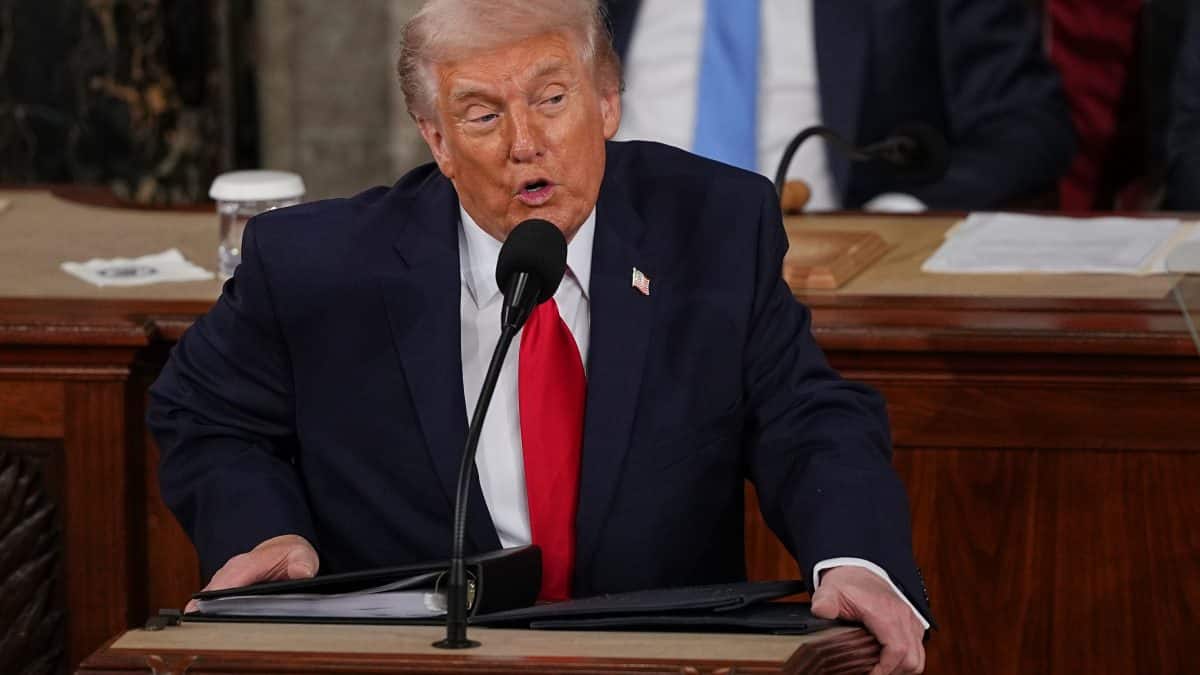
In the high-stakes theater of the 2026 State of the Union, President Donald Trump stood before a fractured Congress and issued a warning that shifted the trajectory of American foreign policy. He claimed that Tehran was "working on missiles that will soon reach" the United States, a terrifying prospect that served as the primary justification for the massive joint U.S.-Israeli military operation, Epic Fury, launched on February 28. Yet, as the smoke clears over Tehran and Isfahan, a stark disconnect has emerged between the White House’s rhetoric and the quiet, evidence-based assessments of the American intelligence community.
The central premise of the administration’s case for war rests on the "immediacy" of an Iranian Intercontinental Ballistic Missile (ICBM) threat. However, senior officials within the Defense Intelligence Agency (DIA) and the Office of the Director of National Intelligence (ODNI) indicate that no such shift in capability has actually occurred. The most recent unclassified DIA assessment, finalized in late 2025, remains the gold standard for those who track Persian hardware. It concludes that Iran is at least a decade away—specifically citing 2035—from fielding a militarily viable ICBM capable of striking the American heartland.
The Physics of Exaggeration
To understand why the "soon" in the President’s speech lacks technical backing, one must look at the brutal physics of long-range rocketry. Building a missile is one thing; making it survive the return to Earth is another. Iran has undeniably made strides with its Space Launch Vehicle (SLV) program, such as the Simorgh and the Zuljanah. These rockets can reach the altitudes required for space, but they lack the sophisticated Re-entry Vehicles (RVs) needed for a weapon.
An ICBM must endure the localized hell of re-entering the atmosphere at speeds exceeding Mach 20. Without a heat shield capable of protecting a warhead from temperatures that melt steel, the missile simply incinerates miles above its target. Experts at the Institute for Science and International Security point out that while Iran has mastered liquid-fuel engines, it has shown no evidence of the advanced material science required for a functional RV. Even with technical "shortcuts" potentially provided by partners in North Korea or China, the most optimistic intelligence estimates for a working Iranian ICBM still hover around an eight-year minimum.
The Missing Intelligence Link
The friction between the West Wing and Langley isn't just about timelines; it's about the existence of the data itself. Sources familiar with the classified briefings provided to the "Gang of Eight" congressional leaders confirm that no "smoking gun" report was presented in the weeks leading up to the strikes.
When Secretary of State Marco Rubio was pressed on the President’s specific claims, his response was telling. Rather than confirming the "soon" timeline, he pivoted to a broader, more abstract threat. Rubio argued that Iran is on a "pathway" and that their space launches prove "it’s possible" for them to develop the technology one day. This is a classic rhetorical bridge: transforming a theoretical future capability into an active, present danger to justify preemptive action.
The Preemption Trap
The administration’s shift toward a "preemptive defensive" posture is a page taken directly from the 2003 Iraq playbook, yet the technical landscape has changed. In 2026, the justification isn't just about what Iran has, but what it might do with its existing regional arsenal.
It is true that Iran possesses the largest and most diverse missile force in the Middle East. Their Shahab-3 and Khaibar-Shekan missiles can easily range Israel, U.S. bases in Qatar and Bahrain, and even parts of Eastern Europe.
| Missile Class | Estimated Range | Status |
|---|---|---|
| Short-Range (SRBM) | 300 - 700 km | Fully Operational |
| Medium-Range (MRBM) | 1,000 - 2,500 km | Mass Produced |
| Space Launch (SLV) | Orbital | Dual-use Tech |
| Intercontinental (ICBM) | 5,500+ km | Non-existent |
The administration’s logic, briefed by a senior official on condition of anonymity, suggests that the U.S. could not "sit back and wait to get hit first" by these conventional, regional missiles. By conflating the very real regional threat with a phantom ICBM threat to the American mainland, the White House created a sense of domestic urgency that the intelligence community simply could not verify.
Contradictions in the Rubble
There is also the matter of the "obliterated" nuclear facilities. During the announcement of Operation Epic Fury, the President claimed that previous June 2025 strikes had already wiped out Iran’s nuclear capabilities. If that were the case, the urgency of the February 2026 strikes becomes a logical paradox. Internal White House documents from late 2025 used the term "significantly degraded" rather than "obliterated," admitting that Tehran was already rebuilding its enrichment centrifuges at Fordow and Natanz.
This pattern of linguistic inflation—where "degraded" becomes "destroyed" and "a decade away" becomes "imminent"—suggests a policy driven by desired outcomes rather than hard intelligence. The military reality on the ground is now a chaotic exchange of fire across the Persian Gulf, with U.S. Fifth Fleet HQ in Bahrain and al-Udeid airbase in Qatar coming under direct Iranian retaliatory fire.
The gap between the intelligence community’s sober 2035 projection and the administration’s 2026 casus belli is more than a clerical error. It is a fundamental disagreement on the nature of threat assessment. When the "why" of a war is built on a technical capability that the nation's own experts say does not exist, the "how" of the resulting conflict becomes much harder to justify to a public that remembers the cost of "faulty intelligence."
The missiles raining down on the Middle East today were launched to stop a threat that, by all objective accounts, was still ten years in the making.
Would you like me to analyze the specific technical hurdles Iran faces in miniaturizing a nuclear warhead for their existing medium-range missiles?