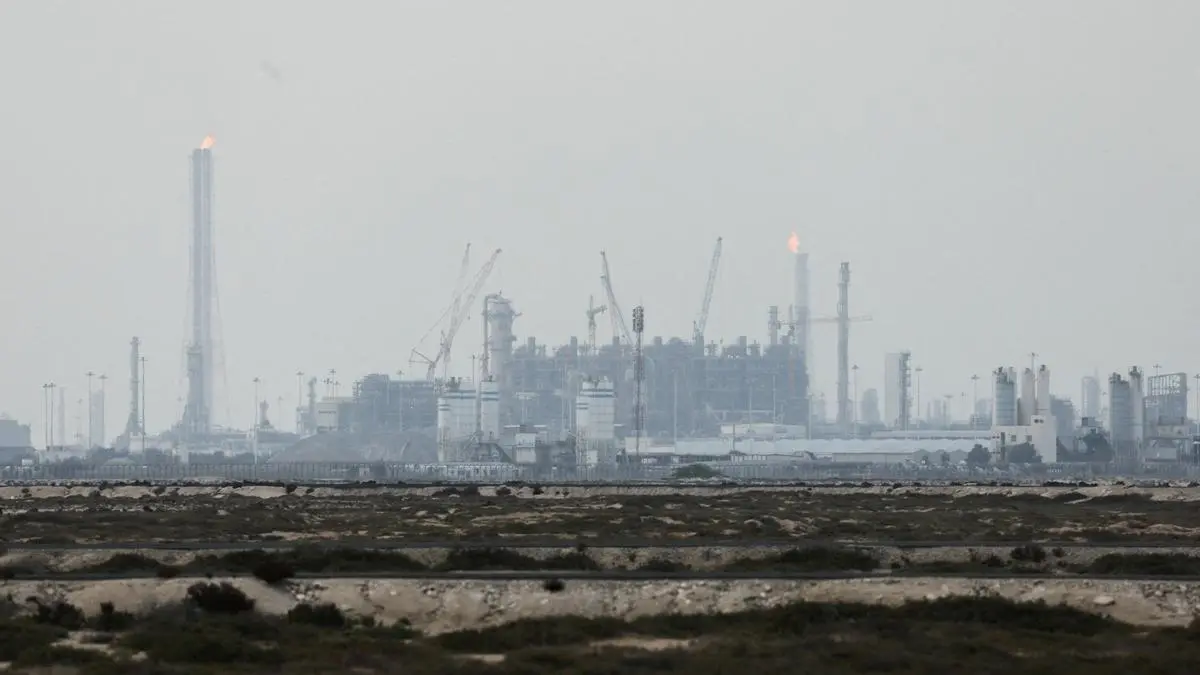
The steel joints of the Ras Laffan industrial complex do not scream when they break. They groan. It is a low-frequency vibration that most humans can’t hear, but the sensors—thousands of them—feel it instantly. When the pressure dropped in the primary liquefaction train of Qatar’s massive gas facility last Tuesday, it wasn't just a local mechanical failure. It was a puncture in the jugular of global energy.
For a moment, the sky over the Persian Gulf turned a bruised violet as the safety flares roared to life, venting billions of cubic feet of gas that could no longer be processed. In the high-tech control rooms of Doha, technicians watched red lines cascade across their monitors. They saw the flow stop. What they couldn't see, however, were the invisible ripples traveling six thousand kilometers east, toward the crowded kitchens of Mumbai and the glass-walled boardrooms of New Delhi.
Qatar is not just a country. For India, it is a life-support system.
The relationship is built on a series of underwater pipelines and massive cryogenic tankers that ferry Liquefied Natural Gas (LNG) across the Arabian Sea. India imports nearly half of its gas from Qatar. It is the fuel that powers the buses in the capital, the fertilizer that feeds the wheat fields of Punjab, and the blue flame under the chai kettle in a billion homes. When Qatar stutters, India loses its breath.
The Anatomy of a Shockwave
Consider Ravi. He is a hypothetical composite of the millions of small-scale entrepreneurs in India’s industrial belt. He runs a glass-molding workshop in Firozabad. His furnaces require a steady, unblinking flow of gas to keep the molten silica at exactly $1200^{\circ}C$. If the temperature drops by even a few degrees because the supply pressure wavers, the glass clouds. If the gas stops entirely for an hour, the molten mass solidifies inside the machinery, effectively bricking his entire livelihood.
Ravi doesn't track Middle Eastern geopolitics. He doesn't know the specific serial number of the turbine that failed in Ras Laffan. But he knows that his "spot price" for fuel—the gas he buys when his long-term contracts run dry—just doubled in a single afternoon.
This is the fragility of the modern energy grid. We have built a world that functions on the assumption of "just in time" delivery. We don't store energy anymore; we stream it. Like a movie on a digital platform, the moment the connection flickers, the picture freezes.
The attack on the Qatari facility, reportedly a coordinated drone strike targeting the cooling towers, was a masterclass in modern sabotage. It didn't need to level the city. It only needed to disrupt the cooling process. Without cooling, gas cannot be turned into liquid. If it isn't liquid, it cannot be loaded onto ships. The ships sit idle. The sea becomes a parking lot for billions of dollars in stalled heat.
The Geometric Cruelty of the Market
Markets are often described as rational, but in moments of crisis, they behave like panicked animals.
India’s energy security is a delicate math problem. The country consumes roughly 160 million standard cubic meters of gas every day. A significant portion of this is tied up in long-term contracts with fixed prices. However, about 30% to 40% is bought on the "spot market." This is where the volatility lives.
When the Qatari supply dropped by an estimated 15% following the facility strike, the global spot market didn't just rise by 15%. It spiked by 60%. Traders in London and Singapore, sensing a shortage, began outbidding each other for the few remaining cargoes at sea. India, a price-sensitive buyer, suddenly found itself competing with wealthy European nations who were also looking to fill the Qatari void.
The math for the Indian government becomes brutal. Do they subsidize the cost of gas to keep Ravi’s furnaces running, or do they let the price pass through to the consumer? If they subsidize, the national deficit balloons. If they don't, inflation ripples through the vegetable markets. Fertilizer is made from gas. High gas prices mean expensive urea. Expensive urea means a farmer in Bihar spends more to plant his crop. Six months later, a mother in Chennai pays more for a bag of rice.
Everything is connected. The drone in the desert is the reason the rice costs more in the city.
The Ghost in the Machine
The technical reality of the Ras Laffan disruption is a lesson in the complexity of $LNG$ technology. To turn gas into a liquid, it must be cooled to $-162^{\circ}C$. This requires a staggering amount of energy and precision.
$$PV = nRT$$
The Ideal Gas Law isn't just a classroom memory; it is the rulebook by which these facilities live and die. When the pressure ($P$) or volume ($V$) is manipulated through a physical strike, the temperature ($T$) fluctuates violently. The "trains"—the massive cooling units—are so sensitive that a sudden shutdown can cause metal fatigue that takes months to repair.
We often think of energy as a commodity, like gold or wheat. But gas is different. It is a service. It requires a continuous, unbroken chain of mechanical perfection. The "invisible stakes" here aren't just about the price of a gallon of fuel. They are about the trust we place in a global infrastructure that is increasingly vulnerable to "asymmetric warfare"—where a drone costing $5,000 can cause $500 million in damage and disrupt the lives of 1.4 billion people.
The Pivot to the Unpredictable
For years, India has been trying to diversify. It has looked to Australia, the United States, and Mozambique. But geography is a stubborn thing. Qatar is close. The shipping lanes are short. The infrastructure is already there. Breaking up with Qatari gas is like trying to change the foundation of a house while the family is still living in it.
The real story isn't the explosion. It's the silence that follows.
It’s the silence of a factory floor in Gujarat where the shift has been canceled because the fuel is too expensive. It’s the silence of a government official staring at a spreadsheet, trying to find the money to cover the gap. It's the silence of the Arabian Sea, where the great tankers usually hum with the sound of progress, now floating still, waiting for the smoke to clear in the desert.
We are entering an era where "energy security" is no longer a buzzword for policy papers. It is a visceral, daily anxiety. The strike in Qatar exposed the nerves of the global economy, showing us exactly how thin the skin is.
We sit in our brightly lit rooms, clicking switches and turning knobs, rarely considering the thousands of miles of steel and the delicate cryogenic balances that keep the darkness at bay. We assume the fire will always be there when we strike the match. But out in the dunes of Ras Laffan, among the twisted pipes and the cooling towers, we have been reminded that the flame is not a right. It is a fragile, hard-won miracle.
The smoke has mostly dissipated now. The repairs have begun. Engineers are swarming the site with blueprints and welding torches, determined to restore the flow. But the price tickers in Mumbai haven't returned to their previous levels. The uncertainty has been priced in. The world has looked at the invisible thread and realized how easily it can be cut.
Ravi stands at his furnace in Firozabad. He looks at the blue flame. It is steady for now. But he keeps his hand near the valve, watching, waiting for the flicker that tells him the world has changed again.
The next time a light goes out, don't look at the bulb. Look at the horizon.