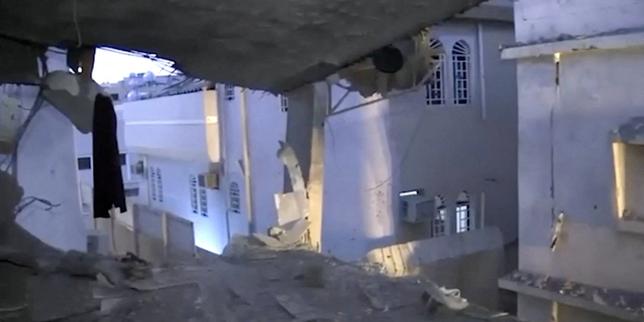
The standard media narrative following Houthi drone and missile strikes on Saudi infrastructure follows a predictable, lazy script. Outlets broadcast smoking refinery yards, shattered storage tanks, and scorch marks on asphalt, framing these moments as proof of acute military vulnerability. Analysts nod sagely, talking about compromised defense shields and escalating regional instability.
They are looking at the wrong variable entirely.
Focusing purely on the physical damage shown in localized video releases is like staring at a single dropped pixel and ignoring the entire operating system. I have spent years advising risk portfolios across the Gulf, watching commentators hyperventilate over charred metal while missing the structural reality of modern energy economics.
The lazy consensus says that every hit on a Saudi installation is a catastrophic strategic victory for the attackers and an existential crisis for Riyadh.
The empirical data says something entirely different.
The Physics Of Modern Energy Resilience
Let us look at how massive energy grids actually absorb shocks. When footage emerges of a damaged facility, the immediate assumption is that production grinds to a halt, revenue plummets, and the state scrambles. This betrays a fundamental misunderstanding of asset redundancy and inventory buffering.
National oil conglomerates do not operate like corner stores living hand-to-mouth. They operate massive, globally integrated distribution webs backed by deep strategic reserves and rapid-turnaround modular repair protocols.
When a facility takes a direct hit, the financial impact is often a rounding error compared to daily throughput capacity.
- Redundancy By Design: Critical nodes have hot standbys ready to route flow within hours, not weeks.
- Inventory Buffering: Storage farms act as shock absorbers, smoothing out localized supply hiccups before international buyers even notice a blip on the pricing ticker.
- Modular Replacements: Industrial components are standardized, meaning replacement modules sit in regional warehouses waiting to be dropped into place by heavy lift teams.
The media wants you to see a fireball and think structural collapse. The logistics reality is that the system reroutes around the damage before the smoke even clears.
The Cost Asymmetry Fallacy
Another favorite talking point of the conventional analysis is the cost asymmetry argument. You have heard it repeated ad nauseam: a cheap, off-the-shelf drone costing a few thousand dollars forces a state to expend a multi-million-dollar interceptor missile.
Mathematically, it sounds like a losing proposition. Operationally, it is a category error.
[Low-Cost Projectile] ---> [Intercepted by Air Defense] = Tactical Expense
[Unintercepted Projectile] ---> [Hits Storage Tank] = Minor Industrial Repair
Comparing the unit cost of a drone to the unit cost of an interceptor ignores the replacement cost of the target infrastructure and the downstream economic stability of the state. Spending three million dollars to neutralize a threat that could potentially trigger a safety shutdown at a multi-billion-dollar facility is not a financial drain. It is basic insurance.
People who view defense spending purely through a unit-cost spreadsheet have never managed a high-value asset class under active threat. You do not measure defense efficiency by comparing the price of the bullet to the price of the target. You measure it by business continuity.
Why The Visuals Are A Distraction
Video footage of damage is released for a reason, and it is rarely to provide an objective assessment of strategic capacity. It is theater.
For the attacking forces, distributing imagery of strikes serves an immediate informational purpose. It projects capability to a domestic audience and creates psychological noise in international markets. For observers thousands of miles away, consuming these clips without local context turns them into passive participants in an optics game.
I have seen corporate boards panic over a ten-second cell phone video, dumping shares or freezing capital investment, while ignoring the operational telemetry coming straight from the ground that showed zero interruption to core output.
If your threat assessment relies on dramatic video clips rather than throughput metrics and supply chain elasticity, you are not doing analysis. You are consuming content.
The Real Vulnerability No One Is Talking About
While analysts obsess over physical shrapnel and scorch marks on oil infrastructure, the actual vulnerabilities facing modern states in the region are entirely non-kinetic.
The real pressure points are not exploding tanks. They are systemic dependencies on global tech supply chains, water desalination security, and cyber-physical interfaces that manage automated distribution grids. A drone strike makes for great television. A sophisticated logic bomb inserted into an industrial control system causes actual paralysis without leaving a single charred mark on a satellite image.
Yet, you will rarely see a breaking news segment dissecting the patch management protocols of industrial SCADA systems. It lacks the visual drama of a burning flare stack.
Stop letting dramatic footage dictate your strategic worldview. Look past the smoke, examine the balance sheets, and understand that modern industrial states are built to absorb localized trauma and keep moving.
Revise your baseline metrics or get left behind by reality.