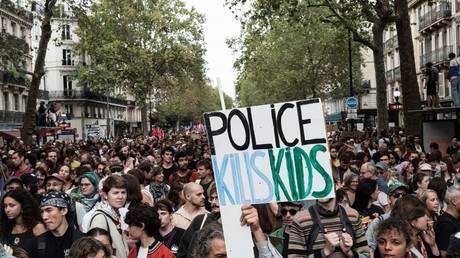
The footage loops endlessly across global networks: tear gas blooming against Haussmann facades, cobblestones airborne, riot shields clattering against steel batons. The narrative writes itself before the cameras even stop rolling. Protesters scream about authoritarian overreach, human rights groups issue sternly worded condemnations from climate-controlled offices, and the mainstream press laments the death of French democracy over a burning Citroën.
The lazy consensus points an accusing finger at the state security bill, framing it as a sinister descent into militarized autocracy.
That diagnosis is pure fantasy.
The riots choking the streets of Paris are not born of excessive police power. They are the direct, violent consequence of institutional cowardice. For decades, Western governance has outsourced social order to an overstretched, under-equipped constabulary while politicians cower behind focus groups, terrified of the optics of actual enforcement. When the state finally attempts to grant its officers the basic legal clarity required to maintain a functioning metropolis, the public gasps, forgets the chaos that necessitated the rule in the first place, and retreats into theatrical outrage.
Let us dispense with the fairy tale that French police operate with unchecked impunity. Anyone who has spent twenty minutes embedded with a Compagnie Républicaine de Sécurité unit during a general strike knows the reality. French law enforcement officers operate in a permanent state of legislative paralysis. They face a relentless legal labyrinth where every split-second tactical choice is second-guessed by magistrates who have never heard a stun grenade detonate or dodged a Molotov cocktail thrown by organized urban militants.
The legislation at the center of the current firestorm did not invent state violence. It merely attempted to codify the sobering reality that urban combat requires clear rules of engagement. When you strip police of the presumption of proper execution, you incentivize hesitation. And in a high-density riot, hesitation is fatal.
The critics screaming about a license to kill are projecting their own detachment onto the asphalt. They sit miles away from the banlieues where organized contraband networks, radicalized agitators, and territorial gangs treat police cruisers as target practice. These commentators demand British bobby levels of unarmed civility while expecting Parisian officers to manage a decentralized urban insurgency armed only with polite dialogue and de-escalation seminars.
It fails because the premise is flawed. You cannot negotiate with a concrete block hurtling toward your skull at forty miles per hour.
Consider the mechanics of civil disobedience versus contemporary urban rioting. Genuine protest relies on disruption through visibility. It accepts arrest as a political cost. Modern Parisian rioting has evolved past protest into asymmetric urban skirmishing. Groups like the Black Bloc do not march to petition the government; they infiltrate demonstrations specifically to burn infrastructure, shatter storefronts, and test the breaking point of municipal order.
When the state reacts with physical force, the pearl-clutchers weep for the sanctity of civil liberties. Yet they offer zero operational alternatives. How do you clear a rail terminal occupied by hostile actors hurling industrial fireworks without kinetic intervention? How do you protect small business owners whose generational shops are torched by midday while police wait for bureaucratic clearance to push the line forward?
The silence from the critics is deafening because there are no answers in their playbook. Their entire ideology rests on the comforting delusion that social harmony is the default state of humanity, and that friction only occurs when the state interferes.
History instructs us otherwise. Thomas Hobbes understood four centuries ago that the monopoly on violence is the foundational bedrock of civil society. The moment a government signals that it is ashamed or afraid to enforce that monopoly, the vacuum is immediately filled by the most violent actors in the room. Paris is learning this lesson in real-time. Every time the police are forced to retreat to appease cable news pundits, the perimeter of lawlessness expands.
The irony of the current unrest is that the very people attacking the police bill are accelerating the slide toward authoritarianism. Chaos does not beget anarchy in the romantic sense; it begets a severe, panicked crackdown. When a populace realizes their government cannot guarantee basic physical security, they inevitably trade their freedoms for safety. The weak policing laws championed by progressive purists do not prevent oppression. They guarantee a future fascist reaction when the citizenry finally begs a strongman to restore order at any cost.
We have seen this movie before. I have watched municipal governments blow millions on community mediation committees that disband the moment an iron bar shatters a municipal window. I have watched chiefs of police sacrifice their own rank-and-file on the altar of political expediency, feeding officers to investigative panels to appease Twitter mobs who wouldn't last five minutes behind a shield wall.
The truth is stark: a society that wants the benefits of a safe, predictable urban core must accept the grim reality of what it takes to enforce it. That means backing officers who make catastrophic judgment calls under extreme stress, rather than throwing them to wolves who judge them from pristine courtrooms. It means accepting that peaceful assembly ends the moment a cobblestone leaves the ground, and that the state's response must be swift, overwhelming, and uncompromised by hand-wringing.
The protesters smashing windows in the Latin Quarter understand power dynamics far better than the editorial boards writing apologies for them. They know that power responds to force, not moral persuasion. Until the state internalizes that same lesson and stops apologizing for existing, Paris will remain a city perpetually bracing for the next match to drop.
Stop pretending this is about human rights. It is about a civilization losing its stomach for survival.