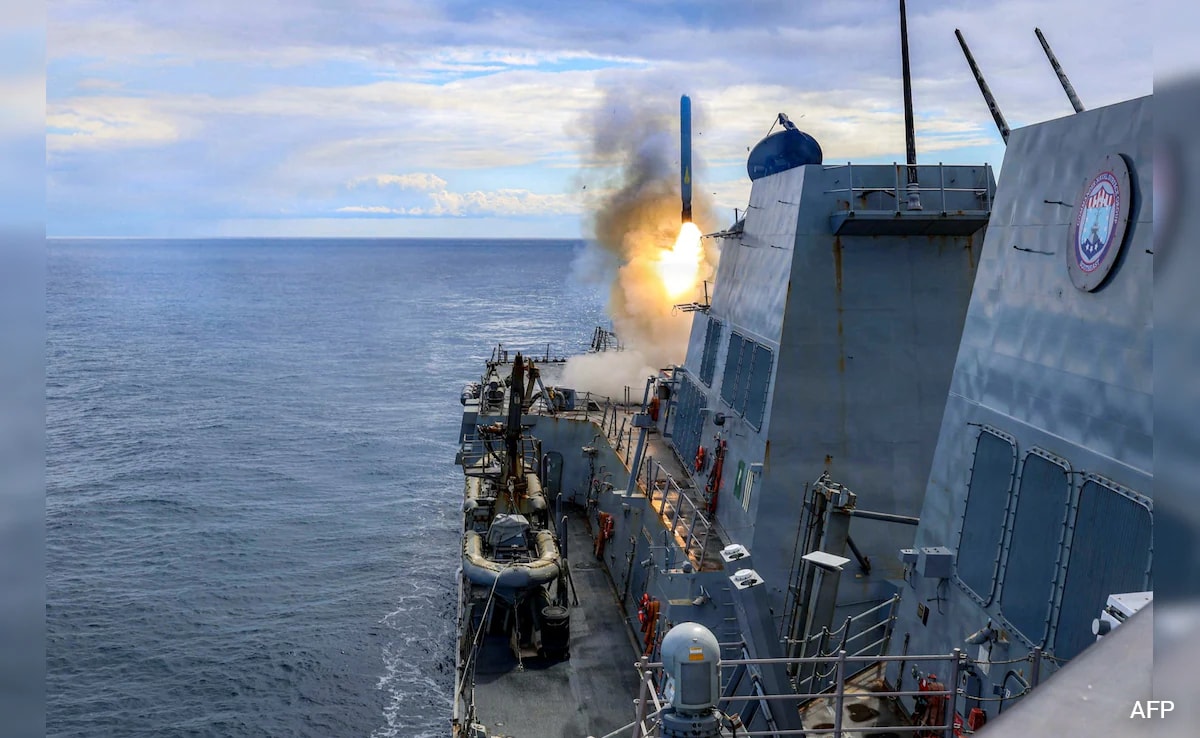
The United States is currently engaged in a high-stakes endurance test where the primary opponent isn't a foreign military, but the math of industrial production. Over the last eighteen months, the Department of Defense has depleted its stockpiles of precision munitions—specifically Patriot interceptors and Tomahawk cruise missiles—at a rate that vastly outpaces domestic manufacturing capabilities. While the hardware performs as advertised, the financial and logistical burden of firing a $4 million missile to down a $30,000 drone is creating a strategic deficit that may take a decade to repair. This is the reality of modern attrition. It is a quiet crisis of inventory that leaves the nation vulnerable to a secondary, larger conflict while it remains preoccupied with regional policing.
The Mathematical Trap of Interdiction
Defense logic used to rely on the idea of "overmatch." If the enemy sends a threat, you hit it with something faster and more reliable. But in the current theater, particularly in the Red Sea and Eastern Europe, that logic has inverted. The U.S. Navy and Army are now forced to use the highest tier of their arsenal against low-cost threats because the alternative is letting a multimillion-dollar ship or critical infrastructure get hit.
Take the MIM-104 Patriot system. It was designed to swat tactical ballistic missiles and advanced aircraft out of the sky. Instead, it is being used to defend against swarms of suicide drones. When you fire a Patriot, you aren't just spending money; you are spending time. Each missile requires specialized semiconductors and solid rocket motors that have lead times of over two years.
The supply chain is brittle. It cannot simply be turned up like a faucet. Raytheon and Lockheed Martin are working with facilities that were optimized for "just-in-time" delivery, a relic of the post-Cold War era where we assumed major wars were a thing of the past. Now, the Pentagon is trying to pivot to "just-in-case" manufacturing, but the machinery of the American defense industrial base is old and rusted.
The Tomahawk Inventory Gap
The Tomahawk Land Attack Missile (TLAM) is the backbone of American power projection. It allows the U.S. to strike targets from a thousand miles away without risking a single pilot. However, during recent operations to suppress Houthi launch sites and stabilize regional corridors, the Navy has burned through hundreds of these missiles in weeks.
The problem is the replacement rate.
The U.S. Navy typically buys fewer than 200 Tomahawks per year. In a sustained engagement, the fleet can fire that entire annual purchase in a single afternoon. We are essentially living off the "savings account" of missiles built during the 1990s and 2000s. As that account hits zero, the U.S. loses its ability to deter larger adversaries who are watching these inventory levels with mathematical precision.
The High Price of Success
Military analysts often talk about the "kill chain," the process of finding, fixing, and finishing a target. But we need to start talking about the cost-exchange ratio.
If an adversary spends $2 million to build 100 drones, and the U.S. spends $200 million to shoot them down, the adversary is winning even if they never hit their target. They are winning the economic war. This is a deliberate strategy of exhaustion. By forcing the U.S. to deplete its most expensive assets against "junk" targets, opponents are effectively disarming the superpower without ever engaging in a head-to-head battle.
The Components of a Multi-Million Dollar Miss
Why do these weapons cost so much? It isn't just corporate greed, though the lack of competition in the defense sector certainly doesn't help. A modern interceptor is a flying supercomputer.
- Seeker Heads: These use rare earth elements and advanced sensors to find a target moving at Mach 3.
- Solid Rocket Motors: There are only a handful of factories in the U.S. capable of mixing the high-energy chemicals required for these motors.
- Titanium and Specialized Alloys: Sourcing these materials has become a geopolitical nightmare, as much of the global supply was traditionally tied to regions that are now hostile or unstable.
Small Suppliers and Big Failures
The public focuses on the big names like Boeing or Northrop Grumman, but the real bottleneck is the "Tier 3" and "Tier 4" suppliers. These are small machine shops and specialized chemical plants that make one specific valve or one type of coating. Many of these companies went out of business during the last twenty years as the U.S. focused on counter-insurgency wars that didn't require high-end missiles.
Now that the demand has spiked, these small shops can't find the skilled labor or the capital to expand. If one shop in Ohio that makes a specific gasket for a Tomahawk engine goes under, the entire assembly line in Arizona grinds to a halt. The Pentagon is currently trying to "prime the pump" by giving these companies long-term contracts, but you cannot train a specialized master machinist in a weekend.
The Drone Symmetrical Fallacy
There is a growing movement within the Pentagon to develop "low-cost interceptors." The idea is to build a missile that costs $100,000 instead of $2 million. But this is harder than it sounds. To make a missile cheap, you have to sacrifice range, speed, or accuracy. In a world where the enemy's "cheap" drones are becoming increasingly sophisticated, a "cheap" interceptor might simply miss.
We are caught in a technological arms race where the offense has a massive financial advantage. Building a garage-made drone that can fly via GPS is easy. Building a system that can track, target, and destroy that drone in a crowded sky without causing collateral damage is incredibly difficult.
The Stealth Tax on National Security
Every Patriot missile fired in the Middle East is a missile that isn't available for the defense of Taiwan or the support of NATO. This is the "hidden cost" of these engagements. It isn't just the taxpayer dollars; it is the erosion of the global deterrent posture.
Congress has recently moved to authorize "multi-year procurement" for these weapons, which is a fancy way of saying the government is finally promising to keep buying them so the factories feel safe hiring more workers. But even with these changes, it will take years to refill the magazines. We are currently operating in a period of "maximum danger" where our stockpiles are at their lowest point in decades while global tensions are at their highest.
The Industrial Base is the Front Line
In the world of 20th-century warfare, victory was decided by who had the best pilots or the bravest soldiers. In the 21st century, victory is being decided by who has the most resilient supply chains. The U.S. has spent thirty years perfecting the "pointy end of the spear" while letting the "shaft of the spear"—the factories and the raw materials—decay.
We are seeing the limits of a service-based economy when it comes to maintaining superpower status. You cannot "app-develop" your way out of a shortage of solid rocket motors. You cannot use "social media influence" to manufacture more titanium. It requires heavy industry, chemistry, and physics.
The current rate of expenditure is a wake-up call that the U.S. is currently ignoring at its own peril. The ships are out of missiles, the warehouses are getting empty, and the machines in the factories are already running twenty-four hours a day. If a major conflict breaks out tomorrow, the U.S. will find that its greatest weakness isn't a lack of will, but a lack of ammo. The age of infinite precision is over; the age of industrial endurance has begun.