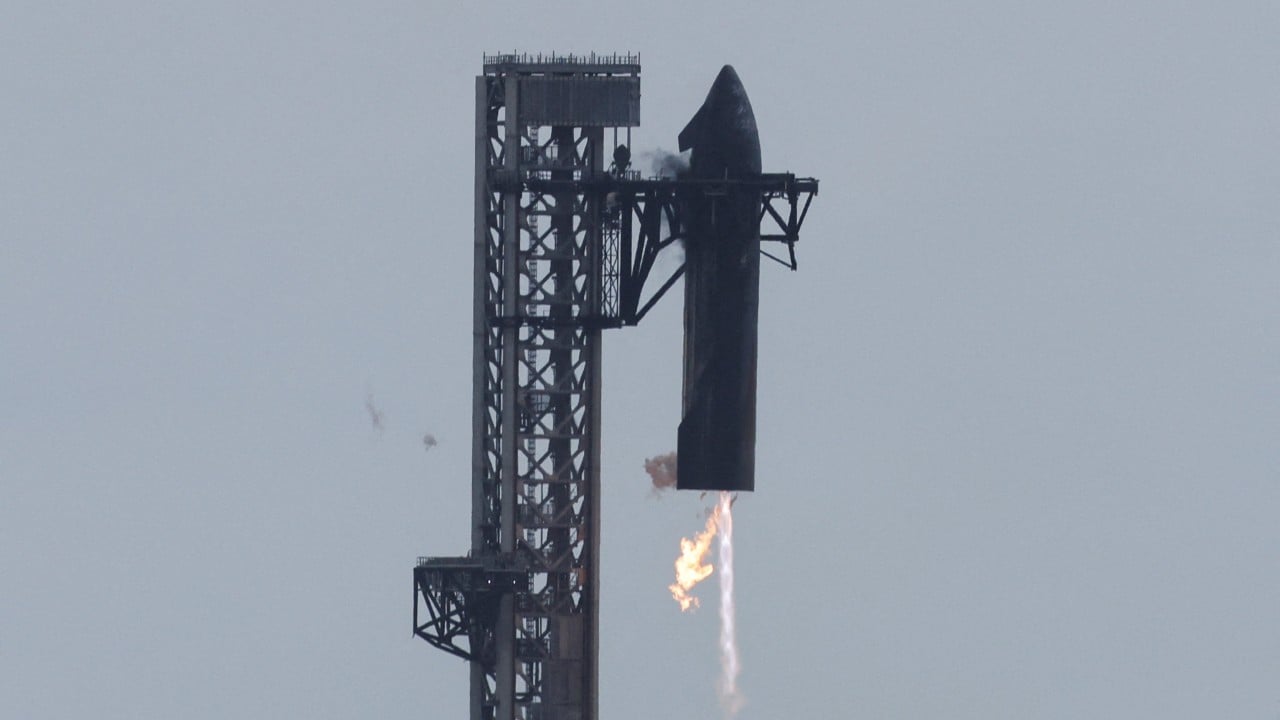
Eliminating landing legs on an orbital-class booster is not an aesthetic choice or an engineering stunt; it is a direct assault on the Tsiolkovsky rocket equation. Every kilogram of structural mass dedicated to hydraulic deployable legs, crush cores, and reinforced aft skirts imposes a compounding penalty on payload capacity to orbit. SpaceX’s decision to capture the Super Heavy booster using tower-mounted mechanical arms—colloquially termed "chopsticks" or Mechazilla—shifts the mass, complexity, and energy dissipation requirements from the flight vehicle to ground support equipment. This architectural shift transforms launch cadence from a refurbishment-bound cycle into an industrial manufacturing flow.
To understand why mechanical capture represents the logical conclusion of vertical-takeoff, vertical-landing (VTVL) rocketry, one must analyze the mass penalty of flight hardware, the kinematics of terminal guidance, and the operational bottlenecks of post-landing processing.
The Mass Penalty and the Rocket Equation
In orbital mechanics, mass carried to the edge of space and returned to Earth is the most expensive real estate in aerospace engineering. The Tsiolkovsky rocket equation dictates that the change in velocity ($\Delta v$) a vehicle can achieve is proportional to the natural logarithm of the ratio between its initial wet mass and its final dry mass.
$$\Delta v = I_{sp} g_0 \ln \left( \frac{m_0}{m_f} \right)$$
Where $I_{sp}$ represents specific impulse, $g_0$ is standard gravity, $m_0$ is initial total mass, and $m_f$ is final dry mass.
When a booster carries landing legs, those components travel through the entire ascent profile as dead weight. They contribute zero thrust and zero propellant volume. On the Falcon 9 first stage, four carbon-fiber and aluminum-honeycomb legs deploy just prior to touchdown. While efficient for a medium-lift vehicle, scaling this architecture to Super Heavy—a booster standing roughly 71 meters tall with a dry mass exceeding 200 metric tons—creates severe structural penalties.
The Three Structural Costs of Onboard Landing Gear
- Direct Inert Mass: Legs capable of arresting the descent of a 200-ton cylinder, plus the pneumatic or hydraulic actuators required to deploy them against aerodynamic loads, add several metric tons of mass to the aft section.
- Load Path Reinforcement: A booster landing on its base must absorb massive compressive and bending loads through its engine skirt and thrust structure. Designing the airframe to survive asymmetric touchdown forces requires thickening hull plating and adding internal stringers, further inflating $m_f$.
- Propellant Overhead: Every ton of dry mass added to the booster requires additional propellant during ascent to lift it, and additional propellant during descent to decelerate it. This creates a compounding mass spiral where extra hardware demands extra fuel, which requires larger tanks, adding further structural weight.
By transferring the catching mechanism to the launch tower, SpaceX removes the landing gear entirely from the flight vehicle. The booster instead utilizes two small, fixed load-bearing pins located near the top of the airframe, adjacent to the forward grid fins. Because the rocket is already built to withstand massive tensile forces during launch and aerodynamic stress at the forward interstage, hanging the vehicle from its upper bulkheads aligns the recovery loads with existing structural load paths.
Kinematics of Terminal Capture
Catching a falling skyscraper requires solving a coupled control problem involving aerodynamic surfaces, gimbaled rocket engines, and ground-based robotics. Unlike a drone ship landing—where the target deck is passive and the rocket performs all terminal corrections—a tower catch requires active synchronization between two moving systems.
The capture sequence breaks down into four distinct dynamic phases:
- Hypersonic and Supersonic Grid Fin Control: During atmospheric reentry, four large steel grid fins steer the booster toward the launch site. These surfaces operate in regimes ranging from hypersonic to subsonic, generating aerodynamic lift to null out cross-range and down-range trajectory errors.
- Engine Relight and Thrust Vector Control: As the booster approaches the tower, a cluster of Raptor engines ignites for the landing burn. Because Raptor engines feature rapid throttle response and precise gimbal actuation, the flight computer can translate the booster horizontally while arresting its vertical velocity.
- Hover-Slam Elimination: The Falcon 9 cannot hover; its single Merlin engine produces more thrust at minimum throttle than the empty booster weighs, forcing a precisely timed "hover-slam" where vertical velocity hits zero at the exact altitude of the deck. Super Heavy, equipped with multiple Raptor engines that can shut down sequentially down to a single center engine, achieves a thrust-to-weight ratio near 1.0 during final approach. This allows the booster to briefly hover and translate laterally into the capture zone.
- Mechanical Dampening and Arrest: Once the booster aligns between the open tower arms, the arms close around the upper airframe. The booster reduces thrust, settling its forward lifting pins onto dedicated rails mounted on the arms. These rails incorporate shock-absorbing dampers and trolley systems that slide to dissipate residual lateral momentum and vertical kinetic energy.
The Precision Gap
The primary technical risk in this sequence is positional variance at the moment of capture. Wind shear, sensor latency, or minor thrust fluctuations can displace the booster by tens of centimeters. Ground equipment must accommodate these tolerances without inducing destructive lateral shear forces on the booster’s thin stainless-steel propellant tanks.
SpaceX addresses this through mechanical compliance. The tower arms do not form a rigid vise; instead, the contact surfaces act as guides that funnel the booster’s lifting pins into a centered position as the vehicle descends the final few meters. The arms absorb the kinetic energy through hydraulic cylinders, preventing localized buckling of the booster skin.
The Operational Bottleneck of Refurbishment
A reusable rocket only disrupts launch economics if the turnaround time between flights approaches that of commercial aviation. If a booster requires weeks of inspection, transport, and re-stacking, the capital expenditure of building the vehicle remains trapped on the ground, inflating the amortized cost per launch.
Standard ocean recovery, while proven on Falcon 9, introduces a multi-day logistical chain:
- Transit Latency: Autonomous spaceport drone ships operate hundreds of kilometers downrange. Transit back to port takes 48 to 72 hours, depending on sea states.
- Crane Operations: At the port, mobile cranes must attach to the booster, retract or remove the landing legs, and lower the stage onto a horizontal transport cradle.
- Integration Delays: The booster must be trucked back to the launch complex, integrated with a new second stage, and lifted onto the transporter-erector.
Mechanical capture collapses this entire logistical pipeline into a single vertical axis. The tower that launches the rocket is the exact same structure that catches it.
Once the tower arms secure the booster, they act as an integrated gantry crane. The arms can immediately lift, rotate, and place the booster directly onto the orbital launch mount. Simultaneously, the tower’s quick-disconnect umbilical can re-mate with the vehicle to begin propellant loading operations for the next flight, contingent on automated health checks of the engines and airframe.
Risk Concentration and Failure Modes
Shifting recovery to the launch pad introduces a severe asymmetric risk profile. When a booster fails during an ocean landing, the loss is limited to the flight hardware and minor damage to a replaceable barge. When a booster fails during a tower catch, the kinetic energy of a 200-ton vehicle—potentially carrying residual methane and liquid oxygen—is directed straight at the most expensive and time-consuming asset in the entire architecture: the orbital launch complex.
Critical Failure Vectors
- Propulsion Degradation: If a central Raptor engine fails to ignite or suffers a turbopump anomaly during the final seconds of the landing burn, the booster lacks the thrust required to arrest its descent. Unlike a multi-engine failure during ascent, where adjacent engines can compensate, terminal descent relies on a minimal engine count operating near the ground.
- Sensor Spoofing or Latency: Terminal alignment relies on a fusion of onboard inertial measurement units, GPS, and ground-based radar or optical tracking. Discrepancies between the booster’s perceived position and the tower’s actual coordinates could cause the vehicle to strike the arms rather than thread between them.
- Thermal and Acoustic Exhaust Plume Effects: Firing multiple high-pressure methalox engines directly adjacent to the launch tower subjects the mechanical arms, hydraulic lines, and sensor arrays to extreme thermal loads and acoustic vibration. Over repeated cycles, fatigue cracking or sensor degradation in the ground equipment could compromise capture reliability.
To mitigate catastrophic pad damage, the flight termination system and guidance algorithms must maintain strict commit criteria. Until the final milliseconds before capture, the booster’s trajectory is targeted slightly off-axis from the tower. Only when telemetry confirms nominal engine performance, hydraulic readiness of the arms, and positional convergence does the flight computer command the final lateral translation into the catch zone. If any parameter falls outside acceptable bounds, the booster is programmed to divert away from the tower and impact the adjacent ground or ocean.
The Economics of Rapid Cadence
The financial viability of next-generation heavy-lift architectures, particularly those aimed at deploying massive satellite constellations or supporting deep-space propellant depots, depends entirely on marginal launch costs. Manufacturing an expendable heavy-lift rocket costs hundreds of millions of dollars per unit. Even with a partially reusable booster, if refurbishment requires replacing heat shields, rebuilding landing legs, and transporting stages across oceans, the operational overhead keeps launch prices elevated.
By treating the booster as an extension of the ground infrastructure, SpaceX aims to shift the cost structure from aerospace manufacturing to utility-style operations. The primary expenses become liquid methane, liquid oxygen, and routine preventative maintenance of the ground support equipment.
Consider the capital efficiency of a single booster:
- Expendable Model: 1 vehicle = 1 flight. Capital cost is 100% amortized on a single mission.
- Drone Ship Recovery Model: 1 vehicle = 15 to 20 flights over several years, constrained by marine transit and port refurbishment.
- Tower Capture Model: 1 vehicle = dozens or hundreds of flights, theoretically capable of multiple launches per week if thermal protection systems and engine components require minimal intervention.
This high-cadence capability is mandatory for missions requiring orbital refueling. Sending a single payload to the Moon or Mars under an orbital depot architecture requires launching a tanker variant of the upper stage multiple times in rapid succession to transfer cryogenic propellants before boil-off depletes the supply. Without the rapid turnaround enabled by mechanical tower capture, the number of boosters and launch pads required to sustain a propellant depot would be financially and logistically prohibitive.
Strategic Forecast for Launch Providers
The aerospace industry faces a stark architectural divergence. Legacy providers and emerging competitors developing medium- and heavy-lift vehicles currently rely on expendable designs or traditional deployable landing legs. As mechanical tower capture transitions from experimental testing to routine operation, these alternative architectures will face severe competitive obsolescence in the high-mass-to-orbit market.
Competitors must immediately evaluate their booster structural designs against three strategic realities:
- Abandon Deployable Legs for Heavy Lift: Designing landing gear for vehicles exceeding 100 tons of dry mass imposes unacceptable payload penalties. Future heavy-lift designs must integrate recovery interfaces directly into the primary load-bearing bulkheads of the airframe.
- Co-Design Ground Systems and Flight Vehicles: Launch towers can no longer be treated as passive support structures. Aerospace firms must allocate equal engineering capital to active ground robotics, hydraulic dampening systems, and automated umbilical interfaces from the inception of a rocket program.
- Build Redundant Launch Complexes: Concentrating recovery risk at the launch site requires insulating operational schedules from single-point failures. Any provider adopting tower-catch architecture must construct at least two fully independent launch and capture towers at separate pads to ensure continuous flight cadence following an inevitable terminal guidance anomaly.