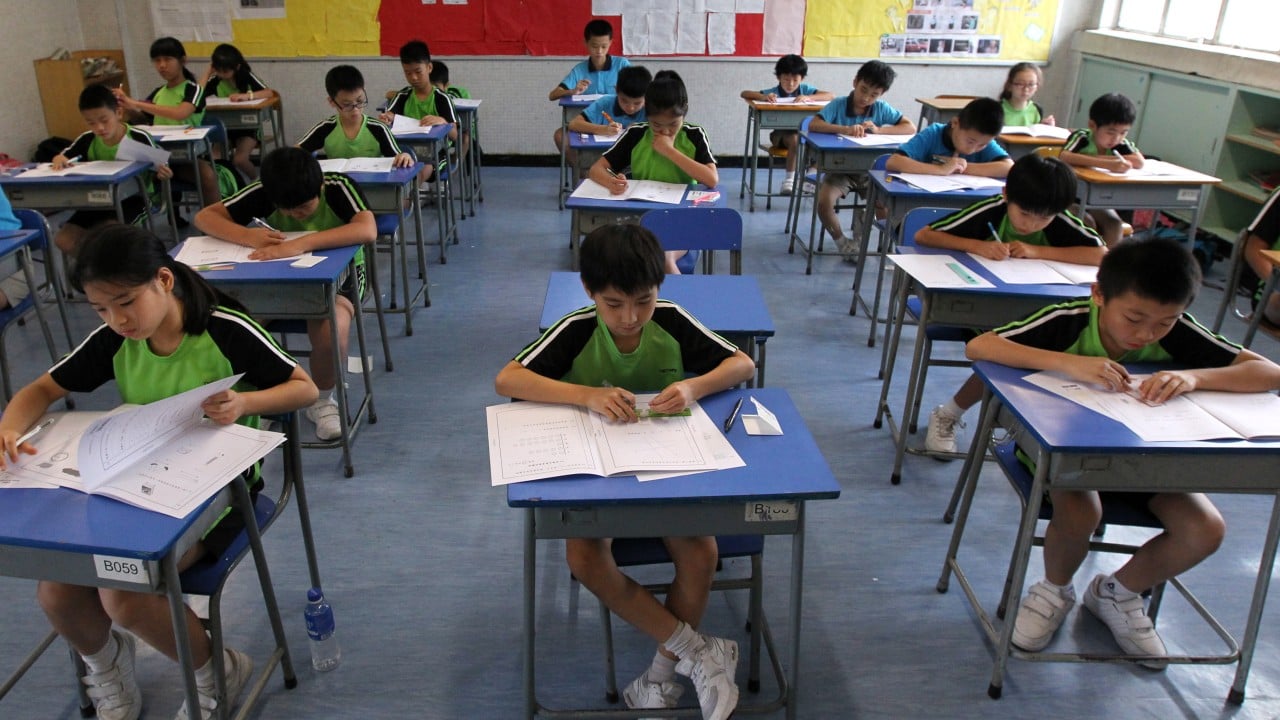
At 8:45 on a humid Tuesday morning in Kowloon, an eight-year-old boy named Leo—a composite of dozens of students sitting at worn wooden desks across the city this autumn—stares at a single sheet of paper.
The prompt is simple. It asks him to divide a pile of marbles equally among four friends and figure out how many remain. On the surface, it is basic arithmetic, the kind of foundational puzzle Hong Kong schoolchildren have solved with mechanical precision for decades. Yet Leo’s pencil hovers an inch above the page, trembling slightly. He does not know where to start. He does not know what the words are asking him to do.
Panic.
That quiet, suffocating freeze at a primary school desk is no longer an isolated moment of childhood frustration; according to recent Territory-wide System Assessment (TSA) data released by the Hong Kong Examinations and Assessment Authority, mathematics competency among Primary Three pupils has plunged to its lowest level since the standardized benchmark was introduced in 2004.
For a city that built its modern identity on financial acumen, engineering rigor, and relentless academic excellence, the numbers land like a sudden tremor beneath a skyscraper. In 2024, only 83.2 percent of Primary Three students achieved basic competency in mathematics—a sharp, unsettling drop from 85.3 percent the previous year, and well below the near-90-percent thresholds the city routinely posted in the decade before the pandemic. Nearly one in six eight-year-olds in one of the world’s wealthiest, most education-obsessed metropolises cannot reliably perform elementary subtraction, read an analog clock, or untangle a two-step word problem.
The Ghost in the Classroom
To understand how an entire cohort lost its footing with numbers, you have to look backward to the spring of 2020, when the city’s kindergartens went dark.
Consider the timeline of a child sitting in Primary Three today. Born around 2015 or 2016, they were four or five years old when COVID-19 shuttered classrooms, replaced wooden counting blocks with glowing iPad screens, and turned living rooms into makeshift lecture halls. While older students struggled with the isolation of remote learning, they at least possessed the scaffolding of early childhood education. They already knew how to hold a pencil, how to sit still, and how a physical quantity of apples relates to an abstract digit on a chalkboard.
The Primary Three cohort of today had no such anchor.
They learned their earliest number sense through glass. Think of early mathematical literacy not as memorizing formulas, but as building a brick wall from the ground up. In a normal kindergarten classroom, a child touches three red blocks, trades them for five blue ones, argues over who has more snacks, and physically experiences volume, weight, and sequence. When you strip away the tactile world and replace it with passive screen time, you are essentially trying to lay the second and third rows of bricks without ever pouring the concrete foundation.
When schools finally reopened and normal schedules resumed, the curriculum did not wait for the missing concrete to set. The syllabi marched forward on their rigid, unforgiving timetables. Teachers, buried under administrative catch-up and behavioral regression, had to push eight-year-olds into multiplication, fractions, and multi-step logic before those children had truly internalized what a number actually represents.
I still remember the distinct, metallic taste of anxiety from my own childhood math drills in Hong Kong—the sharp rap of a ruler on a blackboard, the fluorescent hum of a tutorial center at seven in the evening, the terror of bringing home a worksheet bled dry with red ink. Back then, the pressure was brutal, but the mechanics were clear. You memorized the times tables until they lived in your muscle memory. Today’s eight-year-olds face the exact same cultural expectation of perfection, yet they are walking into the exam hall with invisible holes in their cognitive floor.
Why Word Problems Became Brick Walls
Ask any veteran primary school math teacher in Sham Shui Po or Sha Tin where the Primary Three scores are bleeding out, and they will rarely point to pure calculation. Most eight-year-olds can still add two three-digit numbers when the digits are stacked neatly in vertical columns.
The collapse happens the moment numbers are wrapped in sentences.
To see why, look at the parallel drop in English and Chinese language competencies recorded in the exact same TSA report. Language and mathematics are not separate rooms in a child's brain; they are connected by a single hallway. Before a child can solve a problem about a train leaving Hung Hom station with forty-two passengers and dropping off nineteen at Mong Kok, that child must decode the syntax, hold the narrative sequence in working memory, and translate human language into mathematical operations.
During the years of masked faces and muted microphones, children missed millions of micro-conversations. They missed the casual playground negotiations, the bedtime stories cut short by exhausted parents working from home, and the subtle facial cues teachers use to check whether a quiet student actually understands a word.
Now, when a Primary Three pupil reads a math question, they are fighting a war on two fronts. First, they struggle to comprehend the vocabulary of the story. Second, they lack the number sense to intuit whether their final answer makes sense. If a child calculates that a bus now carries three hundred passengers after nineteen people get off, they do not pause and laugh at the absurdity. They simply write down the number and move on, disconnected from the reality the math is supposed to describe.
The Myth of the Tiger Parent Safety Net
For decades, Hong Kong’s unspoken educational safety net was the household itself. Whenever public schooling faltered, parents stepped in with private tutors, stacks of supplementary workbooks from Commercial Press, and relentless evening drills.
But the city has changed, and the safety net is fraying at both ends.
On one side, a historic wave of emigration over the past four years has drained classrooms of tens of thousands of middle-class families—and, just as critically, emptied staff rooms of experienced, veteran teachers. Schools across the territory have scrambled to fill vacancies with younger, less seasoned educators who are learning classroom management on the fly while navigating an unprecedented wave of post-pandemic learning gaps.
On the other side, the families who remain are navigating a bruised economy and widening inequality. Imagine a single mother working twelve-hour shifts in a Causeway Bay retail shop, coming home at nine in the evening to a subdivided flat in Sham Shui Po. She wants nothing more than for her eight-year-old son to succeed, to climb the same ladder of upward mobility that Hong Kong promised for generations. Yet when she looks at his Primary Three worksheet, she is exhausted, he is overtired, and neither of them has the bandwidth to rebuild foundational math concepts from scratch. Meanwhile, wealthier families quietly hire specialized educational therapists and private tutors to bridge the gap, turning a public health crisis into a silent, permanent class divide.
Even the test itself—the Territory-wide System Assessment—carries an emotional weight that bureaucrats often downplay. Officially, the Education Bureau insists the TSA is a low-stakes diagnostic tool designed solely to help schools evaluate teaching effectiveness, not to rank students or punish teachers.
Nobody in the trenches actually believes that.
In a hyper-competitive school system where declining birth rates threaten under-enrolled schools with closure, every metric becomes a matter of survival. Principals watch the percentages nervously. Teachers feel the unspoken pressure to drill past papers rather than pause and teach through play. Parents buy TSA-specific mock exam books months in advance, turning an eight-year-old’s Tuesday afternoon into a high-stakes rehearsal. When you try to fix a lack of conceptual understanding with more rote drilling, you are putting a fresh coat of paint over rotting wood. It looks passable until someone steps on it.
The Invisible Stakes of Age Eight
Why does a two-percentage-point dip in third-grade math matter so urgently? After all, these are eight-year-olds. They have nearly a decade of schooling left before they ever sit for the Hong Kong Diploma of Secondary Education exams or enter the workforce.
Educational psychologists have long identified Primary Three—roughly ages eight to nine—as the great continental divide of childhood learning. Up until this point, children are learning to read and learning to count. From Primary Four onward, the entire educational apparatus flips: children must read to learn, and they must use basic arithmetic as an automatic tool to grasp fractions, geometry, algebra, and science.
If a child crosses that threshold without solid number sense, math stops being a puzzle and becomes an identity. They decide, often permanently, that they are "bad at math." Once that label hardens in a child's mind, every subsequent lesson triggers a low-grade threat response in the brain. Working memory shuts down. Avoidance kicks in. By secondary school, that eight-year-old who couldn't divide marbles on a Tuesday morning is locked out of STEM tracks, engineering programs, data science, and the very analytical careers Hong Kong relies upon to stay relevant in a shifting global economy.
The damage is quiet, cumulative, and deeply personal. You do not see it on the evening news like a typhoon or a stock market crash. You see it in the slumped shoulders of a child hiding a graded test at the bottom of a schoolbag.
Rebuilding the Concrete Foundation
Fixing this cannot be accomplished by adding another hour of homework or printing thicker revision guides. If Hong Kong wants to rescue this generation of young thinkers, the rescue has to begin with radical patience.
First, schools must be given explicit permission from the Education Bureau to slow down. You cannot race through a syllabus when sixteen percent of the room is still standing at the starting line. Reclaiming classroom time for tactile, concrete learning—letting eight-year-olds use physical fraction tiles, measure real water in beakers, and talk through why an answer works before writing a single equation—is not a step backward. It is the only way forward.
Second, we have to decouple early math from shame. When parents sit down with their children at the kitchen table, the goal cannot be finishing the worksheet before bedtime. Think of math anxiety like stage fright: the harder you demand a flawless performance, the stiffer the performer becomes. Asking a child, "How did you get that number?" with genuine curiosity rather than sharp correction transforms an interrogation into a conversation. Even small, everyday rituals—calculating change at a wet market stall, splitting dim sum portions at Sunday yum cha, estimating travel time on the MTR—anchor abstract digits back into the physical world where children actually live.
Finally, policymakers must confront the human drain in the classroom. Supporting teachers with dedicated classroom assistants, smaller group interventions for struggling pupils, and genuine relief from bureaucratic paperwork will do far more for Primary Three scores than any standardized directive ever could.
Late in the afternoon, back in that quiet classroom in Kowloon, the bell rings. Papers are collected, stacked neatly in alphabetical order, and carried away to be tallied into percentages, charts, and policy briefings.
Leo packs his pencil case slowly, zipping it shut with small, careful fingers. Out on the street below, neon signs flicker to life against the dusk, and the city hums with the relentless, glittering speed of global finance. Inside his backpack sits a folded sheet of paper with three red crosses in the margin—a tiny, silent record of a foundation still waiting to be poured, and a generation waiting for the adults in the room to notice before the concrete sets for good.