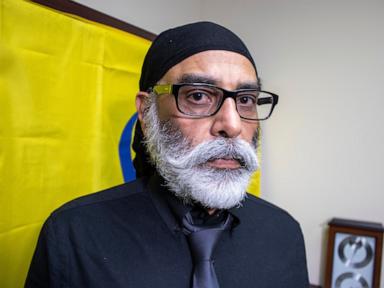
The ink on the federal warning was barely dry, yet the coffee in the kitchen had already gone cold.
Silence in a safehouse has a specific weight. It is not the peaceful quiet of a country morning or the soft hush of a library. It is a dense, pressurized atmosphere where every creak of floorboards sounds like a footstep, where headlights sweeping across a window blind force muscles to instantly lock into a defensive posture. For a Sikh separatist living under the long, heavy arm of state security, this is not a temporary inconvenience. It is a permanent address.
The Federal Bureau of Investigation does not show up at a doorstep to offer casual advice. When federal agents arrive with fresh intelligence regarding an active threat on a human life, they bring a chilling certainty. A new plot. A recurring target. An invisible machinery of transnational violence that spans oceans, bypassing borders as if they were nothing more than lines drawn in dust.
To understand what it means to be hunted across continents, one must first unlearn the comforting myth that geography equals safety.
The Distance Between Two Worlds
Imagine sitting in a quiet suburban kitchen thousands of miles away from the land of your birth, drinking tea from a mug emblazoned with a local sports team logo, while a foreign government compiles your coordinates.
This is the surreal reality facing prominent Sikh activists in Western democracies today. The movement for Khalistan—a sovereign homeland carved out of Punjab—has deep historical roots, marked by decades of trauma, political upheaval, and diaspora yearning. For many who fled to North America or Europe, these nations represented a sanctuary. A place where speech could be free, dissent could be voiced, and the ghosts of past state crackdowns could finally be laid to rest.
Except the ghosts do not stay buried.
When intelligence agencies issue warnings about transnational repression, they are describing a modern phenomenon where governments reach beyond their sovereign borders to silence critics, journalists, and dissidents. It is a quiet war fought in the shadows of immigration offices, encrypted messaging apps, and whispered warnings from counterterrorism officers.
The mechanics of this threat are chillingly routine. Surveillance operatives map daily routines. Local assets are recruited, sometimes unwittingly, sometimes through coercion. Funds move invisibly through international channels. And somewhere in a distant capital, a decision is made that a voice thousands of miles away has become too loud to ignore.
The target does not cower. But the toll is exacted in a thousand micro-moments. Checking the rearview mirror twice before turning into a driveway. Wondering if the stranger asking for directions at a gas station is merely lost or something far worse. Looking at children playing on the front lawn and feeling a cold knot of dread tighten in the chest.
The Anatomy of Transnational Threats
Security analysts often speak of transnational repression in clinical, sterile terms. They use acronyms, risk assessments, and threat matrices. They talk about state actors, intelligence vectors, and diplomatic fallout.
Let us strip away the jargon.
At its core, this is about fear acting as a proxy for physical violence. If an authoritarian state can make a dissident look over their shoulder every single day for the rest of their natural life, they have achieved their goal without ever firing a shot. The psychological cage is just as effective as an iron one.
When the FBI alerts a prominent community figure about a fresh plot, they are validating a terrifying truth. The threats are not paranoia. The danger is not exaggerated. The machinery targeting them is real, well-funded, and operating with a brazen disregard for the laws of the host nation.
Governments like India have long bristled at Sikh separatist activism within Western diasporas, viewing it as a direct threat to national integrity. For decades, diplomatic channels were used to pressure foreign governments into cracking down on political expression. But in recent years, intelligence communities have uncovered evidence that these efforts have escalated far beyond diplomatic pressure into targeted physical plots. The assassination of hardline activist Hardeep Singh Nijjar in British Columbia shattered any remaining illusions that Western soil offered absolute immunity. It proved that the invisible border was porous. It proved that silence could be bought with blood.
And so, when a new warning lands on a desk, it arrives with the haunting echo of precedent.
Living in the Crosshairs
How does a person function when their very existence becomes a geopolitical friction point?
Resilience is often romanticized. People love stories of the unbreakable spirit, the hero who stands tall against the storm without a single tremor in their hands. But real resilience is messier. It is trembling hands wrapped around a warm mug. It is waking up at three in the morning to check the deadbolts for the third time. It is the heavy, grinding exhaustion of hyper-vigilance.
Activism in this space is rarely glamorous. It consists of endless committee meetings, community outreach, and legal battles, punctuated by moments of acute, paralyzing terror. Those caught in the crosshairs know the risks intimately. They did not stumble into this life by accident. They made a choice—a deliberate, costly choice—to speak out against what they perceive as historical injustices and ongoing human rights abuses.
They speak because they believe that silence is a slow surrender. If they stop talking, if they step back into the shadows, the narrative is handed entirely to those who wield power through intimidation.
Yet, the cost is staggering. Family gatherings are fraught with unspoken anxiety. Friendships are filtered through the lens of security clearances and background checks. Every public appearance carries the latent possibility of catastrophe.
The Wider Mirror
This is not merely a story about Sikh separatism or geopolitical posturing between nations. It is a stress test for the integrity of global democracies.
When foreign intelligence networks operate with impunity within the borders of sovereign nations, the social contract begins to fray. The promise made by democratic states to immigrants and political refugees—that you will be safe here, that your voice will be protected—is put on trial.
If a government cannot protect a dissident walking its streets, what does sovereignty even mean? If economic and diplomatic ties routinely supersede the safety of individuals, justice becomes a commodity traded in backroom negotiations.
The warning issued by the FBI is more than a piece of police procedural intelligence. It is a flashing red light on the dashboard of international law. It asks a question that Western capitals have long avoided answering: How much foreign aggression are we willing to tolerate in exchange for geopolitical convenience?
The activist sits at the kitchen table, listening to the hum of the refrigerator, watching the pale morning light crawl across the linoleum. Outside, the world goes about its ordinary business—cars passing by, mail carriers delivering letters, children walking to school.
Inside, the weight remains. The threat is real. The shadow is long. And the door, reinforced by federal warning and personal resolve, remains locked against the dark.