The air in the eastern provinces of the Democratic Republic of Congo does not smell like death. It smells like wet earth, woodsmoke, and the sharp, sweet tang of roasting cassava.
If you stand on the edge of a village nestled near the rolling green hills of North Kivu, you might mistake the quiet hum of daily life for ordinary peace. Women walk down red-clay paths balancing woven baskets on their heads. Children chase makeshift soccer balls made of tightly bound plastic bags. Smoke curls lazily from thatched roofs. You might also find this related coverage insightful: Why Risk Reducing Surgery for Ovarian Cancer is Medical Cowardice.
Yet, beneath this ordinary skin of existence, a quiet arithmetic is unfolding.
Numbers do not bleed. When statisticians type updates into glowing screens thousands of miles away, they see rows and columns. They see metrics. Right now, those metrics show that Ebola cases in Congo have topped 3,200. This milestone brings the region terrifyingly close to the record of the country's worst outbreak, which fractured communities and claimed thousands of lives just a few years ago. As highlighted in latest reports by Mayo Clinic, the effects are notable.
Behind that cold statistic of 3,200 is a mother named Alphonsine.
Imagine her sitting on a wooden stool outside a clinic painted in peeling white paint. She is not a data point. She is a woman whose hands are calloused from tilling the soil, currently trembling because her youngest son, six-year-old Jean, developed a sudden fever that wouldn't break.
In this part of the world, a fever is never just a fever. It is a loaded gun.
To understand what 3,200 cases actually means, you have to abandon the safety of abstract numbers and walk the muddy roads with the people who fight this invisible war every single day.
Outbreaks do not happen in sterile laboratories. They happen in crowded homes where families share a single room. They happen in bustling local markets where gossip travels faster than wind, and where fear is an old, bitter companion.
When the virus first arrived in this latest wave, it did not announce itself with sirens. It whispered. It arrived disguised as malaria, as typhoid, as ordinary exhaustion from a life of hard labor. By the time the diagnosis was confirmed, the invisible enemy had already slipped through the front door, visited the local market, and sat at the family dinner table.
This is the psychological terror of Ebola. It turns human instinct against itself.
When someone you love falls violently ill, every natural impulse commands you to rush to their side. You want to hold their hand. You want to wipe the sweat from their forehead. You want to offer a cool drink of water. But in the architecture of this disease, those acts of profound love become vectors of destruction.
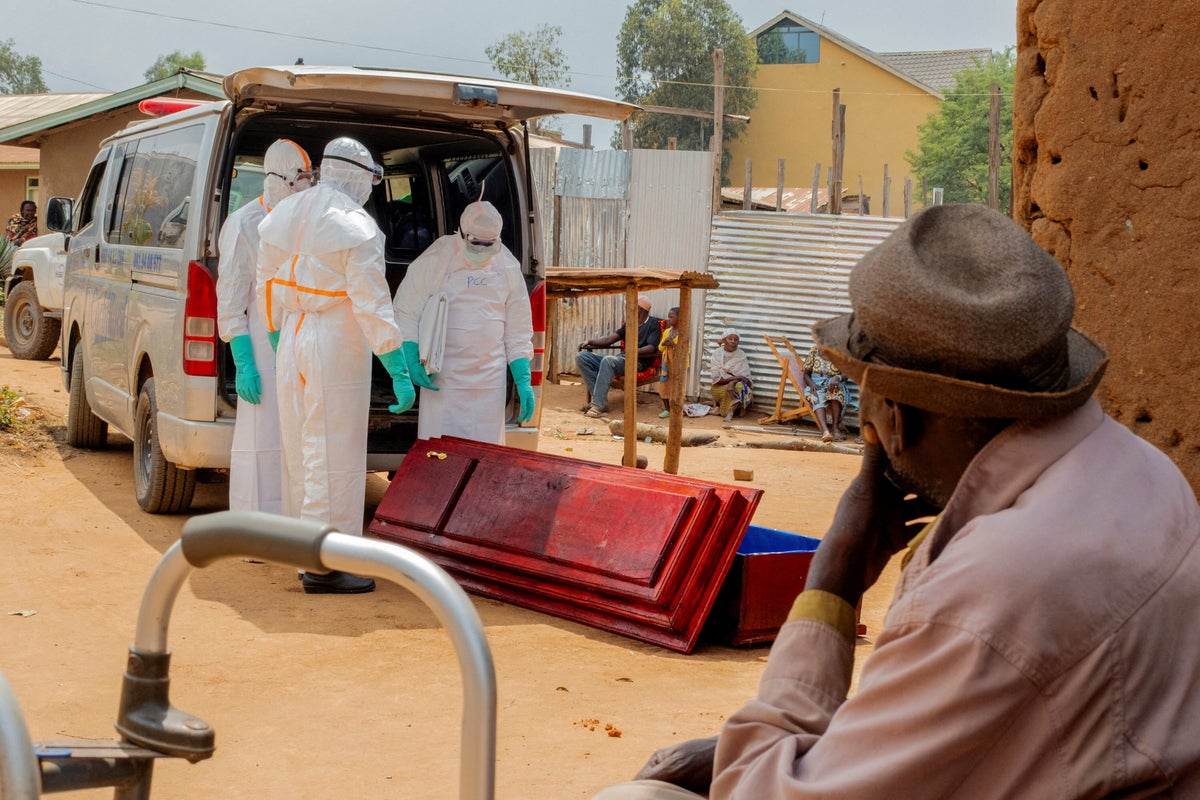
Medical workers in bulky yellow hazmat suits—resembling astronauts dropped onto an alien planet—often become objects of suspicion. To a grieving community, these suits are terrifying apparitions. They represent isolation. They represent a world where loved ones taken away in ambulances rarely return home alive, instead vanishing into anonymous, heavily regulated burials designed to halt the spread.
I remember standing in a treatment center during a previous flare-up, watching a nurse named Mama Beatrice talk down a terrified young man. She had worked twelve hours straight, sweat pouring down her face beneath layers of plastic and rubber. Her goggles were fogged. Her back ached with a dull, persistent agony.
She did not use medical jargon. She spoke in the gentle, rhythmic cadence of the local dialect. She took off her outer gloves—keeping the inner ones safe—so she could touch the young man's trembling shoulder through a barrier of careful distance.
"We are not here to steal your family," she told him, her voice cracking with exhaustion. "We are here to help them walk back out into the sun."
That is the hidden labor holding the line against 3,200 infections. It is not just about epidemiology or cold-chain refrigeration for experimental vaccines. It is about human translation. It is about bridging the chasms of distrust forged by decades of political instability, broken promises, and institutional neglect.
Why does the virus keep returning to these specific hills?
The answer lies in a volatile cocktail of geography, conflict, and human resilience. North Kivu and Ituri are not quiet expanses of wilderness. They are zones fractured by armed groups, where checkpoints shift by the hour and humanitarian corridors are frequently sealed by violence.
When a clinic is attacked—as has happened with tragic frequency in past years—the machinery of public health grinds to a terrifying halt. Contact tracers, the unsung detectives of any epidemic, cannot venture into rebel-controlled territory. Communities retreat inward, hiding their sick out of fear that reporting a case will bring soldiers, quarantine, or forced removal.
Logic dictates that if you isolate the sick and vaccinate their contacts, the fire will starve. But logic requires stability. It requires trust.
When trust is shattered, the virus wins in the shadows. People turn to traditional healers who know nothing of viral loads, or they hide their dead in secret ceremonies, unwittingly passing the torch of infection to the very people who loved them most.
This is why crossing the threshold of 3,200 cases is more than a historical marker. It is a warning siren. It signals that the containment walls are buckling under the sheer weight of fatigue.
The health workers are tired. The communities are exhausted. The international donors, whose attention spans are constantly hijacked by newer crises across the globe, are looking away.
Consider what happens next if the curve continues its upward trajectory.
Every new infection is a branching path in a dark forest. One wrong turn—a delayed diagnosis, a community resistance flare, a logistical failure in delivering vaccine doses—and the outbreak explodes beyond the capacity of local clinics.
Yet, amidst the gloom, stubborn defiance persists.
It lives in the local youth who volunteer as burial teams, donning protective gear to bury their neighbors with dignity while risking their own lives. It lives in the survivors who return to the treatment centers, their blood now rich with antibodies, walking through the wards to hold the hands of the newly infected. They look the terrified patients in the eye and say simple, life-saving words: "I sat in that exact bed. I walked out. You will too."
That is the true engine of survival. Not just science, though science is our shield. Not just funding, though funding is our fuel. It is the refusal of ordinary human beings to surrender their humanity to a microscopic predator.
The numbers will continue to tick upward or downward on dashboards in Geneva and Kinshasa. Analysts will debate the reproduction numbers and the efficacy rates of monoclonal antibodies.
But down on the red-clay paths of eastern Congo, Alphonsine sits beside her son, waiting for a fever to break, watching the mist roll over the green hills, hoping against hope that the shadow will finally lift before it swallows everything she loves.