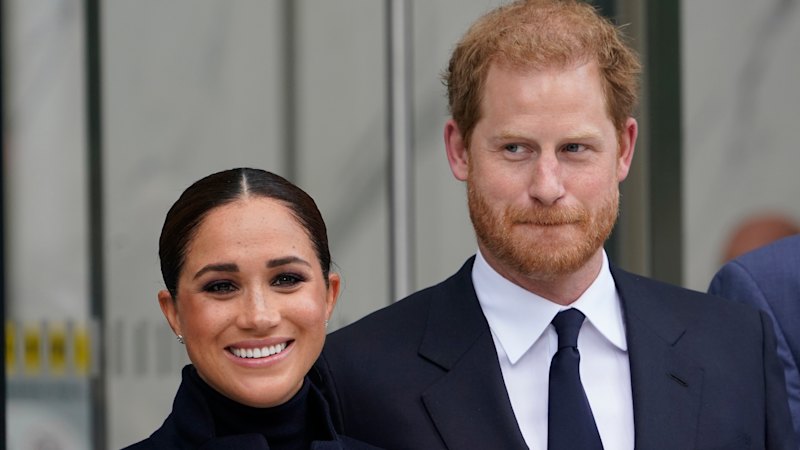
Morning arrives in Montecito not with a trumpet, but with the quiet hiss of sprinklers hitting manicured lawns and the heavy, damp Pacific fog rolling over the ridge. For most parents, the morning routine is a chaotic symphony of missing sneakers, burnt toast, and rushed goodbyes. But for Prince Harry and Meghan Markle, the domestic shuffle carries a weight entirely its own.
Consider the mathematics of a standard morning. Two children. One car. A short stretch of tarmac connecting a private driveway to the gates of an elite campus. To an outside observer, it looks ordinary. Unremarkable, even. Yet, security experts, former royal protection officers, and anyone who has ever watched a high-profile family navigate the public eye know the terrifying truth hiding in plain sight.
The school run is where vulnerability lives.
It is predictable. It happens at the exact same hour, on the exact same route, five days a week. It requires slow speeds, frequent stops, and open exposure to anyone standing on a sidewalk with a telephoto lens or, worse, something far more sinister. When you trade the ironclad, state-funded cocoon of Windsor or Kensington for the sun-drenched freedom of California, you trade a fortress for an open courtyard.
And that trade is terrifying.
The Anatomy of Exposure
Let us strip away the tabloid headlines and look at the physical mechanics of vulnerability. Imagine standing on a quiet California corner. The morning air smells of eucalyptus and salt. A sleek black SUV approaches the crosswalk, slows down, and stops to let a group of laughing children pass. Inside that vehicle sit two of the most scrutinized children on the planet.
In that moment of deceleration, the armor vanishes.
Security analyst Michael, a hypothetical veteran of executive protection who has spent decades guarding diplomats and high-net-worth families, describes the phenomenon simply. "A moving target is difficult," he says, leaning over a map of coastal Santa Barbara. "A stationary target at a designated drop-off zone is an invitation."
When the vehicle stops, the threat window opens. In the UK, Harry grew up inside a system where routes were sanitized, police motorbikes cleared intersections, and airspace above royal residences was restricted. Every movement was preemptively locked down. Transitioning to a life where private citizens must manage their own perimeter security means that the daily school drop-off ceases to be a mundane chore and transforms into a tactical high-wire act.
Every intersection is an unknown variable. Every stranger waiting by a coffee shop near the campus perimeter is a potential threat actor.
The Weight of History
To understand why Harry is hyper-vigilant about the school run, we have to look backward. We have to look at the haunting images etched into our collective consciousness from August 1997. A Mercedes speeding through a Parisian tunnel, desperately trying to outrun a pack of aggressive photographers on motorcycles.
That trauma does not fade with time. It calcifies.
Harry has spoken openly about the persistent echoes of his mother's death. For him, the camera lens is not an annoyance; it is a weapon. It is a persistent reminder that the machinery of public obsession does not care about age, innocence, or the sacred boundaries of childhood. When he speaks about the dangers facing his family, critics often roll their eyes, dismissing it as paranoia from a life of extreme privilege.
They are missing the point.
Paranoia is an irrational fear of things that cannot happen. What Harry faces is a calculated, empirically validated risk based on real-world data. The relentless pursuit by paparazzi, combined with the unpredictable nature of fixated individuals in the digital age, creates a cocktail of constant hazard. When you combine high-speed media chases with the agonizingly slow crawl of a morning drop-off queue, you get the single most dangerous micro-environment a public figure can enter.
The Illusion of Sanctuary
Montecito sells a specific kind of dream. It promises privacy behind towering hedges, wrought-iron gates, and private security patrols. It whispers that once you cross the county line, the ghosts of London can no longer reach you.
It is a comforting illusion.
In reality, the modern digital landscape has erased traditional borders. A drone can hover quietly above a tree line. A long-range lens can capture a playground from half a mile away. The sanctuary is porous. And the school run represents the ultimate puncture of that sanctuary, forcing the family out of the compound and into the shared public square.
Think about what happens when a royal or celebrity child walks from the back seat of a car to the school doors. They are small. They are trusting. They do not understand why a stranger with a massive camera is shouting their name or why men in suits with earpieces scan the roofline with sharp, unsmiling eyes.
This is the psychological tax of fame. It is paid in installments every single morning before breakfast.
The Quiet Resilience
Yet, despite the looming shadow of risk, life goes on. Lunches must be packed. Homework folders must be signed. Shoes must be tied.
There is a profound humanity in watching public figures attempt to live ordinary lives under extraordinary constraints. We often forget that behind the legal battles over security funding, the dramatic interviews, and the shifting public sentiment, there are two parents simply trying to give their children a normal childhood. They want their son and daughter to play kickball at recess, skin their knees on the playground, and come home with paint on their shirts.
They are fighting for the right to be boring.
That fight is what makes the school run so poignant. It is not just about physical safety, though the statistics and security protocols are formidable. It is about the preservation of normalcy. Every time Harry or Meghan buckles their children into the car and drives toward those school gates, they are performing an act of quiet defiance against a world that demands to consume every piece of them.
The engine hums. The tires crunch on the gravel. The door opens to a world of math tests and finger paints.
And for a few brief hours, the heavy cost of their name fades into the background, leaving only the simple, sacred rhythm of a morning drive.