The wind does not knock on Nebraska doors. It shoves them.
Ask any driver who has ever watched the headlights of a semi dissolve into a wall of whiteout on Interstate 80. You grip the steering wheel until your knuckles turn the color of skim milk. You listen to the tires hum against asphalt, praying for traction that has ceased to exist. In the dead of a Midwestern winter, the highway is not a path of convenience. It is a razor's edge.
For generations, our response to ice has been delightfully medieval. We dump mountains of salt—millions of tons of sodium chloride that eats through the bellies of our cars, leaches into our aquifers, and leaves creeks gasping for freshwater life. We send out heavy yellow trucks with plows that scrape steel against concrete, gouging grooves into the infrastructure we paid billions to build. And still, the black ice wins. It slips in silently under a clear night sky, turning an ordinary bridge deck into a bobsled track before the first salt truck even rolls out of the barn.
We have accepted this as an act of meteorological God.
Then came fifty-two slabs of gray concrete in Lancaster County.
To the casual observer passing by on a construction bypass, they look entirely ordinary. They sit under the open sky, absorbing the pale February sun, gathering dust, minding their own business. But these slabs are not dead stone. They are breathing circuits. They are a quiet rebellion against the tyranny of winter.
Meet the road that keeps its own secrets.
The Physics of Resistance
To understand how a highway learns to fight back, you have to look down at the dirt, then up through the chemistry, and finally inside the stubborn heart of ordinary rock.
Concrete is usually thought of as an insulator. It blocks things. It holds walls up. But concrete is actually a porous matrix of sand, gravel, water, and cement paste. If you mix conductive materials directly into that slurry—tiny, microscopic tendrils of carbon and steel shavings—something strange and wonderful happens. The concrete stops blocking electricity. It starts inviting it.
Imagine a toaster. When you plug a toaster into the wall, the electricity flows through high-resistance wires. Because those wires resist the flow of electrons, they get hot. They glow red.
Now, scale that up to forty tons of highway bridge.
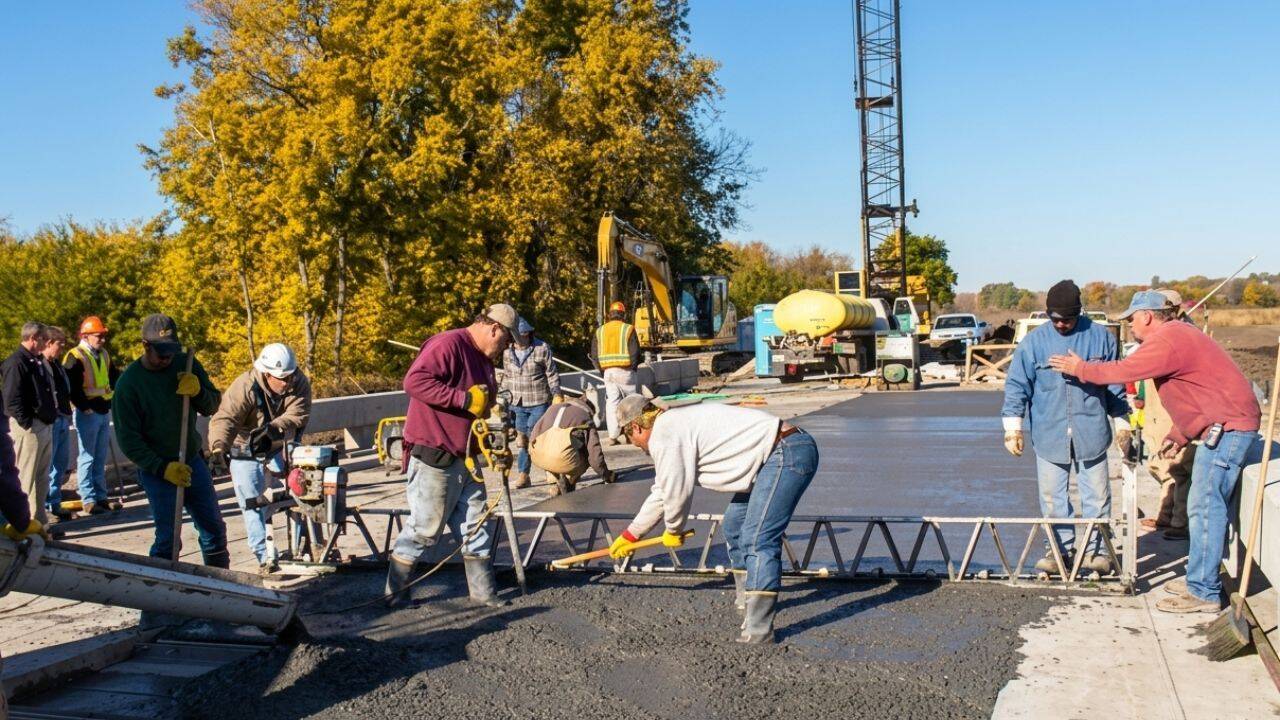
When engineers mixed conductive carbon products and steel fibers into fifty-two distinct slabs of a Nebraska bridge deck, they created a giant, stationary resistor. When a freezing drizzle starts to glaze the guardrails, sensors register the drop in temperature. Operators do not rush for a sack of salt. They flip a switch. Low-voltage electricity surges directly into the concrete itself.
The bridge warms up.
Not to tropical temperatures—it doesn't steam like a hot spring. It just gets warm enough to remember what summer felt like. Thirty-eight degrees Fahrenheit. Thirty-nine. Just enough to convince the snowflakes that hitting this particular stretch of earth is a losing proposition. The ice melts on contact. The sleet turns to water and streams harmlessly down the shoulders.
The salt truck drives past, its hopper empty, its driver out of a job for the night.
The Human Cost of Cold
We talk about infrastructure as if it were entirely made of ledger sheets. We count dollars per mile, tons of aggregate, cost-benefit ratios of deferred maintenance. We forget that behind every statistic of winter road safety is a Tuesday night in January that almost went wrong.
Picture Sarah.
Sarah is thirty-four, drives a sedan with a rusted bumper, and works second shift at a distribution center twenty miles outside of Lincoln. Her father taught her how to drive on gravel roads, which means she knows how to steer into a slide, but she also knows that physics eventually wins arguments against momentum.
When a blizzard blows in off the plains at five in the evening, Sarah’s stomach drops. She isn't thinking about the macro-economics of municipal snow removal budgets. She is thinking about the black bridge deck over Salt Creek. That bridge is notorious. It hangs out in the open air, uninsulated by the earth below, exposed to the howling wind from the north and the south simultaneously. It freezes thirty minutes before the rest of the highway. It is a trap.
She approaches it at forty miles an hour, her tires singing that high-pitched, terrifying whine of packed snow. She lifts her foot from the gas. She doesn't brake—she knows better. But she feels the back end of her car float, just for a heartbeat, drifting toward the concrete barrier.
In a world powered by self-heating concrete, that moment never arrives. Sarah’s tires roll onto the bridge deck, and instead of skating across a sheet of glass, they hit a surface that is quietly radiating thirty-five degrees of ambient warmth. The car doesn't slide. It tracks straight. She breathes out a breath she didn't realize she was holding, her shoulders dropping two inches away from her ears.
She makes it home in time to put her daughter to bed.
That is what a giant resistor is actually for. It isn't just about saving concrete from salt corrosion. It’s about the quiet elimination of dread.
The Stubbornness of Stone
Of course, nothing revolutionary happens without a fight. The civil engineering establishment is conservative by nature, and for good reason. When you build a bridge, you are betting human lives that it will stand up to seventy years of semi-trucks, floodwaters, and thermal shock. You don't experiment lightly with something cars drive across at seventy miles per hour.
For years, researchers at universities like Nebraska-Lincoln tinkered with conductive concrete formulations in drafty labs. Skeptics pointed out the obvious hurdles. Electricity costs money. Power grids are already strained during polar vortexes. What happens when the conductive fibers corrode inside the wet alkaline environment of curing cement? What happens when the whole thing shorts out because of a spring downpour?
The answers came slowly, forged through thousands of hours of freeze-thaw cycles in giant climate-controlled testing chambers. Engineers found that by carefully balancing the ratio of carbon nano-fibers and steel shavings, they could create a material that maintained its structural integrity while carrying a safe, low-voltage current. It didn't need thousands of volts from high-tension power lines. It could run on standard commercial electricity, drawing power intelligently only when moisture and temperature sensors signaled an active threat.
It was no longer science fiction. It was poured material.
When those fifty-two slabs were finally locked into place on the Nebraska bridge, they weren't just a test of a new recipe. They were a declaration of independence from the winter weather machine.
The Ripple Effect
Consider what happens next.
If you can turn a bridge deck into a heating element, why stop at bridges? Think of the infamous highway ramps in every northern city—those dizzying, elevated loops where cars spin out with terrifying predictability every single year. Think of airport runways where a patch of freezing fog can ground an entire fleet of international flights, costing millions of dollars in delayed commerce and stranded passengers. Think of pedestrian walkways outside hospitals, where a single patch of black ice can turn a routine visit into a compound fracture.
We are standing at the threshold of a quiet shift in how we inhabit cold climates. For centuries, our answer to nature’s hostility has been brute force. More salt, heavier plows, faster trucks, stronger chemicals. We have treated the environment as an adversary to be beaten into submission.
Conductive concrete represents something entirely different. It is smart infrastructure. It listens to the temperature drop, measures the moisture in the air, and responds with a subtle, localized application of energy. It works with the physics of the material rather than fighting against it.
The winter wind still howls across Nebraska. The snow still piles up against the fence posts, and the temperature still plunges past zero when the sun goes down.
But out there on the highway, fifty-two slabs of gray stone are quietly humming to themselves, pushing back the dark, keeping the road alive while the rest of the world sleeps.