The Strategy of Retaliation
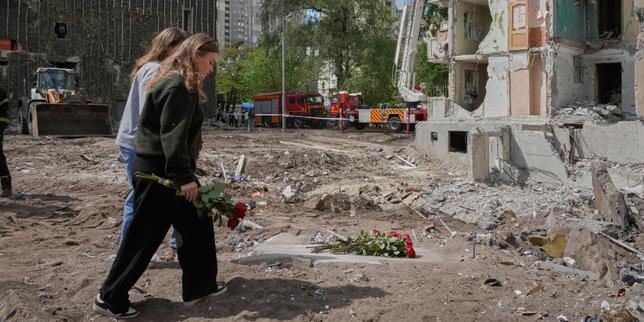
Ukrainian President Volodymyr Zelensky ordered his military commanders to prepare a decisive response following a wave of Russian missile attacks on Kiev. The primary objective is to disrupt Russian logistics and command centers to halt further strikes on civilian infrastructure. However, Kiev faces a compounding challenge. It must balance the political necessity of a forceful counterstrike against severe ammunition shortages and strict Western restrictions on using foreign weapons deep inside Russian territory. This strategic bottleneck forces Ukrainian planners to rely on domestic drone technology and asymmetrical tactics to deliver on the leadership's public promises.
Behind the political rhetoric lies a stark operational reality. When a capital city is hit, a head of state must signal strength. For Zelensky, the directive to Gen. Oleksandr Syrsky is not merely a morale-boosting statement for a weary public. It is a logistical directive.
But launching a meaningful retaliation requires resources that are currently stretched thin across a 1,000-kilometer front line. Ukraine cannot afford a symbolic waste of ordnance. Every missile and drone deployed in a retaliatory strike is a resource diverted from defensive operations in the Donbas, where Russian forces continue to apply grinding pressure.
The Bottleneck of Western Restraints
For months, the geopolitical debate has centered on the red lines drawn by Washington, London, and Berlin. Kiev has consistently argued that fighting with one hand tied behind its back is a losing strategy. To stop the attacks on Kiev, the Ukrainian military needs to hit the archer, not just the arrows. This means targeting the military airfields inside Russia where the Tu-95 bombers take off, and the launch sites of the Iskander ballistic missiles.
+----------------------------+---------------------------------------+
| Target Type                | Operational Status                    |
+----------------------------+---------------------------------------+
| Border Logistics Hubs      | Vulnerable to Ukrainian HIMARS        |
| Deep-Tier Airfields        | Protected by Western Use Restrictions |
| Domestic Drone Factories   | Operating at Maximum Capacity         |
+----------------------------+---------------------------------------+
Western allies remain terrified of horizontal escalation. They fear that a British Storm Shadow or a US-supplied ATACMS missile striking a military target deep within the Russian Federation could trigger a direct confrontation between NATO and Moscow. This hesitation creates a sanctuary for Russian aerospace forces. They can load munitions, take off, and fire cruise missiles from the safety of their own airspace, knowing the most potent weapons in Ukraine's arsenal are legally barred from hitting them on the tarmac.
Consequently, the promised Ukrainian response must look different. It relies on a rapidly expanding fleet of long-range, domestically produced one-way attack drones. These systems, like the Liutyi drone, lack the payload capacity and speed of a Western cruise missile, but they possess the range to reach Moscow, St. Petersburg, and oil refineries across southwestern Russia. They are cheap, built outside the Western veto mechanism, and increasingly sophisticated.
The Logistics of Domestically Built Attrition
To understand how Ukraine plans to execute this response, one must look at the decentralization of its defense industry. Gone are the days of massive, centralized aerospace factories that can be easily mapped and destroyed by Russian Kalibr missiles. Today, Ukrainian drone production is scattered across hundreds of hidden workshops, basements, and converted civilian facilities.
"Production must be invisible to survive," remarked a senior Ukrainian procurement officer during a private briefing in Warsaw last year. "If the enemy can see the factory on a satellite image, it will not exist next week."
💡 You might also like: UNIFIL is a Ghost in the Machine Why Neutrality is Lebanon’s Most Dangerous Illusion
This decentralized network creates its own friction.
- Supply Chain Vulnerability: Components like microchips, brushless motors, and GPS modules must be smuggled or imported through complex civilian supply chains across Europe and Asia.
- Quality Control Variance: A drone assembled in an underground facility in Lviv might have slightly different software calibration than one built near Kharkiv, leading to inconsistent performance in the face of heavy Russian electronic warfare.
- Payload Limitations: Most domestic drones carry warheads ranging from 20 to 50 kilograms. This is enough to ignite an oil distillation column, but insufficient to collapse a hardened concrete bunker or destroy a fortified submarine pen.
This means Ukraine's retaliatory strikes are designed for cumulative attrition rather than instant, catastrophic destruction. When Zelensky demands a response, the military responds by launching swarms of dozens of drones simultaneously. The goal is to overwhelm Russian air defense networks, forcing them to expend expensive S-400 interceptor missiles on cheap wooden and fiberglass targets, allowing a handful of Ukrainian strike drones to slip through to their targets.
The Electronic Warfare Battlefield
Any Ukrainian strike directed at Russian territory must navigate the most dense electronic warfare environment in human history. The Russian military has deployed powerful jamming complexes, such as the Zhitel and Pole-21 systems, along the border and around critical infrastructure. These systems spoof GPS signals and sever the radio control links between drones and their operators.
Ukrainian Drone Launch -> GPS Jamming Zone -> Inertial Navigation -> Terminal Dive via Optical Tracking
Ukraine has countered this by integrating machine learning algorithms into its newest drone guidance systems. When a drone enters a heavily jammed area and loses its connection to navigation satellites, an onboard computer takes over. It compares the terrain below with pre-loaded satellite imagery, navigating visually until it identifies the outline of its target.
This technological race moves faster than traditional military procurement cycles. A software patch deployed by Ukrainian programmers on Tuesday can render a Russian jamming frequency ineffective by Thursday, only for Russian engineers to adjust their tactics by the following Monday. It is a invisible war of mathematics and engineering that dictates whether Zelensky's orders can be physically executed.
The Domestic Political Calculation
There is a distinct difference between military utility and political necessity. From a purely tactical standpoint, the best use of Ukraine's limited long-range strike capacity might be hitting Russian rail junctions near the occupied territories to slow down troop movements. But a population living under nightly air raid sirens demands to see the costs of the war brought home to the aggressor.
Zelensky operates within a democracy, albeit one under martial law. Public opinion matters. If the government appears passive after a devastating strike on the capital, the societal cohesion that has sustained the defense for over two years begins to fray. The demand for action is palpable in the cafes of Kiev and the trenches of Pokrovsk.
Therefore, the target selection for the upcoming response carries a heavy psychological component. Hitting a symbolic target, such as a government building in a major Russian city or an oil depot that lights up the night sky on social media, serves a dual purpose. It satisfies the domestic demand for justice and signals to Western backers that Ukraine retains the capability to strike back, challenging the narrative of an inevitable Russian victory.
The Friction of Weary Formations
Planning a complex, synchronized retaliatory operation requires fresh staff officers and pristine equipment. The reality on the ground is far messier. The brigades tasked with defending the border and operating long-range strike units have been fighting without rotation for months. Mechanical failure is common. Vehicles are held together with duct tape and scavenged parts.
Air defense units inside Ukraine are facing a critical shortage of interceptor missiles. Every time Russia launches an attack like the one on Kiev, Ukraine is forced to expend its limited supply of Patriot, NASAMS, and IRIS-T missiles. This creates a dangerous vulnerability. If Ukraine uses its air defense assets to protect the capital, it leaves major industrial hubs or frontline troops exposed to devastating Russian glide bomb attacks.
This interdependence means that a decision to strike back cannot be made in isolation. Commanders must calculate whether a retaliatory drone launch will provoke a massive Russian counter-response that Ukraine's depleted air defenses cannot fully contain. It is a calculus balance where an error in judgment costs lives.
The order has been given, the coordinates are being programmed into guidance computers, and the fuel tanks of long-range drones are being filled in hidden locations across Ukraine. The coming days will reveal whether this response can alter the strategic equation, or if it will simply be another bloody chapter in a war of attrition that shows no signs of an ending.