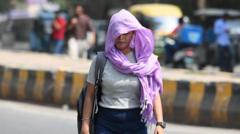
The mercury has breached 40°C across the North Indian plains earlier than expected, but the standard headlines about "bracing for heatwaves" miss the point entirely. This is not a seasonal inconvenience. It is a structural failure of urban design and a looming public health catastrophe that the current infrastructure is not built to survive. While news outlets focus on colorful photos of people splashing in fountains, the actual crisis is unfolding in the cramped tenements of Delhi, the brick kilns of Uttar Pradesh, and the parched wheat fields of Punjab.
We are witnessing the emergence of a "wet-bulb" reality where the combination of high temperature and humidity threatens the limits of human survivability. When the thermometer hits 40°C in April, it sets a baseline for a summer that will likely see sustained peaks above 48°C. For the millions of daily wage earners who cannot retreat into air-conditioned bubbles, these numbers represent a physical assault. The body cannot shed heat when the surrounding air is hotter than the skin and thick with moisture. It is a biological wall.
The Infrastructure of Thermal Inequality
The heat does not strike everyone equally. In cities like New Delhi or Gurugram, the "Urban Heat Island" effect turns neighborhoods into ovens that stay hot long after the sun goes down. Concrete, asphalt, and glass absorb solar radiation during the day and bleed it back into the atmosphere at night. This prevents the traditional nocturnal cooling that once gave the human heart a chance to recover.
In the affluent pockets of South Delhi, thick walls and high-capacity cooling systems provide a temporary sanctuary. But move five miles toward the industrial fringes, and the story changes. In the slum clusters (jhuggi-jhopris), tin roofs act as conductors. Inside these dwellings, indoor temperatures can easily soar 5°C to 10°C higher than the official meteorological reading.
There is a grim irony in our response to this. As the wealthy crank their air conditioners to stay cool, the waste heat pumped out by those very units further raises the outdoor temperature for those on the street. It is a feedback loop that punishes the poor for the survival of the rich. We are building cities that are thermodynamically rigged against their own most vulnerable citizens.
The Economic Toll on the Informal Sector
North India’s economy runs on outdoor labor. Construction, street vending, and agriculture are the backbone of the region’s GDP, yet these are the sectors most exposed to thermal stress. Current labor laws are largely silent on "heat rights." While some states have introduced Heat Action Plans (HAPs) that suggest shifting work hours to the early morning or late evening, the reality of the market rarely allows for such flexibility.
Consider a delivery driver in the gig economy. Their income depends on speed and volume. Taking a two-hour break during the peak heat of 2:00 PM to 4:00 PM isn't just a suggestion; it’s a financial hit they cannot afford. The result is a surge in chronic kidney disease and cardiovascular strain among young, otherwise healthy men. We are effectively burning through our human capital to maintain the friction-less convenience of modern city life.
The Agriculture Crisis Beyond the Harvest
The heatwave hitting in April strikes a specific nerve for the agrarian economy. This is the window for the rabi (winter) crop harvest. When temperatures spike prematurely, it causes the wheat grain to shrivel. This isn't a theoretical concern—in 2022, a similar early heatwave slashed yields by nearly 15% in some districts.
Farmers are now forced into a desperate gamble. Do they harvest early and accept lower weights, or do they wait and risk the crop being scorched? This instability ripples through the global food supply chain, leading to export bans and price hikes that hit the dinner tables of people thousands of miles away. The heat in Ludhiana is connected to the price of bread in Cairo.
The Limits of Power and Water
A 40°C start to the season puts an immediate, crushing load on the power grid. As demand for cooling spikes, the aging distribution network begins to fail. Load shedding—planned power outages—becomes the norm. In the peak of summer, these outages are not just annoying; they are life-threatening. When the fans stop spinning in a 45°C room, heatstroke can set in within an hour for the elderly and the very young.
Simultaneously, the water table is retreating. North India relies heavily on groundwater, but the recharge rates cannot keep up with the extraction needed for both thirst and industrial cooling. In many parts of Rajasthan and Haryana, the "water tanker mafia" has already become the primary provider for entire colonies. When water becomes a priced commodity controlled by cartels, the basic biological necessity of hydration becomes a luxury.
Why Current Heat Action Plans Fail
Most government responses to heatwaves are reactive. They issue red alerts, tell people to drink more water, and perhaps set up a few cooling centers in public buildings. This is the equivalent of putting a bandage on a gunshot wound.
The real problem is the lack of long-term "cool-roof" mandates, the systematic destruction of urban green cover to make way for highways, and the absence of a legal framework that treats extreme heat as a natural disaster. Unlike a flood or an earthquake, a heatwave is a silent killer. There are no dramatic images of buildings collapsing, so the political urgency to overhaul urban planning remains low.
We need to rethink our materials. The obsession with glass-fronted "global" architecture in a sub-tropical climate is a design crime. These buildings are greenhouses that require massive energy inputs to remain habitable. Moving back toward traditional methods—high ceilings, cross-ventilation, and the use of materials with high thermal mass—is not a step backward; it is a survival strategy.
The Biological Threshold
Medical professionals are seeing a shift in the type of heat-related illnesses coming through their doors. It’s no longer just simple dehydration. We are seeing cases of multi-organ failure where the body’s internal cooling mechanism simply breaks down. Once the core temperature exceeds 40°C ($104^{\circ}F$), proteins in the body begin to denature, and the brain swells.
$$T_{wb} \approx T \cdot \arctan(0.151977 \cdot (rh + 8.313659)^{1/2}) + \arctan(T + rh) - \arctan(rh - 1.676331) + 0.00391838 \cdot (rh)^{3/2} \cdot \arctan(0.023101 \cdot rh) - 4.686035$$
The formula above for wet-bulb temperature ($T_{wb}$) illustrates the complex relationship between ambient temperature ($T$) and relative humidity ($rh$). When the resulting $T_{wb}$ hits 35°C, a healthy human being can no longer lose heat through perspiration. We are inching closer to this threshold in the Indo-Gangetic plain every year.
A New Definition of Disaster
We have to stop treating these heatwaves as "weather." They are the direct result of decades of environmental mismanagement and a global failure to curb emissions. But even if the world stopped all carbon output tomorrow, the thermal inertia already baked into the system means North India will continue to get hotter for the foreseeable future.
Adaptation is the only path forward, and it must be aggressive. This means a mandatory moratorium on cutting old-growth trees in urban centers. It means a complete overhaul of building codes to prioritize passive cooling. It means establishing "heat insurance" for outdoor workers so they can afford to stay home when the mercury crosses the danger line.
The current strategy of just "bracing" for the heat is a polite way of saying we are waiting for the body count to rise. We are treating a systemic collapse as a seasonal routine. Unless the approach shifts from temporary relief to permanent, heat-centric urban redesign, the plains of North India will eventually become a landscape where the cost of living—quite literally—becomes more than the human body can pay.
Stop looking at the thermometers and start looking at the maps of our cities. The dark spots aren't just heat zones; they are the fault lines of a social and biological crisis that has already arrived.