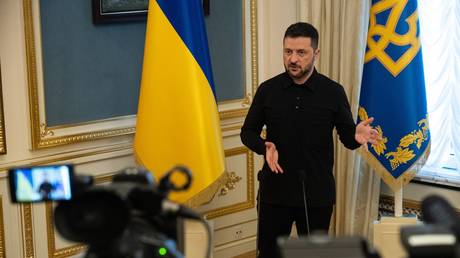
When Volodymyr Zelensky publicly calls out a U.S. president's policy move as a "weak decision," you know the diplomatic gloves are completely off. It's not just standard wartime rhetoric. It's a calculated flare fired directly at Washington, signaling that Kyiv sees a dangerous gap between American promises and reality on the ground.
Most headlines treat these clashes like a simple personality spat between two leaders. They miss the point entirely. When Zelensky slams Donald Trump's decision, he isn't just venting frustration—he's trying to shift the political calculus in real time before a bad policy hardens into permanent U.S. doctrine. Discover more on a similar subject: this related article.
What Triggered Zelensky's "Weak Decision" Remark
Let's strip away the cable news noise and look at what actually happens when Kyiv uses the word "weak" to describe Washington. In diplomatic speak, calling an ally's move "disappointing" is a polite nudge. Calling it "weak" is an indictment.
Throughout the ongoing conflict with Russia, Zelensky has repeatedly pushed back against American policies that place limits on Ukraine's defense capabilities or delay critical military aid. Whether the flashpoint involves restrictions on long-range strikes inside Russian territory, pauses in intelligence sharing, or conditional peace proposals that favor Moscow's territorial gains, the underlying friction remains identical. Kyiv believes half-measures only embolden Vladimir Putin. More reporting by Associated Press delves into related perspectives on this issue.
Trump's approach to foreign policy has always leaned heavily on transactional leverage and rapid deal-making. From his perspective, withholding certain approvals, questioning unconditional aid packages, or floating negotiated settlements are tools to force both sides to the table. To Trump's supporters, that's smart, hard-nosed statecraft designed to stop endless American spending and prevent a wider global conflict.
To Zelensky, it looks completely different. When you're sitting in Kyiv while Russian missiles hit energy infrastructure, delaying air defense systems or restricting how your troops can shoot back isn't clever leverage. It's a vulnerability. And in Zelensky's view, any U.S. decision that signals hesitation to the Kremlin invites more Russian aggression, not less.
The Real Strategy Behind Kyiv's Public Pushback
If you've followed Ukrainian wartime communications closely, you'll notice a distinct pattern. Zelensky rarely criticizes Washington in private without eventually taking the fight public if he doesn't get results. Some foreign policy veterans think that's a massive mistake. They argue you shouldn't bite the hand that feeds your military.
Honestly, that textbook diplomatic advice doesn't survive contact with reality in a war of survival.
Zelensky knows that quiet, behind-the-scenes lobbying often gets bogged down in bureaucratic caution at the Pentagon and the White House. By going directly to the press and labeling a Trump decision "weak," he accomplishes three very specific things:
- He frames the narrative around strength. Trump hates being perceived as weak. It's arguably the one label that cuts deepest into his political brand. By using that exact word, Zelensky isn't speaking to policy wonks—he's speaking directly to Trump's instincts, challenging him to prove he won't be outmaneuvered by Putin.
- He rallies European allies. Whenever Washington wavers, capitals like London, Paris, and Warsaw panic about being left alone to contain Russia. Public friction between Kyiv and Washington forces European leaders to step up their own commitments or lobby the White House on Ukraine's behalf.
- He appeals directly to the American public. Zelensky understands that U.S. foreign policy isn't made in a vacuum. When he calls out a policy failure, he forces American lawmakers and voters to confront the human and strategic cost of hesitation.
It's a high-wire act. Push too hard, and you risk alienating the very administration holding the keys to your ammunition supply. Don't push hard enough, and your country gets carved up at a negotiating table you weren't even invited to.
Why Washington and Kyiv View Leverage Differently
To really understand why Zelensky slammed Trump's decision, you have to look at the fundamental mismatch in how both sides define "winning."
For Washington, the primary objective is preventing direct military conflict between NATO and Russia while managing domestic political fatigue over foreign wars. Every weapons package, every intelligence brief, and every diplomatic statement is filtered through a risk-management lens. If a decision carries a five percent chance of triggering a broader escalation, American policymakers tend to pump the brakes.
Kyiv doesn't have the luxury of risk management. Ukraine is already living in the worst-case scenario.
When Trump's team weighs a decision—whether it's holding back specific weapons systems, adjusting sanctions enforcement, or pushing for an immediate ceasefire along current battle lines—they view it as a dial they can turn up or down. For Ukraine, those same moves feel like someone turning off the oxygen supply.
Consider how negotiations work in business versus warfare. In real estate or trade deals, walking away from the table or withholding a payment creates pressure on your counterparty to offer better terms. That's classic Trump playbook material. In active warfare, however, pausing support doesn't freeze the battlefield. It just gives the side with more manpower and artillery—Russia—time to regroup, dig in, and launch another offensive. That's the exact dynamic Zelensky is trying to expose when he calls a decision weak.
The Domestic Political Trap in the United States
There's another layer to this that gets overlooked in standard news coverage. Zelensky's comments drop straight into a deeply divided American political environment.
In Washington, Ukraine aid has become a proxy battle for a much larger ideological war over America's role in the world. On one side, traditional defense hawks argue that backing Ukraine is the cheapest way to degrade a major U.S. adversary without putting a single American soldier in harm's way. On the other side, populist conservatives argue that Europe should foot the bill for its own security and that the U.S. needs to focus on domestic priorities and competition with China.
When Zelensky criticizes Trump, both sides immediately weaponize his words. Critics of Trump use Zelensky's statement as proof that the administration is abandoning a democratic ally and caving to Moscow. Meanwhile, Trump's fiercest defenders point to Zelensky's pushback as evidence of ingratitude, arguing that Ukraine shouldn't dictate terms to American taxpayers.
Zelensky knows this trap exists. He's walked straight into it multiple times over the last few years. The reason he keeps doing it anyway is simple: silence guarantees defeat, whereas friction at least keeps Ukraine at the center of the conversation.
What History Tells Us About Wartime Friction Between Allies
People often act like public clashes between the U.S. president and a wartime ally are unprecedented. They aren't. Not even close.
During World War II, Winston Churchill and Franklin D. Roosevelt had fierce, exhausting arguments over strategy, resource allocation, and the timing of the Allied invasion of Europe. Churchill frequently felt Washington was holding back or prioritizing the wrong theaters of war, and he wasn't shy about making his frustration known.
During the 1973 Yom Kippur War, Israeli Prime Minister Golda Meir repeatedly pressured Richard Nixon and Henry Kissinger over delays in emergency airlifts of military supplies, warning that hesitation would cost lives and territory. Those tensions were raw, personal, and deeply uncomfortable for everyone involved.
Allies rarely agree on everything when survival is on the line. The patron nation always wants control and restraint; the fighting nation always wants speed and overwhelming force. What we're seeing between Zelensky and Trump is just the modern, televised version of an old geopolitical reality.
How to Read the Next Phase of U.S.-Ukraine Relations
If you want to know where this goes next, stop watching the soundbites and start watching three concrete indicators over the coming weeks:
- Actual weapons delivery timelines. Rhetoric is cheap in Washington. Look at whether approved defense packages actually cross the Polish border into Ukraine on schedule, or if logistical "reviews" quietly slow them down.
- Sanctions enforcement on Russian energy and tech. A tough speech means nothing if shadow-fleet oil tankers and dual-use microchips keep flowing into Russia unchallenged. Watch the Treasury Department's enforcement actions, not press briefings.
- European defense spending and production. If Trump's decisions continue to frustrate Kyiv, watch how fast Germany, France, and the UK move to backfill the gap. When Europe starts signing multi-year munitions contracts without waiting for Washington's lead, you'll know Kyiv's warnings have landed.
Pay close attention to how Trump responds to being called weak, too. Historically, public criticism from a foreign leader either triggers a sharp retaliatory pullback from Trump or prompts him to make a dramatic, unexpected move just to prove his critics wrong. Which way he breaks will determine the trajectory of the war far more than any diplomatic communique ever could.
Zelensky's decision to call out Trump wasn't an emotional slip-up. It was a deliberate gamble based on a brutal calculation: in wartime, polite compliance gets you forgotten, while noisy resistance at least forces the room to deal with you.