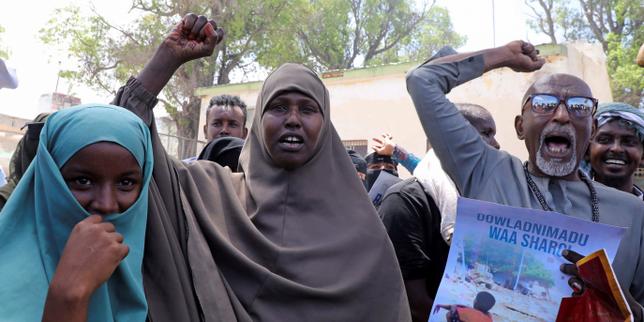
The Western media is running its favorite playbook on East Africa again. The predictable chorus of hand-wringing has begun because Somalia’s federal government announced a "transition period" following the end of a presidential term without a traditional ballot box in sight. The lazy consensus among international analysts is swift and uniform: democracy has failed, the regime is illegitimate, and the country is sliding backward into chaos.
They are completely wrong. They are measuring Somali political reality against an imported, abstract template that has failed the Horn of Africa for three decades. If you found value in this post, you might want to look at: this related article.
The obsession with forcing western-style, one-person, one-vote elections into an active conflict zone is not just short-sighted; it is actively dangerous. When a state is battling a generational insurgency, dealing with fragmented regional states, and rebuilding its core institutions from scratch, a premature national election is a luxury that costs more than it delivers. The announcement of a transition period isn't a failure of governance. It is a rare flash of political pragmatism.
The Illusion of the Ballot Box in Conflict Zones
Mainstream political analysts love the optics of an election. They want to see long lines of citizens ink-stained fingers, and international observers giving a rubber stamp of approval in Mogadishu hotels. What they consistently ignore is the mechanics of what it takes to actually execute that process safely in a fractured security environment. For another perspective on this story, check out the latest coverage from The New York Times.
To run a genuine national election, you need three baseline realities:
- A secure, undisputed census to know who the voters actually are.
- Total territorial control so ballot boxes can reach rural communities without being hijacked.
- A unified judicial framework to arbitrate disputed results without triggering a civil war.
Somalia currently possesses none of these.
When you force a vote under these conditions, you do not get democracy. You get a highly volatile, easily manipulated flashpoint that Al-Shabaab can exploit to destabilize the state. I have watched international donors dump tens of millions of dollars into electoral logistics in fragile states, only for those resources to be swallowed by corruption or used to exacerbate existing clan rivalries.
Let us be brutally honest about the "People Also Ask" query that dominates this discussion: Is Somalia ready for a one-person, one-vote system? The answer is a definitive no, and pretending otherwise is an expensive form of intellectual dishonesty.
The False Promise of the 4.5 Clan System
For years, Somalia has relied on the 4.5 clan-cleavage system to distribute parliamentary seats and executive power. It is an imperfect, frustrating mechanism that divides power among the four major Somali clans, with a fraction left over for a coalition of minority clans.
The conventional narrative insists that Somalia must urgently dismantle this system and transition to a direct democracy to achieve true representation. This argument ignores how political architecture actually functions on the ground.
The 4.5 system is not an ideal democratic model, but it functions as an essential peace treaty. It provides a predictable, negotiated framework for power-sharing in a society where institutional trust is low. Tearing that down before building a functional alternative creates a power vacuum.
Imagine a scenario where a hasty direct election is held, and because of security constraints or regional blockades, one major clan bloc is unable to vote effectively. The resulting government would be viewed as completely illegitimate by a massive chunk of the population. The 4.5 system, for all its flaws, guarantees that everyone has a seat at the table. Preserving that equilibrium through a managed transition period is infinitely safer than gambling the country's fragile stability on an unviable vote.
State-Building Must Precede Electioneering
The fundamental error of international observers is getting the order of operations entirely backward. They view elections as the mechanism that creates a functional state. In reality, a functional state is the mechanism that allows for a safe election.
Look at the hard data of successful post-conflict transitions across the globe over the last century. True stability is built sequentially:
- Security Monopolization: The central government must establish a definitive monopoly on the legitimate use of force, pushing insurgent groups outside of economic hubs.
- Fiscal Infrastructure: The state must develop reliable internal revenue collection—tariffs, property taxes, and business licensing—so it does not rely exclusively on foreign aid.
- Institutional Capability: The creation of a professional civil service and an independent judiciary that can enforce contracts and resolve disputes.
- Electoral Politics: The final layer, introduced only when the previous three foundations are solid enough to withstand the polarization of a political campaign.
By prioritizing step four while steps one through three are still under construction, international partners are trying to put a roof on a house that lacks a foundation. The current administration's decision to extend its mandate via a formal transition period is an acknowledgment of this structural reality. It allows the government to maintain focus on the offensive against Al-Shabaab and the consolidation of the national army, rather than diverting scarce resources and military personnel to guard thousands of vulnerable polling stations.
The High Cost of Pragmatism
This contrarian approach is not without its risks. The obvious danger of a transition period is institutional inertia. When an administration extends its time in power without an electoral mandate, it risks alienation from regional federal member states like Puntland or Jubaland, who are already suspicious of Mogadishu’s centralization efforts.
There is a fine line between a necessary strategic pause and a consolidated power grab. If the federal government uses this transition period merely to entrench its own network rather than aggressively building out the state apparatus, the critics will be proven right.
But the alternative—forcing an immediate, chaotic election simply to satisfy the timeline of international donors—carries a much higher probability of catastrophic failure. We have seen this movie before across the continent. When a flawed election is pushed through in a deeply divided society, the losing faction rarely accepts the outcome quietly. They pick up weapons, retreat to their regional strongholds, and the country resets to zero.
Stop asking when Somalia will hold its next election. Start asking when it will finish building its state.
The transition period isn't a crisis. It is an opportunity to fix the foundation before trying to build the house. Turn off the western commentary, ignore the panicked press releases from international think-tanks, and look at the brutal arithmetic of survival in the Horn of Africa. Security and institutional strength are the only currencies that matter right now. Everything else is just noise.